Bitcoin Mining · Updated November 5, 2026

How to Sell or Rent Hashrate as a Small Bitcoin Miner in 2026

If you run a few ASICs, or even a single small miner, you have four ways to turn hashrate into money: join a pool, sell hashpower on a marketplace, rent your rig out, or mine solo. With hashprice near $33 per PH/s per day in November 2026, the margin between them matters. We run a small solo setup ourselves (about 4.8 TH/s in the Comox Valley), so here is the honest math.


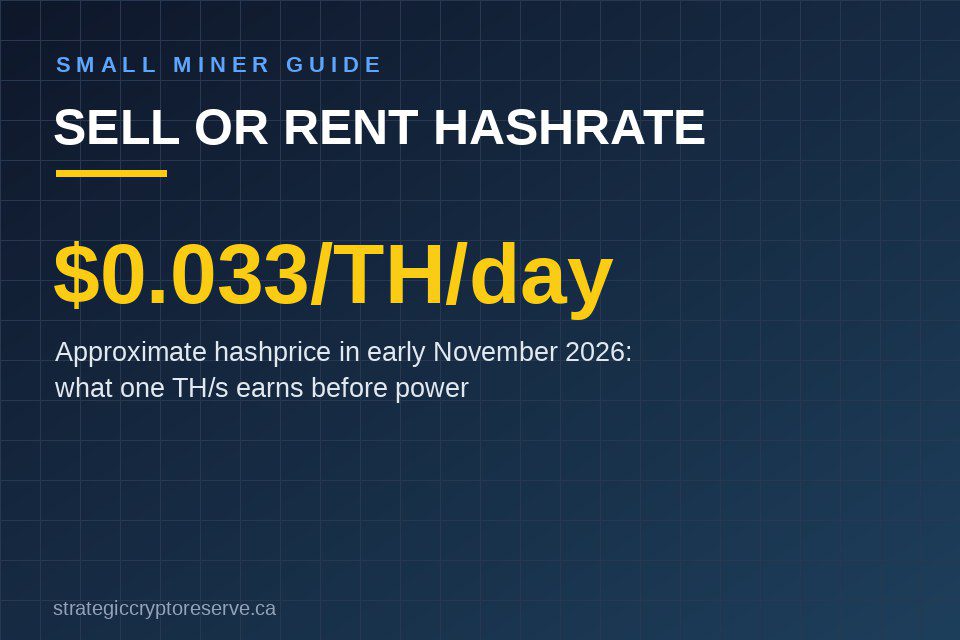
Sell or rent hashrate as a small bitcoin miner: hashprice about $0.033 per TH per day in November 2026

Hashprice, Nov 2, 2026

$32.86 / PH / day

Hashprice from Luxor Hashrate Index. Examples are illustrative, not earnings promises.

$SCRPolygon $— Connecting to Polygon…

Quick answers (updated November 5, 2026)

Can a small miner sell hashrate? yes. Point your ASIC at a hashpower marketplace such as NiceHash, which pays you in bitcoin for the hashrate buyers use, or list it on MiningRigRentals and rent it out at a price you set.

What does 1 TH/s earn? about $0.033 a day before power at November 2026 hashprice ($32.86 per PH/s per day, Luxor).

Fees: reported marketplace fees are roughly 2% to 3% (NiceHash) and 3% for rig owners (MiningRigRentals FAQ). Check each site's current fee page.

Pool or sell? pools pay steady earnings with similar fees; selling or renting can pay a premium when demand spikes but adds counterparty and setup risk.

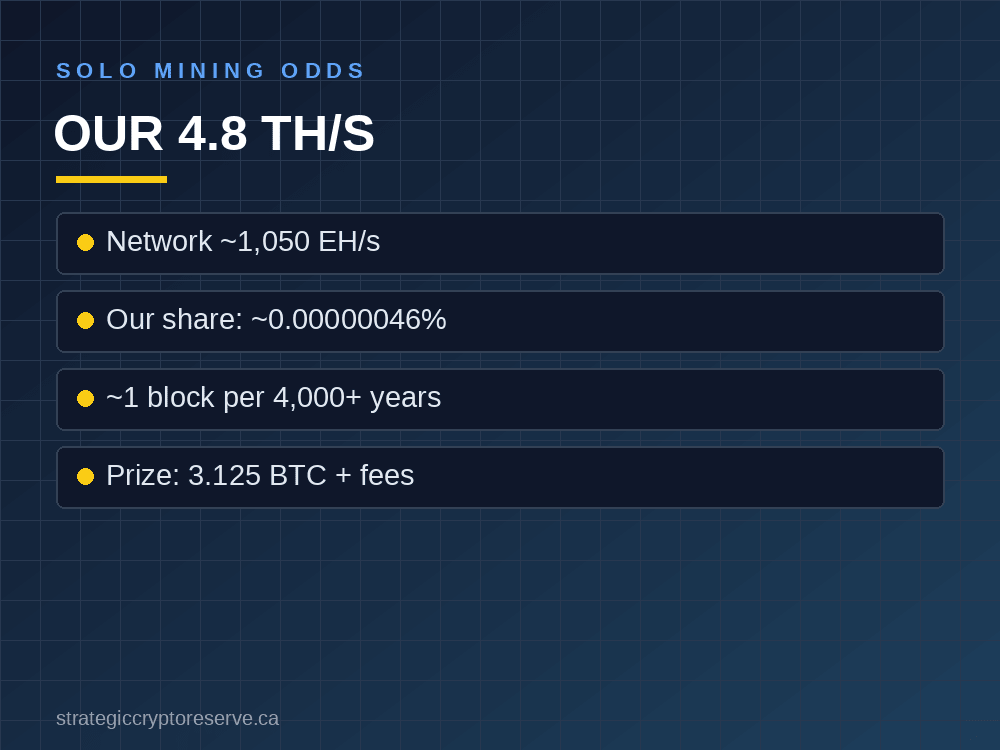
Solo mining? at 4.8 TH/s against a ~1,050 EH/s network, the expected time to find a block is thousands of years. Solo is a lottery ticket, not income.

Sell Hashrate, Rent Hashrate, Pool or Solo: Your Four Options

Options for a small bitcoin miner (fees as reported; verify on each site)
OptionHow you get paidTypical feeBest for
Mining pool (FPPS / PPS+)Daily BTC for shares submitted~1-4% pool feeSteady, simple income
Sell hashpower (NiceHash)BTC for hashrate buyers use~2-3% reportedPlug-and-play, market pricing
Rent your rig (MiningRigRentals)Renter pays your listed price3% for owners (site FAQ)Capturing demand spikes
Solo miningWhole block reward if you win0-2% (solo pools)Hobbyists who accept lottery odds

Selling hashrate means renting your machine's work to whoever is buying on a marketplace. You point your ASIC's stratum to the marketplace, and it routes your hashes to buyers' chosen pools. You are paid in bitcoin for the work accepted, without picking a pool yourself.

Renting hashrate on MiningRigRentals works more like Airbnb: you list your rig with a price per TH per day and a minimum term, and renters point it at their own pool for the rental period. You keep control of pricing but need to handle downtime, because renters can claim refunds for missing hashrate.
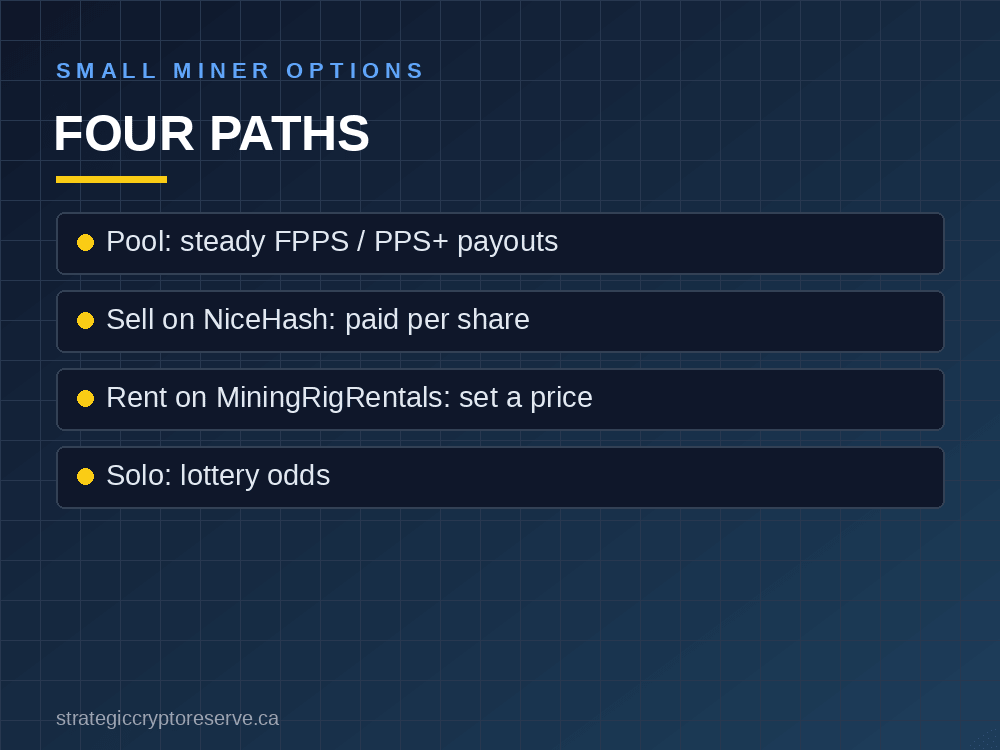
Four ways for a small miner to monetise hashrate: pool, sell, rent or solo

Hashprice Math: What a Small Miner Earns in 2026

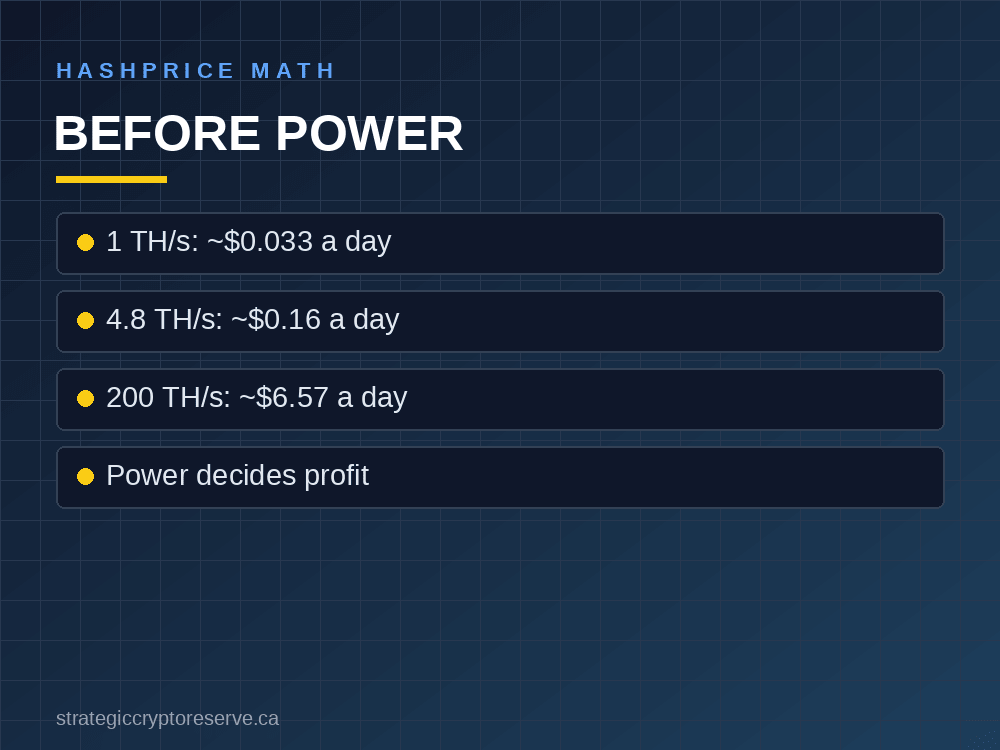
Hashprice is what one unit of hashrate earns per day. Luxor's Hashrate Index put it at $32.86 per PH/s per day on November 2, 2026, down 8.7% in a week, with forwards near $33 into April 2027. One PH/s is 1,000 TH/s, so each TH/s earns about $0.033 a day before fees and power.

Illustrative gross revenue at $32.86 per PH/s per day (before fees; USD)
SetupHashratePer dayPer 30 days
Small home miner (like ours)4.8 TH/s~$0.16~$4.73
One S21-class ASIC200 TH/s~$6.57~$197
Ten S21-class ASICs2 PH/s~$65.72~$1,972

Power decides profit. An S21-class machine draws about 3.5 kW, or 84 kWh a day. At $0.10 per kWh that is $8.40 a day, more than the $6.57 it earns, so it loses money. At $0.05 per kWh power costs $4.20 and it clears about $2.37 a day before fees. Selling or renting does not change this maths much: buyers pay roughly hashprice, sometimes a small premium. Check your utility's rate first; our BC Hydro rates for crypto mining guide shows how much the tariff matters.

Hashprice math for small bitcoin miners in November 2026

Solo Mining Odds: What Our 4.8 TH/s Setup Teaches

Strategic Crypto Reserve runs a small solo bitcoin miner in British Columbia's Comox Valley at about 4.8 TH/s. We do it for research and fun, not income, and the numbers show why.

The network ran at roughly 1,020 to 1,070 EH/s in early November 2026. At 1,050 EH/s, 4.8 TH/s is about 0.00000046% of the network. With 144 blocks a day, the expected wait to find one block is on the order of 4,000 years. Each day's chance is tiny but real, and the prize is the full 3.125 BTC block reward plus fees, which is why solo mining stays popular with hobbyists.

If you want predictable income from small hashrate, a pool or a marketplace is the rational choice. If you want a lottery ticket that also heats your room, solo is fine, as long as you understand the odds. Heat reuse is a real bonus in cold climates: see bitcoin mining heat reuse.

Solo mining odds at 4.8 TH/s against a 1,050 EH/s bitcoin network

When a Mining Site Outgrows Mining: The AI Option

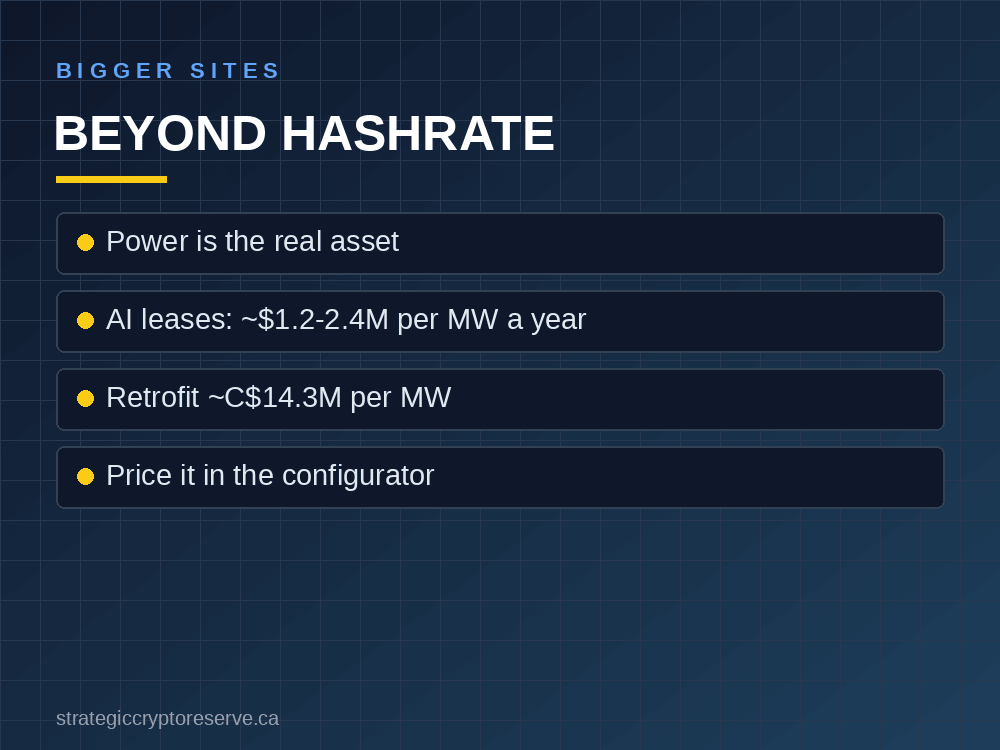
For home miners, selling or renting hashrate is the whole decision. For anyone with megawatts of power, the bigger question in 2026 is whether to keep mining at all. Public miners such as IREN, TeraWulf and Hut 8 are leasing power to AI customers for roughly $1.2 to $2.4 million per MW a year, far more than hashrate earns. See IREN stock and the bitcoin miner AI pivot.

Our AI Build Configurator has a Bitcoin Miner Retrofit profile (about C$14.3 million per MW before GPUs with liquid cooling) and a Hybrid Mining + AI profile for sites that want to keep mining while AI tenants ramp up. Run your own location in the free demo.

When a bitcoin mining site outgrows mining: AI hosting and retrofit costs

Have Megawatts? Price an AI Retrofit

If your mining site has real power, compare mining with AI hosting: pick your province or state and the Bitcoin Miner Retrofit or Hybrid profile.

Price your own AI build in seconds. The AI Build Configurator shows capital cost by line item, power cost and payback for every Canadian province and US state, by GPU class and cooling type. Try the free demo, or put it on your own site: Standard licence C$4,000 a year, Pro C$10,000, site screening reports from C$950 (see licensing).

AI Build Configurator

Bitcoin Miner Retrofit and Hybrid Mining + AI profiles, by province or state. Free demo.

Try the free demo →

IREN Stock and the Miner AI Pivot

Why public miners are turning into AI clouds.

Read it →

BC Hydro Rates for Crypto Mining

What power costs a miner in British Columbia.

Read it →

Bitcoin Mining Heat Reuse

Turn waste heat into a second income.

Read it →

Frequently Asked Questions: Selling and Renting Hashrate

1. Can I sell my hashrate as a small miner?

Yes. You can point your ASIC to a hashpower marketplace such as NiceHash, which pays you in bitcoin for the hashrate buyers use, or list your rig on MiningRigRentals and rent it out at a price you set. Both accept small miners.

2. How much does 1 TH/s earn per day?

At Luxor's November 2, 2026 hashprice of $32.86 per PH/s per day, one TH/s earns about $0.033 a day before fees and electricity. A 200 TH/s machine earns about $6.57 a day before power.

3. What fees do NiceHash and MiningRigRentals charge?

Reviews report NiceHash seller fees of roughly 2% to 3%, and the MiningRigRentals FAQ lists a 3% fee for rig owners, charged only on rentals. Fees change, so check each platform's current fee page before you start.

4. Is it better to sell hashrate or join a pool?

Pools pay steady earnings for the shares you submit and are simplest. Selling or renting hashrate can pay slightly more when demand is high but adds platform risk and, for rentals, refund risk if your rig goes offline. For most small miners the difference is small; electricity cost matters far more.

5. What are the odds of solo mining a bitcoin block with 4.8 TH/s?

With the network near 1,050 EH/s, 4.8 TH/s is about 0.00000046% of the hashrate. At 144 blocks a day, the expected wait to find a block is roughly 4,000 years, though a lucky block can come at any time.

6. Is bitcoin mining profitable in 2026?

It depends on electricity price and machine efficiency. At about $33 per PH/s per day, an efficient 200 TH/s ASIC drawing 3.5 kW loses money at $0.10 per kWh and earns a small margin at $0.05 per kWh. Many large miners are leasing their power to AI customers instead.