AI Infrastructure · Updated November 5, 2026

AI Data Center Water Usage: How Much Water Does AI Really Use?

AI data center water usage is now one of the most searched questions about artificial intelligence. A medium data center can use around 300,000 gallons of water a day, and a large one in a hot, dry climate can use millions. But the answer depends almost entirely on how the building is cooled. Here are the real numbers, why AI needs water at all, and how operators cut it to nearly zero.


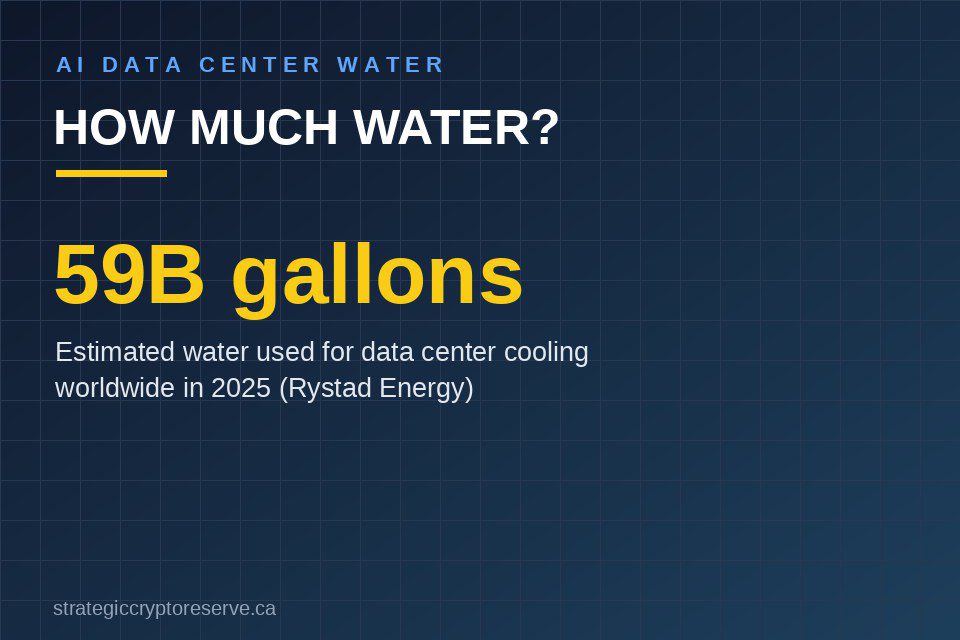
AI data center water usage: about 59 billion gallons used for cooling worldwide in 2025

Global data center cooling water, 2025

222B litres · 59B gal

Estimates from Rystad Energy, Lawrence Berkeley National Laboratory and company reports. Figures vary by method.

$SCRPolygon $— Connecting to Polygon…

Quick answers (updated November 5, 2026)

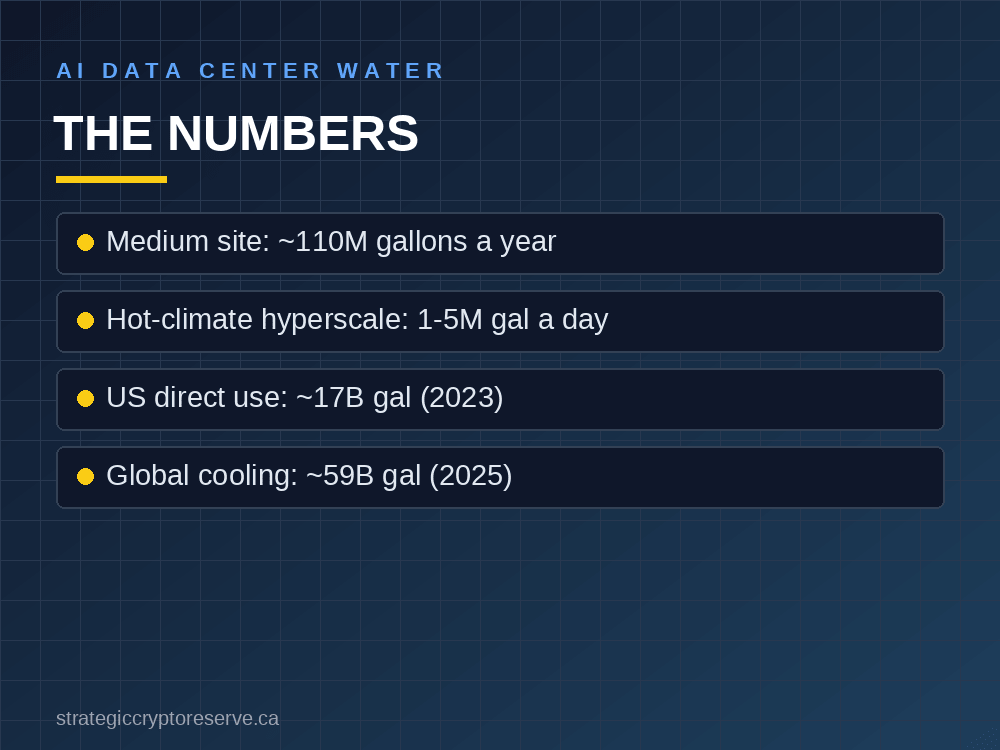
How much water does an AI data center use? A medium-sized data center uses roughly 110 million gallons a year (about 300,000 gallons a day). Large hyperscale campuses using evaporative cooling in hot climates can use 1 to 5 million gallons a day.

Worldwide: Rystad Energy estimates data centers used about 222 billion litres (59 billion gallons) of water for cooling in 2025.

United States: Lawrence Berkeley National Laboratory put direct US data center water use at about 17 billion gallons in 2023, and expects it to rise with AI.

Why it uses water: most of it evaporates in cooling towers that carry server heat away. Power plants supplying the electricity use more water indirectly.

How to cut it: closed-loop direct-to-chip liquid cooling and immersion reuse the same fluid and can bring on-site water use close to zero, at a higher capital cost.

How Much Water Do AI Data Centers Use?

There is no single number, because water use depends on climate, cooling design and how busy the servers are. The most useful reference points:

AI data center water usage estimates
ScopeWaterSource
Medium data center~110 million gallons a year (~300,000 a day)Industry estimates
Large campus, hot and dry, evaporative cooling1 to 5 million gallons a dayIndustry estimates
30 MW site, evaporative cooling all year300 million to 1 billion gallons a yearIndustry estimates
All US data centers, direct use (2023)~17 billion gallonsLawrence Berkeley National Laboratory
All data centers worldwide, cooling (2025)~222 billion litres (59 billion gallons)Rystad Energy
Texas data centers (2025)~25 billion gallonsHARC, January 2026

For scale, one large evaporatively cooled campus can use as much water as a town of 10,000 to 50,000 people. Company disclosures show the trend: Google reported about 8.1 billion gallons of data center water consumption for 2024, and later reporting points higher again for 2025.
How much water AI data centers use: per site, US and global estimates

Why Do AI Data Centers Use Water?

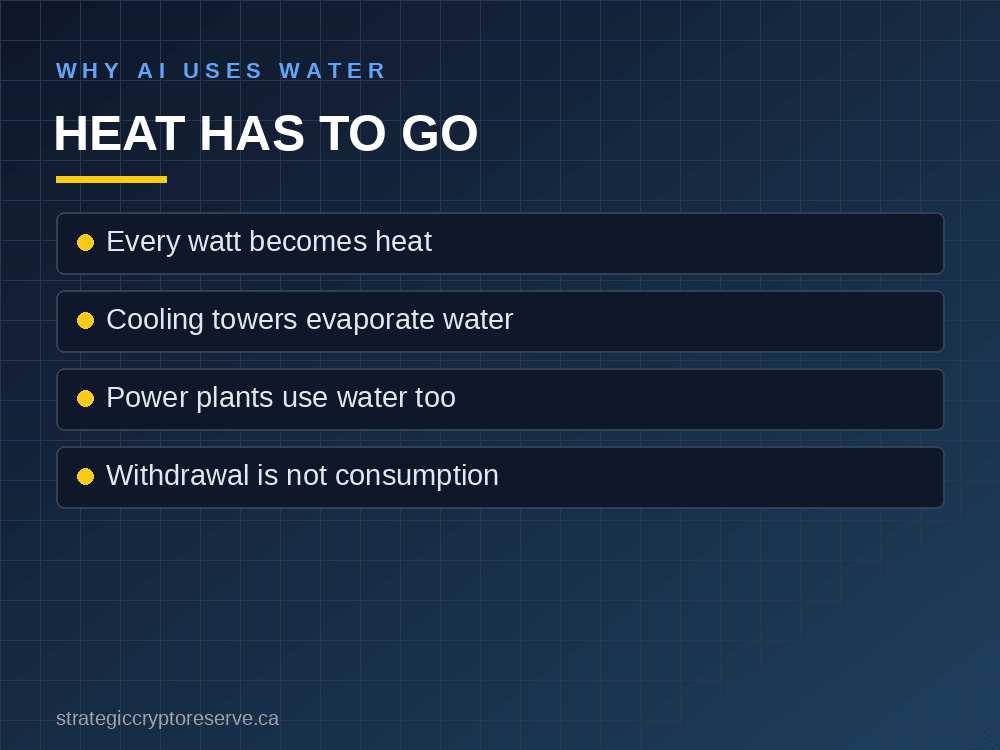
Every watt a GPU uses turns into heat, and an AI rack can draw 100 kW or more. The cheapest way to remove that heat at scale is evaporation: warm water is sprayed through a cooling tower, part of it evaporates, and that evaporation carries the heat away. The evaporated water is gone, which is why operators talk about water consumption rather than just withdrawal.

  • Direct water is what the site's cooling system uses. Evaporative systems consume most of what they withdraw; the rest leaves as blowdown.
  • Indirect water is used by the power plants that make the electricity. Thermal plants need cooling water too, so a data center on a coal or gas grid carries a hidden water footprint.
  • Water Usage Effectiveness (WUE) is the industry metric: litres of water per kilowatt-hour of IT energy. Lower is better, and liquid-cooled halls can approach zero on-site.

Does a single AI chat use much water? OpenAI's CEO Sam Altman wrote in June 2025 that an average ChatGPT query uses about 0.000085 gallons, roughly one-fifteenth of a teaspoon. Small per query, enormous across billions of queries and the training runs behind them.

Why AI data centers use water: evaporative cooling, power plants and withdrawal vs consumption

How Cooling Choice Changes AI Data Center Water Use

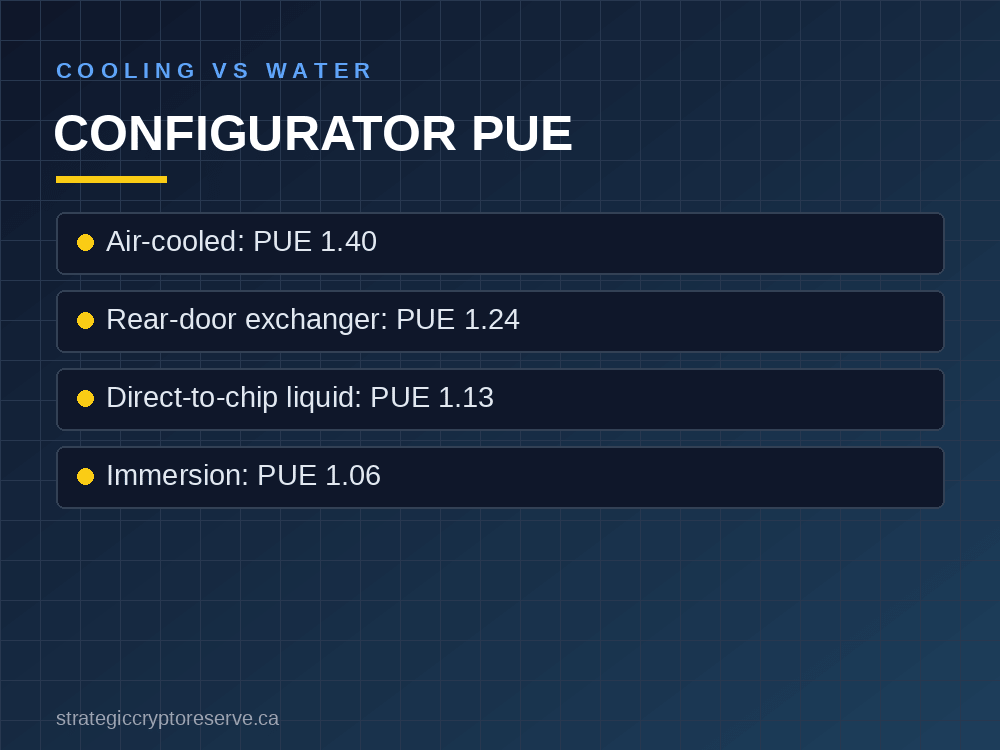
Cooling design is the biggest lever on water. The four architectures in our AI Build Configurator show the trade-off between energy, density and water:

Cooling options (configurator defaults; added cost over air, C$ million per MW of IT)
CoolingPUEMax rack densityAdded CapExWater profile
Air-cooled / hot-aisle containment1.4050 kWC$0Highest if chillers use cooling towers
Rear-door heat exchanger1.2490 kWC$1.43MModerate
Direct-to-chip liquid (DLC)1.13250 kWC$3.68MLow with closed loop and dry coolers
Single-phase immersion1.06300 kWC$4.50MNear zero on site

The catch is that dry coolers, which reject heat without evaporating water, need more fan energy on hot days. In a desert you often trade water for electricity. In a cool climate such as British Columbia or Quebec, free cooling makes both low, one reason Canada is attracting AI data center investment.

Chipmakers are pushing the same way: NVIDIA says its next platforms can run on warm-water liquid cooling that needs little or no evaporative water, a vendor claim worth checking against real deployments.

AI data center cooling options and water use: air, rear-door, direct-to-chip liquid and immersion

AI Data Center Water: Cost, Permits and Community Risk

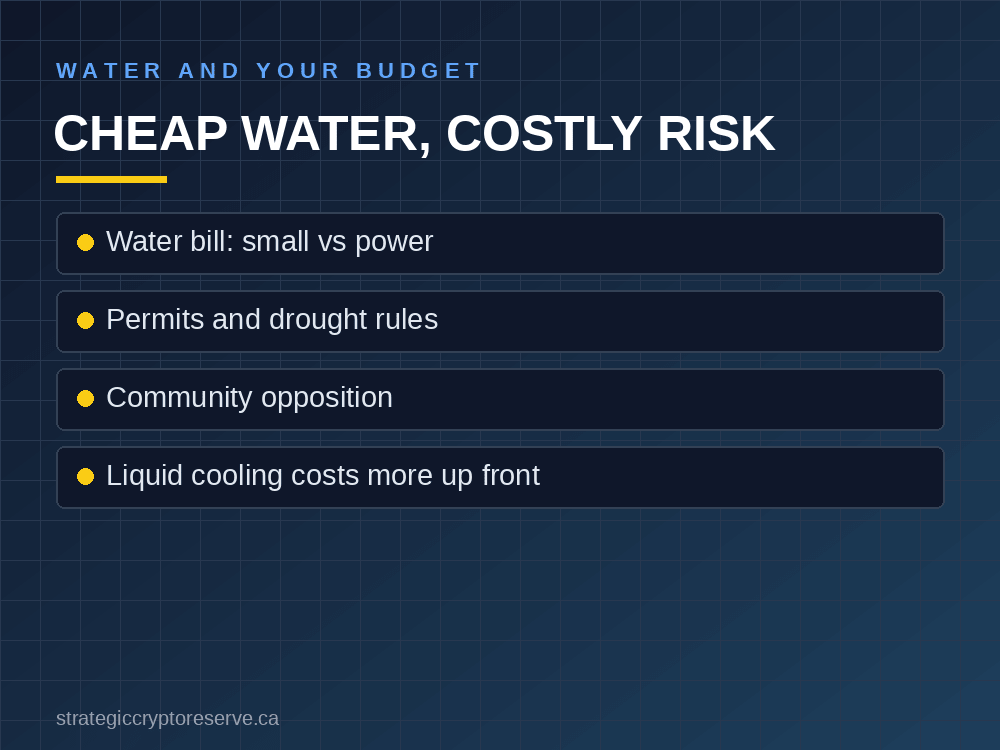
For most operators the water bill itself is small next to electricity. The real cost of water is risk: drought restrictions, permits, municipal capacity and public opposition. Projects from Arizona to New Jersey have faced pushback over water, including residents near the DataOne Vineland AI data center.

That makes cooling a planning decision, not just an engineering one. Liquid cooling raises capital cost by roughly C$3.7 to C$4.5 million per MW in our model, but it cuts water, lowers PUE and allows denser racks, which can shrink the building. Our data center cooling cost calculator and the full configurator demo show how that trade plays out in each state and province.

AI data center water cost, permits and community risk

Compare Cooling Options for Your AI Build

Choose air, rear-door, direct-to-chip or immersion cooling and see how PUE, capital cost and payback change for your location.

Price your own AI build in seconds. The AI Build Configurator shows capital cost by line item, power cost and payback for every Canadian province and US state, by GPU class and cooling type. Try the free demo, or put it on your own site: Standard licence C$4,000 a year, Pro C$10,000, site screening reports from C$950 (see licensing).

AI Build Configurator

Pick a cooling type and see PUE, CapEx and payback for any province or state. Free demo.

Try the free demo →

Cooling Cost Calculator

Estimate the cost of cooling a data center by design and climate.

Read it →

DataOne Vineland Emissions

Gas generators, a record fine and fuel cells at a 300 MW AI campus.

Read it →

Canada AI Data Center Boom

Why cool climates and clean power are drawing AI builds north.

Read it →

Frequently Asked Questions: AI Data Center Water Usage

1. How much water does an AI data center use?

A medium-sized data center uses about 110 million gallons of water a year, roughly 300,000 gallons a day. Large hyperscale AI campuses using evaporative cooling in hot, dry climates can use 1 to 5 million gallons a day. Sites with closed-loop liquid cooling can use far less.

2. How much water do data centers use worldwide?

Rystad Energy estimates data centers used about 222 billion litres, or 59 billion gallons, of water for cooling worldwide in 2025. Lawrence Berkeley National Laboratory estimated direct US data center water use at about 17 billion gallons in 2023.

3. Why do AI data centers need water?

AI servers turn almost all of their electricity into heat. Many data centers remove that heat with evaporative cooling towers, where part of the water evaporates and carries heat away. Power plants that supply the electricity also use water, which adds an indirect footprint.

4. How much water does one ChatGPT query use?

OpenAI CEO Sam Altman wrote in June 2025 that an average ChatGPT query uses about 0.000085 gallons of water, about one-fifteenth of a teaspoon. Independent estimates vary because they include different cooling systems and power sources.

5. Can AI data centers use less water?

Yes. Closed-loop direct-to-chip liquid cooling and immersion cooling reuse the same fluid and reject heat through dry coolers, which can bring on-site water use close to zero. Cool climates also allow free cooling. The trade-off is higher capital cost and sometimes more fan energy on hot days.

6. How do I compare cooling costs for an AI build?

The free demo of the Strategic Crypto Reserve AI Build Configurator lets you choose air, rear-door, direct-to-chip or immersion cooling and see PUE, capital cost and payback for any US state or Canadian province.