Infrastructure Hub · Comox Valley, BC · Updated June 2026

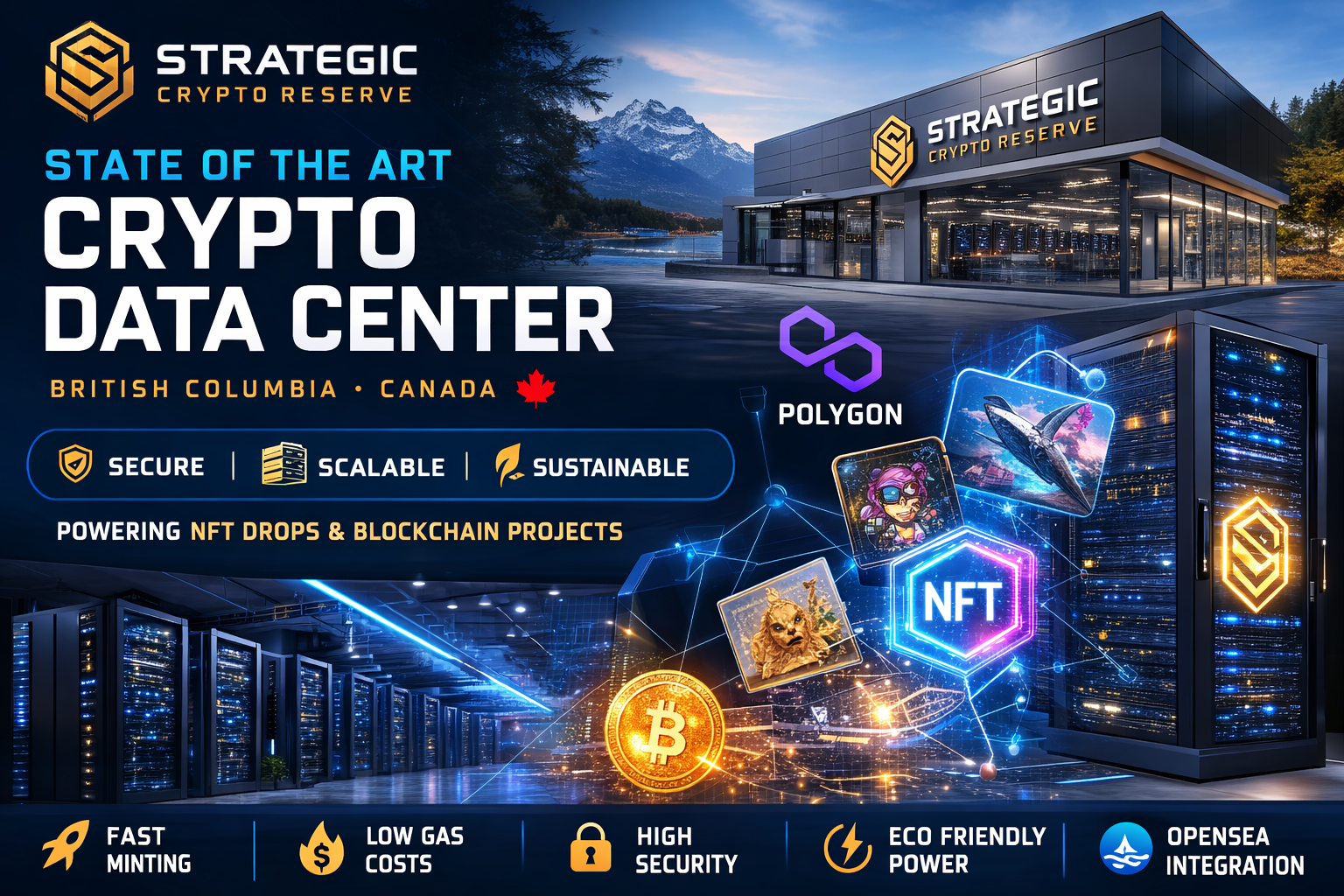
The Strategic Crypto Reserve Crypto Data Center: BC Blockchain Infrastructure Hub

This page is the starting point for everything Strategic Crypto Reserve builds in the physical world: a real, small-scale Bitcoin mining operation in the Comox Valley on Vancouver Island, plus a growing set of practical guides on BC Hydro power strategy, build planning, and cost modeling for crypto data center infrastructure in British Columbia. No invented facility claims — just what's real today, and the resources to plan something bigger.


Strategic Crypto Reserve crypto data center infrastructure in British Columbia

SCR Infrastructure

Secure · Scalable · BC Hydro-Powered

What Is a Crypto Data Center?

A crypto data center is a computing facility purpose-built to support blockchain networks, digital asset platforms, and decentralized applications. Unlike a general-purpose data center, it has to handle continuous cryptographic computation, blockchain validation, and — in the case of Bitcoin mining specifically — sustained 24/7 power draw from ASIC hardware rather than the bursty, variable loads typical of web hosting or enterprise IT.

For Strategic Crypto Reserve, "crypto data center" isn't a single building — it's a cluster of related infrastructure and knowledge: a real Bitcoin mining setup currently running in the Comox Valley, plus the technical groundwork (power planning, cooling, hardware selection, BC Hydro rate strategy) that anyone would need to plan a similar operation at a larger scale. This page ties that cluster together.

As blockchain technology and Bitcoin mining difficulty both continue to climb, the infrastructure layer matters more than ever. Power cost, cooling design, and grid strategy are usually the difference between a mining operation that's economically viable and one that isn't — which is why most of this hub is about those specifics rather than abstractions.

Infrastructure also matters for a less technical reason: trust. Anyone can launch a token or mint an NFT collection. Far fewer projects are willing to publish the actual hardware, the actual power numbers, and the actual location behind their claims. That's the standard this cluster is held to — every page links back here, and every page is upfront about what's real today versus what's a planning guide for a larger build someone else might pursue.
Crypto data center infrastructure explained

Crypto Data Centers vs. Traditional Data Centers

"Data center" covers a wide range of facilities, and conflating crypto-specific infrastructure with the enterprise IT or cloud-hosting kind leads to bad assumptions on both sides. A traditional data center is provisioned for variable, bursty workloads — web traffic, enterprise applications, cloud compute — and is typically built with redundant power feeds, redundant cooling, and low-latency network proximity to population centers as top priorities, since downtime there usually breaches a customer service-level agreement.

A crypto data center, by contrast, is usually built around a single, predictable workload: ASIC-based proof-of-work mining, or increasingly GPU-based compute. That workload runs at or near 100% utilization around the clock rather than fluctuating, which flips several design priorities compared to a traditional facility.

Factor Traditional Data Center Crypto / Mining Data Center
Power Profile Variable, burst-capable Continuous, near-constant load
Cooling Priority Precision climate control for sensitive enterprise hardware High-volume heat rejection, more tolerant of temperature swings
Location Priority Proximity to population centers for low network latency Proximity to cheap, abundant, reliable power
Redundancy N+1 or 2N power and cooling redundancy is standard Often optional — downtime costs lost mining revenue, not SLA penalties
Primary Cost Driver Real estate, networking infrastructure, compliance Electricity cost per kWh

That last row is the one that matters most for anyone planning a build: in a crypto data center, the electricity bill dominates the economics in a way it rarely does for a traditional facility, which is exactly why so much of this hub is about BC Hydro rate structure rather than server racks. It's also why British Columbia, despite not being a major data center hub in the traditional sense, is a genuinely sensible location for this specific kind of infrastructure.

Why British Columbia for Crypto Infrastructure

British Columbia isn't the first place most people think of for crypto mining — Texas and central Washington get more attention, and for good reason: cheap industrial power and aggressive tax incentives draw large operators there. But for the kind of small, honest operation Strategic Crypto Reserve actually runs, three regional factors make BC a sensible choice anyway, even without those large-scale incentives.

BC Hydro's Clean Grid

BC Hydro generates the vast majority of its power from hydroelectric dams rather than fossil fuels, which keeps the carbon footprint of mining here meaningfully lower than fossil-heavy grids elsewhere in North America.

Clean Grid

Coastal Climate

Coastal BC, including Vancouver Island, stays cool for most of the year. That cuts the active cooling overhead small ASIC deployments otherwise need, which matters directly for operating costs.

Lower Overhead

Rural & Light-Industrial Space

Outside Vancouver's metro core, rural and light-industrial real estate and electrical service costs are far more achievable for an independent operator working at small or mid-size scale.

Practical Cost

Worth being specific about: Strategic Crypto Reserve's own operation currently runs at hobbyist scale — a handful of ASIC units in the Comox Valley on Vancouver Island, not an industrial facility. The full hardware, power setup, and solo-mining strategy behind that real operation are documented on the Bitcoin Mining Vancouver Island page.

Explore the Crypto Data Center Cluster

Everything Strategic Crypto Reserve has published about physical infrastructure connects back to this page. Whether you're curious about the real operation or planning your own, here's where to go next.

Bitcoin Mining Vancouver Island

The real, currently-running operation: hardware, BC Hydro power setup, and the case for solo mining from the Comox Valley.

Read the full story →

How to Build a Small-Scale Crypto Data Center

A practical, ground-up guide: hardware selection, power planning, cooling design, networking, and security for a small build.

Read the build guide →

Cost Breakdown: 300-Unit Facility

What it actually costs to plan a 300-unit ASIC facility in Canada — hardware, electrical, cooling, networking, and monthly operating costs.

See the full breakdown →

Power Grid Strategies for Vancouver

BC Hydro rate optimization, demand charge reduction, load management, power factor correction, and grid redundancy for 2026.

Read the power guide →

Crypto Data Center Calculator

A free, interactive, BC Hydro-calibrated tool — estimate ASIC unit capacity, upfront CapEx, and daily power costs for any scale.

Open the calculator →

From a Hobbyist Setup to a 300-Unit Facility: How Scale Changes the Math

The single biggest variable in crypto mining infrastructure isn't the hardware — it's scale, because scale determines which BC Hydro rate tier you fall under and what kind of electrical service you need. The table below is a high-level map of how that changes as an operation grows, from where Strategic Crypto Reserve actually sits today up to the 300-unit case study covered in our full cost breakdown.

Scale Approx. Unit Count Total Facility Power What It Looks Like
Hobbyist / Solo 1 – 5 ASIC units Under 5 kW A dedicated room on a standard BC Hydro connection — what Strategic Crypto Reserve runs today
Small Commercial 10 – 50 units ~50 – 300 kW Dedicated space, RS 1100/1200 BC Hydro service, basic cooling design
Mid-Size Facility 50 – 150 units ~300 kW – 1 MW Purpose-built room, RS 1200 service, active cooling, power factor correction
300-Unit Facility 300 units ~1.6 – 3.2 MW Medium-voltage utility connection, dedicated transformer — see the full cost breakdown

To be clear: the 300-unit figures above come from our cost-modeling guide for anyone planning a build at that scale — they describe what such a facility would cost and require, not an existing Strategic Crypto Reserve facility. The only Strategic Crypto Reserve hardware actually running today sits in the "Hobbyist / Solo" row.

The practical takeaway: figure out which row you're actually planning for before you start pricing hardware. A hobbyist or small-commercial build can usually run on a standard BC Hydro service with minimal electrical upgrades, while anything at mid-size or above typically needs an electrical engineer involved early — both to confirm available capacity at your site and to scope the service upgrade timeline, which can run months for larger connections. The calculator below is built to help you figure out roughly where your own plans land before you commit to either path.

Choosing ASIC Hardware: What Actually Matters

Spec sheets for mining hardware are dense with numbers, but only a handful actually move the needle on return on investment. The rest is mostly noise that's easy to get distracted by when comparing units side by side.

Efficiency (J/TH)

Joules per terahash is the single most important number for long-term economics — it determines how much electricity you burn per unit of mining output, and it's what separates profitable hardware from hardware that loses money as difficulty rises.

Hash Rate (TH/s)

Raw computing power. Important for sizing a build, but misleading in isolation — a high hash rate paired with poor efficiency can still lose to a smaller, more efficient unit over time.

Noise & Cooling Footprint

Most ASIC units run loud, industrial-grade fans. For a residential or light-commercial setup like a hobbyist build, noise and airflow requirements often matter as much as the hash rate itself.

Resale & Secondary Market Value

Mining hardware depreciates fast as newer, more efficient generations launch. Units with strong secondary-market demand give you an exit option if your plans change.

Hardware can't outrun bad power economics. At most scales, which BC Hydro rate tier you land in matters more to your bottom line than which specific ASIC model you buy. Get the power math right first — the sizing calculator is built around exactly that order of operations.

This is necessarily a high-level overview rather than a buyer's guide to specific models, since hardware generations turn over quickly and a model recommendation here would go stale fast. For a full, ground-up walkthrough of hardware selection alongside power planning, cooling design, and networking for a real small-scale build, the build guide goes considerably deeper.

Power Strategy: Why BC Hydro Rate Design Matters

Electricity rate and demand-charge structure usually decide whether a mining operation in British Columbia is economically viable — more than hardware efficiency does, at most scales. BC Hydro bills commercial accounts across several rate schedules based on demand and consumption, and a continuous 24/7 load like ASIC mining sits squarely in that structure. RS 1100 covers very small operations under 35 kW; RS 1200 covers most commercial mining setups between 35 kW and 999 kW; RS 1600 and qualifying industrial tariffs apply above 1 MW, with correspondingly lower per-kWh rates.

Getting this right is mostly about load management, demand charge reduction, and — at larger scale — power factor correction and grid redundancy planning. Our dedicated power guide walks through all of it in detail, with current 2026 rate context specific to crypto mining loads.

Power isn't the only practical constraint worth planning around early, either. Cooling design and network reliability both scale with hardware count in ways that catch first-time builders off guard — a handful of ASIC units can often run on passive airflow, while a few dozen units in the same space generally can't without active ventilation or dedicated cooling. Networking redundancy matters too, since a mining rig that loses its connection stops earning the moment it does. The build guide below covers both in the context of a real, ground-up small-scale setup.

How the Data Center Connects to NFTs and the $SCR Ecosystem

The crypto data center and the SCR token are connected by ownership — both are part of the same Strategic Crypto Reserve project — but not by finances. SCR is a parody utility token used for NFT redemption within the ecosystem. Holding SCR does not grant any claim on mining proceeds, hash power, or infrastructure revenue, and there is no profit-sharing mechanism between the two.

What the infrastructure side of the project does provide is something more modest: evidence that there's real, physical hardware behind part of the project, not just token mechanics and NFT drops. For the NFT and token side of the ecosystem, including how $SCR and NFT redemption actually work, read the whitepaper before making any decisions, and browse the current NFT collections if you're interested in that side of the project.

For the broader infrastructure picture beyond this cluster — including how the data center fits alongside CryptoFarms PantingCreekside and AI expansion concepts — the infrastructure overview page is the place to start.

One more distinction worth making clearly: nothing on this hub is investment advice, and nothing about the data center's existence implies anything about $SCR's value or future price. The infrastructure is documented because transparency is the standard this project holds itself to, not because it's meant to function as a pitch. If you're researching strategic crypto reserve projects as a category — what "reserve" typically means in a token context, and how these structures are usually funded — the investing guide is a more appropriate starting point than this infrastructure-focused hub.

How to Plan a Crypto Data Center in British Columbia

Whether you're sizing a hobbyist setup like the Comox Valley operation or modeling a larger commercial build, the planning steps are the same — the numbers just change. Here's the framework, in order.

Step 1: Assess Available Power

Determine your BC Hydro rate schedule and how much continuous draw your service supports. RS 1100 applies under 35 kW; RS 1200 from 35 kW to 999 kW. Each ASIC draws roughly 3–4 kW — this number caps your unit count before anything else.

Power grid strategies →

Step 2: Select Hardware

Choose ASIC models whose total draw stays within your capacity with a 15–20% safety margin. For a hobbyist setup on RS 1100, that's typically two to five units. Use the calculator to model unit count vs. monthly power cost before purchasing.

Try the calculator →

Step 3: Design Cooling

Each ASIC generates 3–4 kW of heat continuously. In coastal BC's mild climate, a well-ventilated space with ambient-air intake often suffices for small setups. Larger builds need purpose-designed airflow paths, hot-aisle containment, or immersion cooling.

Build guide →

Step 4: Network & Monitoring

Mining hardware needs a stable connection and a management network. Configure a dedicated VLAN for mining equipment, set up ASIC dashboards, and establish alerting for hash rate drops, temperature spikes, or power anomalies.

Infrastructure

Step 5: Model the Economics

Run break-even analysis using your confirmed BC Hydro rate, hardware efficiency in J/TH, current network difficulty, and BTC price. The cost breakdown guide covers full capital and operating cost models from hobbyist to 300-unit scale.

Full cost breakdown →

Step 6: Commission & Track

Commission units one at a time, confirm hash rate hits rated spec, and establish a steady monitoring cadence. Track actual BC Hydro billing monthly against your projected power cost from the first bill forward.

See the real operation →

The Comox Valley operation followed this exact sequence. Power was assessed first against the RS 1100 schedule, hardware was selected to match — not the other way around. The result is a small, honest setup that stays within its own budget and doesn't overclaim what it is. That sequence is the same whether you're running three units or three hundred.

Frequently Asked Questions: Crypto Data Center

1. What is the Strategic Crypto Reserve crypto data center?

It's the umbrella term for Strategic Crypto Reserve's physical blockchain infrastructure in British Columbia — a real, small-scale Bitcoin mining setup in the Comox Valley, plus educational guides on building and sizing crypto mining infrastructure under BC Hydro's rate schedules.

2. Is the Strategic Crypto Reserve crypto data center a large industrial facility?

No. The real, currently operating hardware is a small, single-operator Bitcoin mining setup — a handful of ASIC units, not a server hall. The 300-unit and larger figures discussed on this site are educational cost-modeling content for anyone planning their own build, not a description of an existing Strategic Crypto Reserve facility.

3. How much does it cost to build crypto mining infrastructure in BC?

It depends entirely on scale. A hobbyist setup with a few ASIC units can run on a standard BC Hydro RS 1100 commercial connection for a few hundred dollars a month in power. A 300-unit facility requires a dedicated medium-voltage utility connection and roughly 1.6 to 3.2 megawatts of total facility power. See our full cost breakdown guide and the free sizing calculator for detailed numbers.

4. Does the crypto data center generate returns for $SCR token holders?

No. The data center and Bitcoin mining infrastructure are owned by Strategic Crypto Reserve but are not financially linked to the SCR token. SCR is a parody utility token used for NFT redemption — it carries no claim on mining proceeds or infrastructure revenue. Read the whitepaper before treating this project as anything other than entertainment and community engagement.

5. Where can I find a tool to size my own crypto mining setup?

The Crypto Data Center Calculator is a free, interactive tool calibrated to BC Hydro rate schedules. It estimates ASIC unit capacity, upfront capital costs, and daily power costs for whatever scale of operation you're planning.

6. How is a crypto data center different from a traditional data center?

The biggest differences are load profile and purpose. A crypto data center runs continuous, near-constant power draw for cryptographic computation — typically Bitcoin mining via ASIC hardware — rather than the variable, bursty workloads of web hosting or enterprise IT. That changes cooling design, electrical service sizing, and even where it makes sense to locate one, since cheap, reliable, continuous power matters more than proximity to population centers.