Infrastructure Cost Guide · Updated June 2026

Cost Breakdown for a 300-Unit Crypto Mining Facility

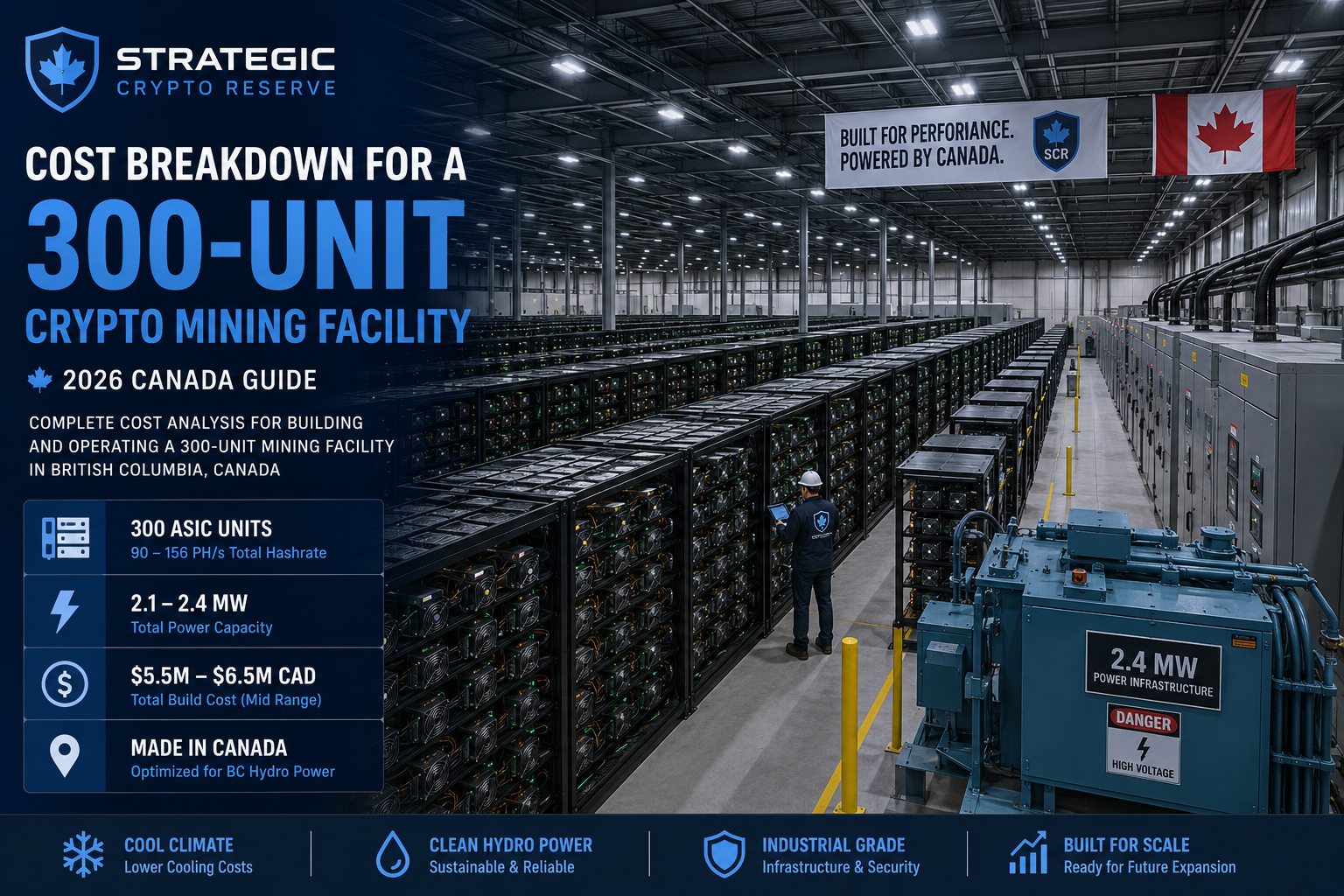
The cost breakdown for a 300-unit crypto mining facility is one of the most consequential financial analyses any serious blockchain operator will undertake. At 300 ASIC units, you are building a genuinely commercial-scale mining operation — one that requires industrial electrical infrastructure, purpose-engineered cooling systems, and a monthly operating budget that rivals a small manufacturing business. This guide delivers a thorough, line-item cost breakdown across every major category: hardware, electrical service, cooling, rack and network infrastructure, facility, and monthly operating expenditure — with Canadian dollar pricing and specific context for British Columbia operators.


300-unit crypto mining facility cost breakdown — Strategic Crypto Reserve infrastructure guide illustration

Facility Scale

300 Units · 1.5–2.2 MW

What Does a 300-Unit Crypto Mining Facility Actually Include?

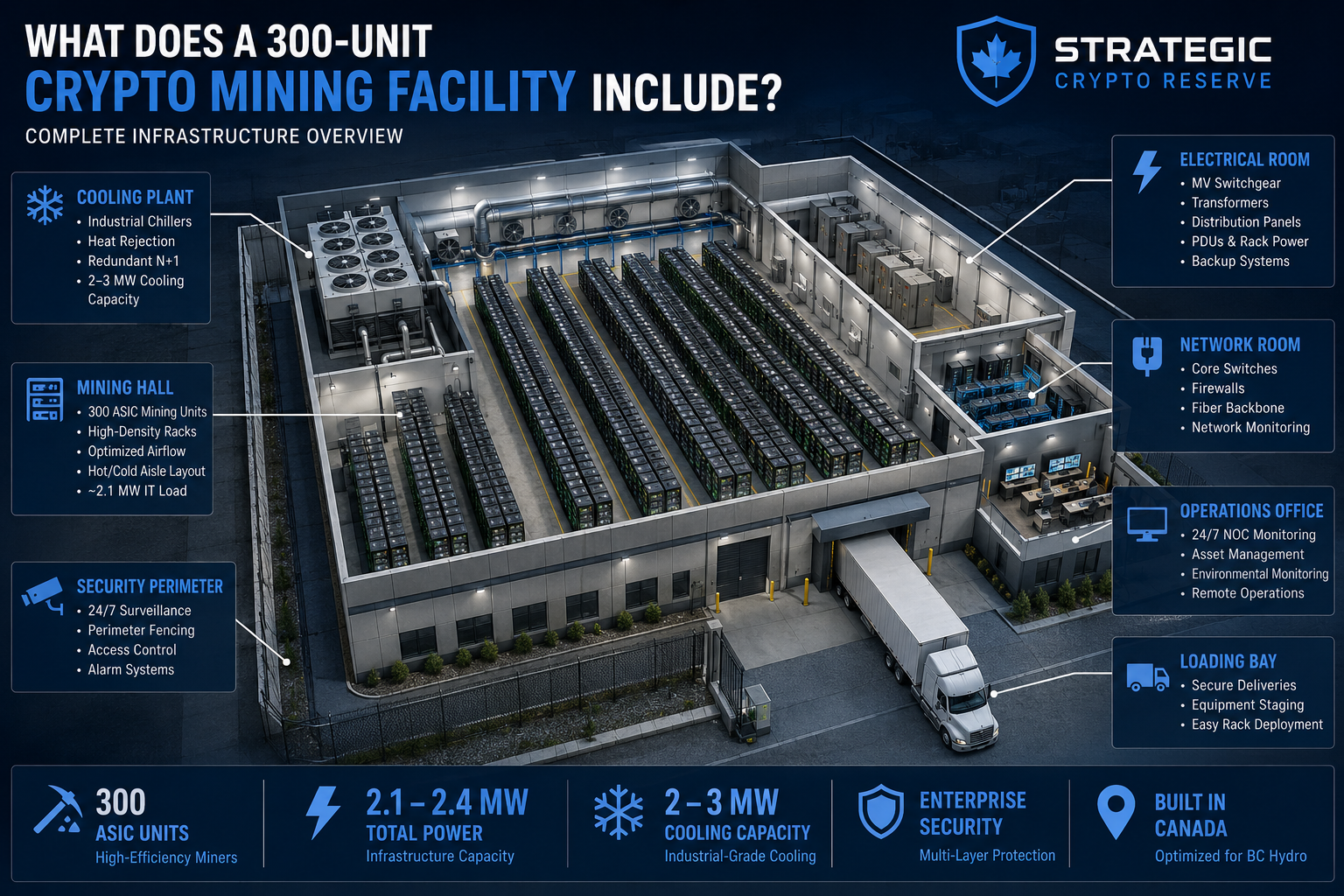
A 300-unit crypto mining facility sits firmly in the commercial-scale tier of blockchain infrastructure — a full step above semi-professional setups and well into the territory of genuine industrial computing operations. At this unit count, you are managing continuous power demands measured in megawatts, cooling loads that require purpose-built HVAC engineering, and a hardware estate worth multiple millions of dollars. Understanding that scope before allocating capital is the entire purpose of this cost breakdown.

At 300 modern ASIC miners, the computing load alone ranges from approximately 1.2 to 2.25 megawatts depending on hardware model selection. With cooling, networking, lighting, and facility overhead added, total facility power consumption rises to roughly 1.6 to 3.2 MW. This single number — total facility draw — determines your utility service requirements, your monthly electricity bill, and whether a given site can physically host the operation at all. It is the first figure to calculate and confirm before any other planning decision is made.

Structurally, a 300-unit facility involves: 35–40 custom ASIC rack shelving positions; a dedicated light industrial or commercial facility of 8,000–15,000 square feet; a utility service entrance rated for 2+ MW of continuous draw; industrial-grade cooling infrastructure; a managed network connecting 300 computing endpoints; and a physical security perimeter protecting hardware worth $1.65 million to $6 million CAD. If you are earlier in your infrastructure journey and planning a smaller installation first, our comprehensive guide to building a small-scale crypto data center covers the foundational infrastructure concepts that scale directly into a 300-unit operation.

The cost breakdown below covers every major category in the order a facility operator encounters them — beginning with hardware selection and concluding with monthly operating expenditure. All figures reflect 2026 Canadian market pricing. Prices in USD have been converted at the prevailing 2026 CAD/USD exchange rate.

300-unit crypto mining facility overview — commercial ASIC mining operation scale and infrastructure requirements

Hardware Costs: ASIC Miners for a 300-Unit Facility

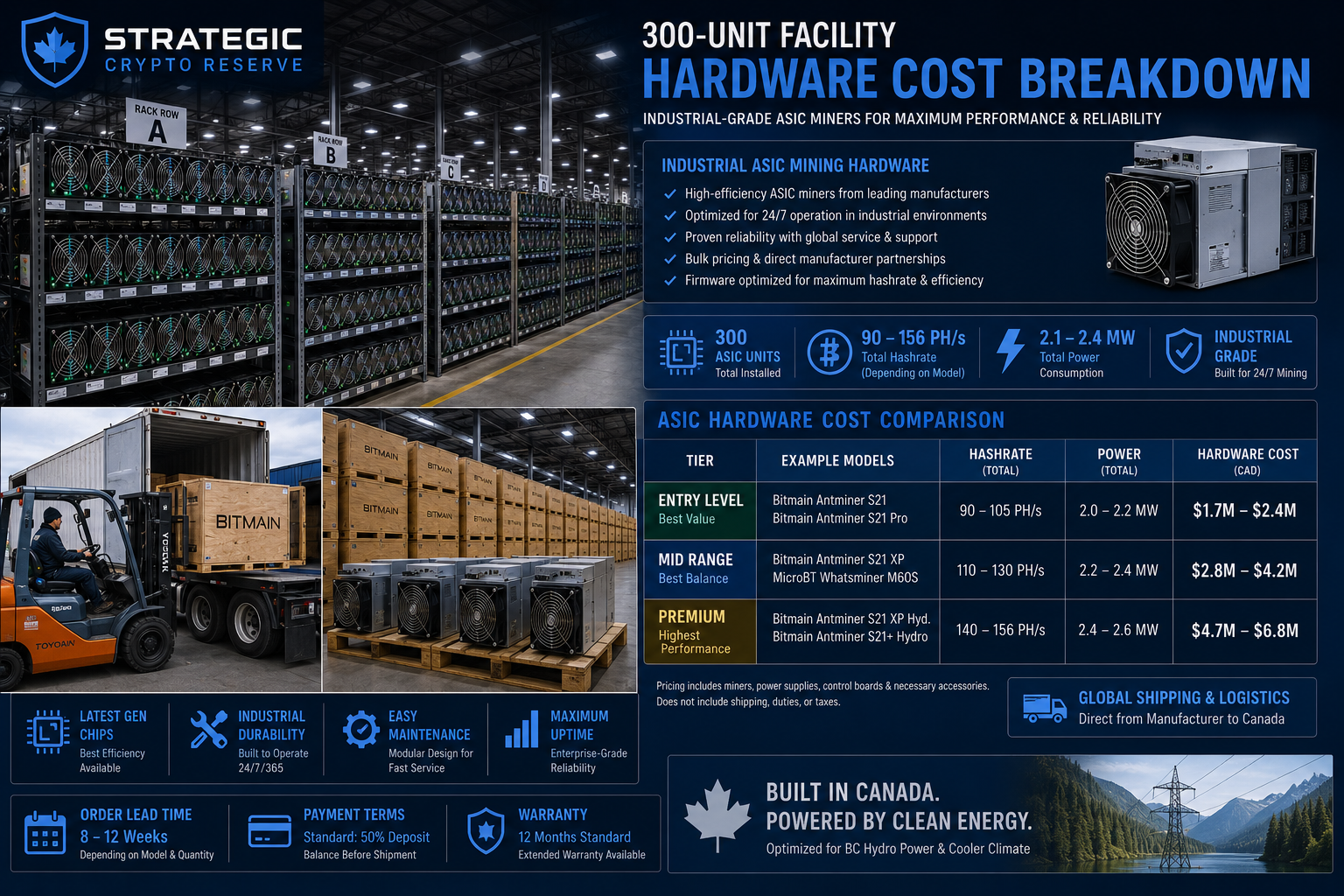
The computing hardware itself is the largest single line item in any 300-unit crypto mining facility budget. In 2026, the commercial ASIC market offers three distinct performance and price tiers, each with different implications for power draw, cooling requirements, and revenue potential:

Entry-Level ASIC

~280–320 TH/s per unit at approximately 4,500–5,000 watts. Lowest cost per unit, highest cost per terahash. Well-suited for operators prioritizing capital preservation over peak efficiency. Typically prior-generation models available for immediate delivery.

$5,500–$7,500 CAD/unit

Mid-Range ASIC

~380–430 TH/s per unit at approximately 5,500–6,500 watts. The most common tier for commercial 300-unit builds — balances acquisition cost, power efficiency, and manufacturer availability. Current-generation models with 3–6 month lead times from direct OEM orders.

$9,000–$13,000 CAD/unit

Premium ASIC

~480–560+ TH/s per unit at approximately 7,000–8,500 watts. Maximum hashrate density per rack position. Highest capital cost per unit but lowest cost per terahash at scale. Premium models typically require direct OEM relationships and advance deposits for allocation.

$15,000–$21,000 CAD/unit

Import and Logistics

Hardware cost does not end at the manufacturer price. Budget 5–8% of hardware cost for international freight (primarily from China or Malaysia), Canadian customs duties and brokerage fees, and delivery to your facility. Factor these costs before finalizing your per-unit budget.

+5–8% of Hardware Total

For an accurate hardware budget, begin with our detailed hardware selection framework for crypto data center operators, which covers how to evaluate hashrate efficiency, thermal output, and manufacturer reliability when sourcing equipment at volume — principles that apply equally at the 300-unit scale.

Hardware Tier Avg. Spec (TH/s / Watts) Per-Unit Cost (CAD) 300-Unit Hardware Total (CAD) 300-Unit Total w/ Import (CAD)
Entry-Level ASIC 300 TH/s · 4,750 W $5,500–$7,500 $1,650,000–$2,250,000 $1,733,000–$2,430,000
Mid-Range ASIC 405 TH/s · 6,000 W $9,000–$13,000 $2,700,000–$3,900,000 $2,835,000–$4,212,000
Premium ASIC 520 TH/s · 7,750 W $15,000–$21,000 $4,500,000–$6,300,000 $4,725,000–$6,804,000
Most Common Build: Mid-Range Tier (used for all subsequent totals) ~$3,300,000–$4,200,000

Volume Procurement Tip: At 300-unit order volumes, most ASIC manufacturers offer direct OEM pricing that is 5–12% below secondary market rates. Engaging a hardware broker for immediate-availability stock is faster but typically costs 8–15% above OEM direct. For a $3M+ hardware order, a 10% difference represents $300,000 CAD — always obtain quotes from at least three sources (OEM direct, two established brokers) before committing.

Electrical Infrastructure Cost Breakdown for a 300-Unit Mining Facility

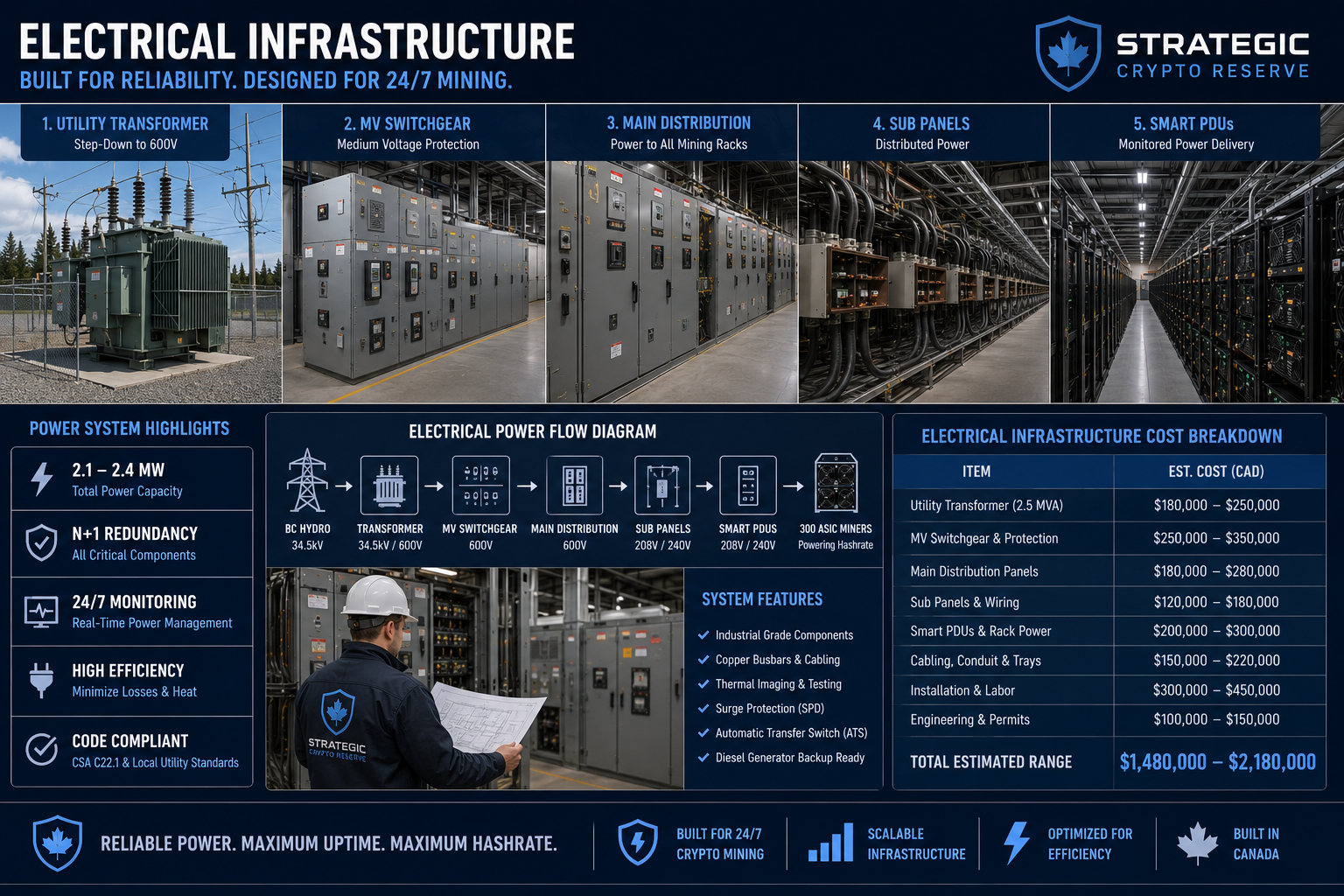
Electrical infrastructure is the second-largest cost category in a 300-unit crypto mining facility build and the one that catches the most operators off-guard. The difference between a small-scale installation and a 300-unit commercial facility is not simply more of the same circuits — it is an entirely different tier of electrical engineering. At 1.5–2.25 MW of continuous computing load, you require medium-voltage utility infrastructure that goes well beyond what any standard commercial property service entrance provides.

The process begins with your local utility provider. In British Columbia, this means engaging BC Hydro's commercial and industrial services team to confirm available service capacity at your site, request a load study, and obtain a timeline and estimated cost for a service entrance upgrade. Utility-side work — transformer installation, metering, and the utility's share of switchgear — is handled by the utility and billed as a connection cost. This alone can run $50,000–$200,000 CAD depending on how far your facility is from the nearest medium-voltage distribution line.

  1. Utility Service Entrance and Medium-Voltage Equipment: A 300-unit facility typically requires a 2–3 MVA dedicated transformer, associated switchgear, and a utility-grade metering installation. The customer-side portion of this work (from the meter socket inward) includes a main distribution panel, circuit breakers, and bus duct rated for the full facility load. Combined utility connection fees and customer-side main distribution: $150,000–$400,000 CAD.
  2. Sub-Distribution Panels and Dedicated Circuits: Each ASIC miner requires a dedicated 240V/30A–50A outlet connection. Distributing power from the main switchboard to 300 ASIC positions across 35–40 rack bays involves installing sub-distribution panels in each rack zone, running appropriately sized conductors, and terminating at rack-mounted smart PDUs. Labor, conduit, conductors, and sub-panels: $120,000–$280,000 CAD.
  3. Smart Power Distribution Units (PDUs): Each rack position requires a smart PDU providing per-outlet current monitoring, remote switching, and environmental sensor ports. For 35–40 rack bays, budget for 35–40 rack PDUs plus spare inventory. Smart PDUs with 20+ monitored outlets: $35–$90 per outlet position. Total for 300-position facility: $40,000–$90,000 CAD.
  4. UPS Systems for Critical Infrastructure: While protecting 300 ASIC miners on a UPS is cost-prohibitive, protecting your critical management infrastructure — network switches, out-of-band management servers, PDU control systems, and monitoring hardware — is essential. A modular 3-phase UPS rated for 50–100 kVA covers all management systems and allows graceful shutdown of mining hardware during extended outages. Budget $60,000–$180,000 CAD for UPS plus installation.
  5. Electrical Engineering, Load Calculations, and Licensed Electrician Labour: A project of this scale requires a licensed professional electrical engineer to stamp the design drawings, a separate licensed electrical contractor for installation, and multiple inspection sign-offs. Engineering reports, permit fees, and licensed electrician labour across the full scope: $80,000–$200,000 CAD.
Electrical infrastructure for 300-unit crypto mining facility — switchgear, sub-distribution panels, and PDUs for a 2 MW ASIC mining operation
Electrical Component Description CAD Range
Utility Service Entrance & Main Distribution 2–3 MVA transformer, switchgear, metering, utility connection fees, main distribution panel $150,000 – $400,000
Sub-Distribution Panels & Dedicated Circuits Zone sub-panels, conductors, conduit, circuit breakers, terminations for 300 ASIC positions $120,000 – $280,000
Smart PDUs (35–40 units) Rack-mounted monitored PDUs with per-outlet switching and environmental sensor ports $40,000 – $90,000
UPS for Management Infrastructure Modular 3-phase UPS (50–100 kVA), bypass switching, battery modules, installation $60,000 – $180,000
Electrical Engineering & Labour PE-stamped drawings, load calculations, permit fees, licensed electrician installation $80,000 – $200,000
Electrical Infrastructure Subtotal $450,000 – $1,150,000

Cooling System Costs for a 300-Unit Crypto Mining Facility

Industrial cooling systems for 300-unit crypto mining facility — in-row cooling units, CRAC units, and hot-aisle cold-aisle containment for ASIC mining operations

Cooling represents the third major capital cost in a 300-unit crypto mining facility — and the one with the greatest variance depending on climate, facility design, and cooling technology chosen. At 300 ASIC miners with 4,750–7,750 watts per unit, total computing heat rejection ranges from approximately 4.9 million to 7.9 million BTU per hour (1.44–2.32 MW thermal). No standard commercial HVAC system approaches this load — industrial-grade infrastructure is required.

The two dominant cooling strategies for a facility of this scale are air cooling with hot-aisle/cold-aisle containment and direct liquid cooling (including immersion). Air cooling is the lower capital cost option and has a larger pool of qualified installation contractors. Immersion cooling — submerging ASIC units in dielectric fluid — offers significantly higher thermal efficiency but carries higher equipment costs and more limited contractor availability in Canada as of 2026.

  1. Air-Cooling: Precision CRAC/CRAH Units: Computer room air conditioning (CRAC) or computer room air handler (CRAH) units connected to a chiller plant are the industry standard for facilities of this density. A 300-unit air-cooled facility typically requires 8–14 precision cooling units totalling 2,000–3,200 kW of cooling capacity. Precision units, chiller plant, piping, and installation: $600,000–$1,400,000 CAD.
  2. Air-Cooling: Hot-Aisle/Cold-Aisle Containment: Physical containment structures — ceiling panels, end-of-row doors, aisle containment kits — prevent cold supply air from mixing with hot exhaust before it is captured and returned to cooling units. Containment hardware for a 35–40 rack facility: $40,000–$100,000 CAD.
  3. Alternative: Immersion Cooling Systems: Purpose-built immersion cooling tanks for ASIC miners hold 8–15 units each, requiring 20–40 tanks for a 300-unit facility. Immersion systems dramatically reduce cooling energy consumption (PUE can approach 1.03) but cost $1,200,000–$2,800,000 CAD installed for a 300-unit facility. Best suited for operators in locations with warm climates or extremely high electricity costs where cooling efficiency savings justify the capital premium.
  4. Cooling Engineering, Commissioning, and Refrigerant: Mechanical engineering design, refrigerant charge, system commissioning, and first-year maintenance contract: $60,000–$160,000 CAD regardless of cooling technology selected.

BC Climate Advantage: In British Columbia's Comox Valley and central island regions, ambient temperatures remain below 15°C for seven to nine months of the year. This allows free-cooling or economizer modes on chillers — reducing compressor energy consumption by 40–70% during cool months. Over a full year, this climate benefit can reduce annual cooling energy costs by 25–35% compared to a facility in a warmer Canadian province, materially improving the return on cooling capital investment.

Rack, Network, Security, Facility, and Monitoring Infrastructure

Beyond hardware, electrical systems, and cooling, a functional 300-unit crypto mining facility requires a supporting layer of rack infrastructure, network equipment, physical security, environmental monitoring, and facility preparation. These costs are individually smaller than the three major categories but collectively represent a significant budget line — and underestimating them is one of the most common planning errors in commercial mining builds.

  1. ASIC Rack Shelving Infrastructure: Standard 42U server racks are designed for 1U–4U rack-mount equipment, not the horizontal brick-style form factor of ASIC miners. Commercial ASIC facilities use custom open-frame shelf racks — typically 4-tier or 6-tier steel structures holding 8–12 miners per bay. For 300 units at 10 miners per position, 30–35 rack shelving units are required, plus cable management and grounding kits. Budget $70,000–$175,000 CAD including hardware, delivery, and assembly.
  2. Network Infrastructure: A 300-unit mining facility needs a 10 Gbps aggregation switch at the core (for management and monitoring bandwidth), four to six 1 Gbps access switches distributing to ASIC management ports, a firewall-capable edge router, structured Cat6A patch cabling throughout, and a dedicated out-of-band management VLAN. Managed enterprise network equipment and installation: $25,000–$75,000 CAD.
  3. Physical Security Systems: At this asset value, professional-grade physical security is non-negotiable. Budget for: access-controlled entry (card or PIN plus biometric for high-security operations), a minimum of 8–16 interior and exterior IP camera positions with off-site cloud recording, rack-level locks on the most critical equipment, and optionally a monitored commercial alarm system. Total physical security: $30,000–$85,000 CAD.
  4. Environmental Monitoring Platform: Deploy temperature and humidity sensors at rack inlet, rack exhaust, and room ambient positions — a minimum of 90–120 sensor points across a 300-unit facility. Connect all sensors to a centralized monitoring platform with automated alerting to email and SMS when thresholds are breached. Add current monitoring probes at each sub-distribution panel and a remote KVM for emergency management access. Environmental monitoring hardware and platform: $20,000–$60,000 CAD.
  5. Facility Leasehold Build-Out and Permitting: Converting a raw light industrial space into an operational crypto mining facility requires: reinforced concrete flooring or floor slab assessment, structured cable management (cable trays, conduit runs), facility lighting upgrades, fire suppression system inspection and clean-agent readiness confirmation, and all required municipal building permits. Leasehold improvement and permitting costs: $150,000–$500,000 CAD depending on facility condition and local requirements.
Ancillary infrastructure for 300-unit mining facility — ASIC rack shelving, network switches, security cameras, and environmental monitoring for commercial crypto operations

Complete Capital Cost Summary: 300-Unit Crypto Mining Facility (2026 CAD)

The table below consolidates the full capital cost breakdown for a 300-unit crypto mining facility. Hardware figures reflect the mid-range ASIC tier — the most common build configuration for commercial operators. Infrastructure ranges reflect typical 2026 Canadian contractor and equipment pricing.

Cost Category Description CAD Range
COMPUTING HARDWARE
ASIC Mining Hardware (300 Units) Mid-range tier: ~380–430 TH/s per unit at ~5,500–6,500 W; current-generation OEM or broker stock $2,700,000 – $3,900,000
International Freight & Import Duties Air or sea freight from Asia, Canadian customs brokerage, duties at 0–6% depending on country of origin $135,000 – $312,000
ELECTRICAL INFRASTRUCTURE
Utility Service Entrance & Main Distribution 2–3 MVA transformer, switchgear, metering, utility connection fees $150,000 – $400,000
Sub-Distribution, Circuits & Smart PDUs Zone sub-panels, dedicated circuits for 300 ASIC positions, smart PDUs $160,000 – $370,000
UPS for Management Infrastructure Modular 3-phase UPS 50–100 kVA, bypass, batteries, installation $60,000 – $180,000
Electrical Engineering & Labour PE-stamped drawings, load calcs, permits, licensed electrician installation $80,000 – $200,000
COOLING SYSTEMS
Precision Cooling Units (Air Cooling) CRAC/CRAH units totalling 2,000–3,200 kW capacity, chiller plant, piping, installation $600,000 – $1,400,000
Hot-Aisle/Cold-Aisle Containment Ceiling panels, end-of-row doors, aisle containment hardware $40,000 – $100,000
Cooling Engineering & Commissioning Mechanical engineering design, refrigerant charge, commissioning $60,000 – $160,000
FACILITY & ANCILLARY INFRASTRUCTURE
ASIC Rack Shelving (30–35 units) Custom open-frame ASIC shelf racks, cable management, grounding, assembly $70,000 – $175,000
Network Infrastructure 10 Gbps core switch, access switches, edge router, structured cabling $25,000 – $75,000
Physical Security Systems Access control, IP cameras with off-site recording, rack locks, alarm system $30,000 – $85,000
Environmental Monitoring Platform 90–120 sensor points, remote KVM, monitoring software, alerting integration $20,000 – $60,000
Facility Leasehold Build-Out & Permits Flooring, cable trays, lighting, fire system, municipal permits, inspections $150,000 – $500,000
Engineering, Consulting & Project Management Structural, electrical, and mechanical engineers; PM fees through commissioning $50,000 – $150,000
Infrastructure Subtotal (Excluding Hardware) $1,495,000 – $3,855,000
TOTAL ALL-IN (Mid-Range Hardware + Full Infrastructure) $4,330,000 – $8,067,000 CAD

Planning Benchmark: For financial modelling purposes, a mid-range 300-unit ASIC facility in British Columbia should be budgeted at approximately $5.5–6.5 million CAD all-in as a central planning estimate — inclusive of mid-tier hardware, standard air-cooled infrastructure, and BC contractor pricing. Budget contingency of 10–15% above this estimate is strongly recommended to account for equipment lead time escalations, unforeseen electrical upgrade scope, and permitting delays.

Monthly Operating Cost Breakdown for a 300-Unit Crypto Mining Facility

Capital cost is a one-time investment. Operating cost is a permanent obligation that begins the moment your facility goes live and determines whether the operation generates profit or loss every single month. For a 300-unit crypto mining facility, monthly operating expenditure is substantial — and electricity dominates the entire cost structure.

For a mid-range 300-unit facility drawing a total of 1.9–2.3 MW (computing plus cooling and facility overhead), monthly electricity consumption runs approximately 1,387,000–1,679,000 kWh. Applied against electricity rate scenarios relevant to British Columbia operators:

  1. Electricity — BC Hydro Industrial Rate (~$0.065/kWh): At BC Hydro's most competitive industrial tariff, a 300-unit facility consuming 1.5 million kWh per month pays approximately $97,500 CAD monthly in electricity. This rate is available to qualifying industrial operations and represents the primary reason British Columbia attracts serious mining investment. Confirm tariff eligibility with BC Hydro's commercial services team before committing to a BC facility.
  2. Electricity — Standard Commercial Rate (~$0.09/kWh): Operators on standard commercial electricity contracts pay approximately $135,000 CAD per month for the same consumption. The $37,500/month gap between industrial and commercial rates equals $450,000 CAD per year — a difference large enough to determine whether a 300-unit operation is commercially viable.
  3. Facility Lease: Light industrial space in BC markets suitable for a 300-unit mining facility (10,000–15,000 sq ft in the Comox Valley, Campbell River, or comparable markets) leases at $12–$22 per square foot annually. Monthly lease costs: $10,000–$27,500 CAD, with triple-net operating costs (property tax, maintenance, insurance contribution) adding 20–30% to base rent.
  4. Technical Staff: A 300-unit facility operating 24/7 requires a minimum of four to six full-time employees: a facility manager, two to three technical operators (on a rotating shift schedule), and a part-time electrical or mechanical maintenance specialist. Monthly all-in staff costs including salary, payroll tax, and benefits: $28,000–$60,000 CAD.
  5. Maintenance, Parts, and Hardware Replacement: ASIC miners operated continuously experience component failures at a rate of 2–5% per year across a fleet this size. Budget for monthly parts procurement, repair labour, and planned preventive maintenance: $10,000–$25,000 CAD per month.
Monthly operating cost breakdown for 300-unit crypto mining facility — electricity, lease, staff, maintenance and insurance in British Columbia
Operating Cost Category Notes Monthly Range (CAD)
Electricity (Industrial Rate ~$0.065/kWh) ~1.5 million kWh/month at 1.9–2.1 MW avg. total draw; BC Hydro industrial tariff $90,000 – $140,000
Facility Lease (incl. triple-net) 10,000–15,000 sq ft light industrial; base rent plus property tax, maintenance contribution $12,000 – $36,000
Technical Staff (4–6 FTE) Facility manager, rotating operators, part-time maintenance specialist; all-in cost $28,000 – $60,000
Maintenance, Parts & Hardware Replacement Ongoing ASIC repairs, PSU replacement, preventive maintenance labour $10,000 – $25,000
Insurance Commercial property, equipment breakdown, and business interruption coverage $6,000 – $15,000
Enterprise Internet (Redundant Fibre) Primary fibre plus secondary 4G/5G backup for out-of-band management continuity $3,000 – $8,000
Security Monitoring Services Monitored alarm system, remote camera review, periodic physical security audit $2,000 – $6,000
Miscellaneous (Consumables, Software, Utilities) Cleaning, supplies, monitoring platform subscriptions, accounting, legal $3,000 – $9,000
Total Monthly Operating Expenditure (BC Industrial Rate) $154,000 – $299,000 CAD

Planning Your 300-Unit Build: Lessons from British Columbia Operations

The cost breakdown figures in this guide are grounded in real-world operational experience, not theoretical estimates. Strategic Crypto Reserve operates blockchain infrastructure and a crypto data center in British Columbia — including ongoing Bitcoin mining operations and NFT platform infrastructure — and the figures we publish reflect what actual BC contractors, equipment suppliers, and utility providers are charging in 2026. That ground-level specificity is what distinguishes a useful cost breakdown from a generic estimate.

For operators planning their first 300-unit facility, several planning lessons consistently emerge from our operational experience:

Electrical timeline is the critical path item. In British Columbia, the end-to-end timeline from utility service application to energized switchgear can range from four to fourteen months depending on the complexity of the service entrance upgrade, proximity to distribution infrastructure, and BC Hydro's current project queue. Hardware procurement lead times for premium ASIC models are often three to six months. In practice, this means the utility application should be submitted before the hardware order is placed — not after. Many first-time facility builders make the expensive mistake of paying for hardware storage because their facility's electrical infrastructure was not ready on hardware delivery day.

Start with small-scale fundamentals. Operators who have personally built and operated a smaller installation before scaling to 300 units make materially better decisions at every stage of the larger build. The core principles of power engineering, hot-aisle/cold-aisle cooling, and out-of-band management that our complete guide to building a small-scale crypto data center covers in detail are the same principles that govern a 300-unit commercial facility — just at a scale where every mistake is proportionally more expensive.

Model three electricity rate scenarios before committing to a site. The difference between building in a BC industrial zone with access to BC Hydro's competitive industrial tariff versus a standard commercial location is not marginal — it is often the difference between a profitable and unprofitable operation at any given Bitcoin price level. Always model monthly OpEx at your actual confirmed electricity rate, not an assumed rate.

Strategic Crypto Reserve blockchain infrastructure in British Columbia — crypto data center and Bitcoin mining operations supporting the 300-unit facility cost breakdown guide

Strategic Crypto Reserve Infrastructure Ecosystem

Crypto Data Center BC

Strategic Crypto Reserve operates blockchain infrastructure and data center facilities in the Comox Valley, British Columbia — supporting NFT drops, node hosting, and on-chain operations on Polygon and Ethereum.

Bitcoin Mining Vancouver Island

Our Vancouver Island Bitcoin mining operations provide firsthand experience with BC power infrastructure, ASIC hardware logistics, and real-world operating costs — the foundation of the cost data in this guide.

Frequently Asked Questions: 300-Unit Crypto Mining Facility Costs

1. How much does it cost to build a 300-unit crypto mining facility in Canada?

The total all-in cost to build a 300-unit crypto mining facility in Canada ranges from approximately $4,330,000 to $8,067,000 CAD, depending on hardware tier, cooling technology, and local electrical infrastructure conditions. For a mid-range ASIC build with standard air-cooled infrastructure in British Columbia, a realistic central planning estimate is $5.5–6.5 million CAD all-in, with 10–15% contingency recommended above that figure. Hardware represents 50–65% of the total; electrical, cooling, and ancillary infrastructure account for the remainder. Strategic Crypto Reserve's crypto data center in British Columbia provides real-world infrastructure context for these cost estimates.

2. How much power does a 300-unit crypto mining facility consume?

A 300-unit ASIC facility draws between 1.2 and 2.25 MW of computing load depending on hardware model, plus 30–45% overhead for cooling, networking, lighting, and facility systems — bringing total facility draw to approximately 1.6–3.2 MW. A proper utility service entrance for this scale must be rated for 2–3 MVA of continuous capacity, requiring a dedicated medium-voltage transformer and switchgear installation rather than a standard commercial building service. Monthly electricity consumption at a 1.9 MW average draw equals approximately 1,387,000 kWh. Engaging your utility provider for a load study and service capacity confirmation is the first step in any 300-unit facility planning process.

3. What are the monthly operating costs for a 300-unit crypto mining facility?

Monthly operating costs for a 300-unit crypto mining facility in Canada range from approximately $154,000 to $299,000 CAD, assuming access to BC Hydro industrial electricity rates. Electricity is the single largest line item, representing 55–65% of total monthly OpEx. Additional major costs include: facility lease ($12,000–$36,000), technical staff of 4–6 FTE ($28,000–$60,000), hardware maintenance and parts ($10,000–$25,000), insurance ($6,000–$15,000), and enterprise internet connectivity ($3,000–$8,000). The difference between industrial electricity rates (~$0.065/kWh) and standard commercial rates (~$0.09/kWh) amounts to approximately $37,000–$50,000 CAD per month on a facility of this size — making rate negotiation and site selection one of the highest-leverage decisions in the entire project.

4. How much space does a 300-unit crypto mining facility require?

A 300-unit ASIC crypto mining facility requires between 8,000 and 15,000 square feet of dedicated floor space. Standard commercial ASIC deployments using open-frame shelf racks hold 8–12 units per rack position — at 300 units, that means 30–38 rack positions, each requiring approximately 20–25 square feet of allocated floor space including hot-aisle and cold-aisle clearance, maintenance walkways, and cooling equipment footprint. Ceiling height should be at minimum 14 feet to accommodate cooling infrastructure. The facility must sit on reinforced concrete rated for high concentrated loads. Light industrial or heavy commercial zoning is essential — residential and standard commercial-zoned properties cannot accommodate the electrical service entrance, continuous noise output, or 24/7 operational profile of a 300-unit ASIC mining facility.

5. How does British Columbia compare to other Canadian provinces for large-scale crypto mining facilities?

British Columbia offers a compelling combination of competitive industrial electricity rates, a temperate climate that significantly reduces cooling costs, and an established blockchain infrastructure ecosystem. BC Hydro's industrial tariffs are among the most competitive available to qualifying commercial mining operations in Canada, and BC's Pacific climate — where ambient temperatures rarely exceed 30°C and remain below 15°C for seven to nine months — allows free-cooling economizer operation for a substantial portion of the year. This climate benefit can reduce annual cooling energy costs by 25–35% versus a comparable facility in a warmer province. Alberta offers deregulated market electricity with competitive spot pricing but requires more robust cooling for summer months. Quebec has historically offered the lowest industrial power rates in Canada but available capacity in some regions is constrained. For operators weighing provincial options, British Columbia's blend of power pricing, climate, and infrastructure access makes it one of Canada's most viable jurisdictions for 300-unit commercial crypto mining facility development. For a foundational understanding of the infrastructure requirements that apply at any scale, review our complete small-scale crypto data center build guide before progressing to commercial-scale planning.