Infrastructure Guide · Updated June 2026

How to Build a Small-Scale Crypto Data Center

Building a small-scale crypto data center is one of the highest-leverage investments a serious blockchain operator can make in 2026. Whether you are running Bitcoin mining hardware, hosting validation nodes, or powering NFT infrastructure, the fundamentals are identical: the right hardware in the right environment, with properly engineered power, cooling, and security in place. This guide covers every step — from auditing your space and electrical capacity to monitoring a live production installation — so you can build a facility designed to run reliably around the clock.


How to build a small-scale crypto data center — Strategic Crypto Reserve infrastructure guide illustration

SCR Infrastructure

Built in British Columbia

What Is a Small-Scale Crypto Data Center?

A small-scale crypto data center is a purpose-built computing environment designed to run blockchain hardware continuously and reliably. The term distinguishes a properly engineered installation from a hobbyist mining rig placed on a bedroom shelf. A genuine small-scale crypto data center has dedicated power circuits, managed cooling, structured network infrastructure, and physical access control — all elements that allow it to operate without on-site human attention for extended periods.

In terms of scale, "small" typically refers to installations drawing between 5 and 50 kilowatts of continuous computing load. That might represent a handful of ASIC miners, a pair of GPU mining rigs, a rack of blockchain validation nodes, or a combination of computing and storage hardware supporting an NFT ecosystem. The size of the installation is less important than the maturity of the infrastructure surrounding it.

Before committing capital to hardware or facilities, it is worth grounding yourself in understanding how blockchain technology works at a fundamental level. A blockchain is a distributed ledger that records transactions across a network of nodes — and the servers inside your data center are the physical layer that keeps that network running. Knowing what you are building for shapes every infrastructure decision that follows.

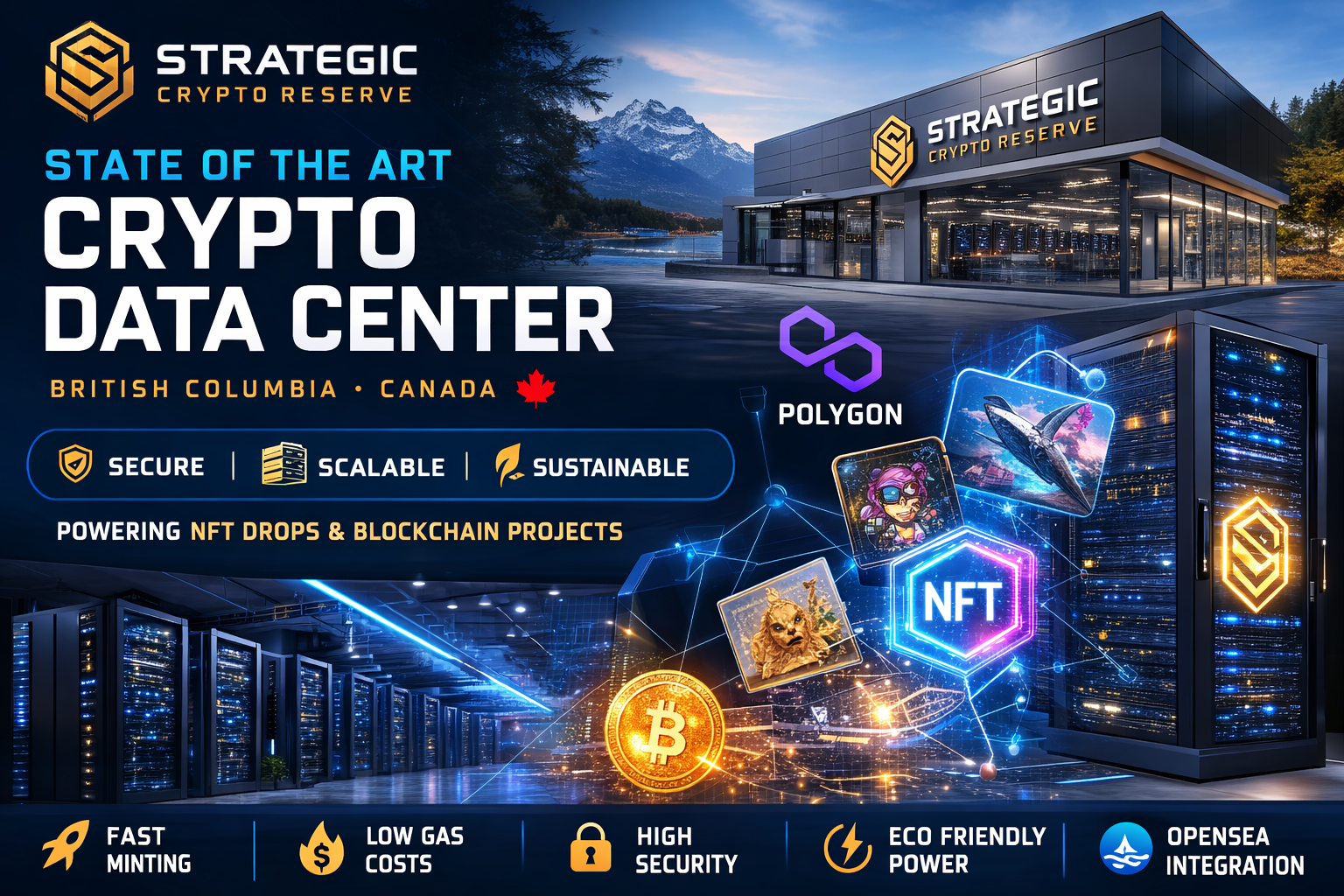
Strategic Crypto Reserve operates its own crypto data center in the Comox Valley, British Columbia to power its NFT drops, blockchain media projects, and on-chain infrastructure. What we have learned from designing and operating that facility is the backbone of this guide.

Small-scale crypto data center overview diagram — server racks, power distribution, cooling, and networking in a blockchain infrastructure facility

Step One: Planning Your Space and Electrical Capacity

Planning a small-scale crypto data center — floor plan, electrical panel audit, and airflow design for blockchain mining infrastructure

Every decision in a small-scale crypto data center build flows from two foundational constraints: available space and available power. No amount of hardware enthusiasm can override physics. Understand these two limits before purchasing anything else.

For space, a functional small-scale crypto data center can operate in as little as 50 square feet — a single-car garage bay, a large utility room, or a dedicated outbuilding. The space must be structurally capable of supporting rack weight (a loaded 42U server rack can exceed 1,000 lbs), and it must allow controlled, directed airflow. Completely sealed rooms with no exterior ventilation are a significant cooling engineering challenge and should be avoided unless purpose-built HVAC is part of the plan from day one.

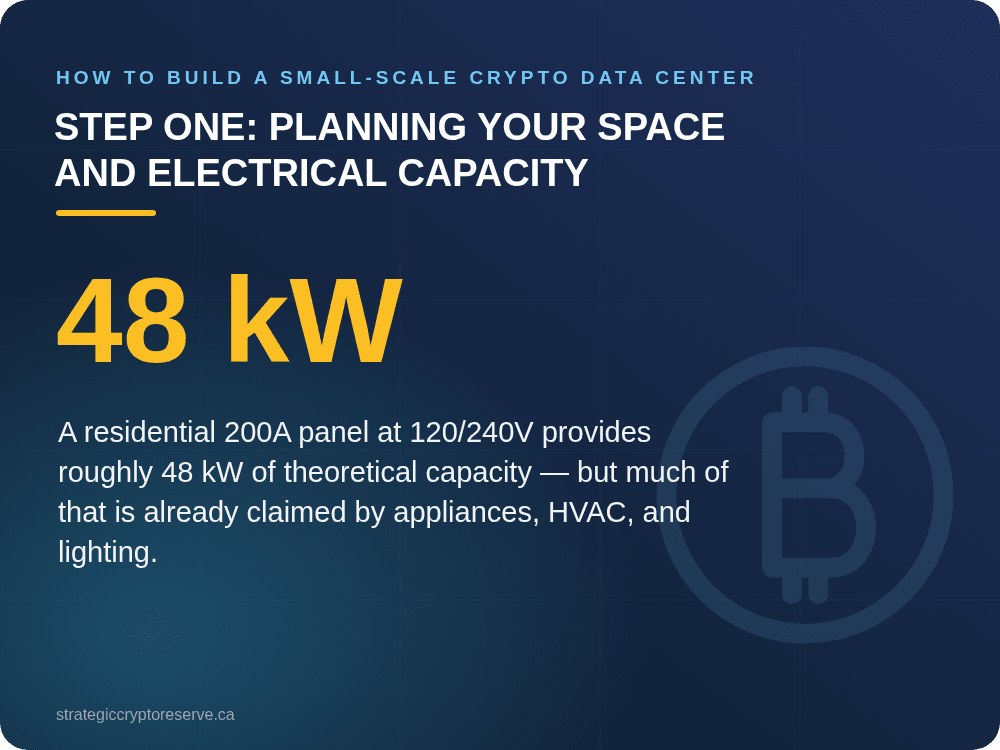
For power, start with an electrical panel audit. A residential 200A panel at 120/240V provides roughly 48 kW of theoretical capacity — but much of that is already claimed by appliances, HVAC, and lighting. A 10 kW computing installation needs a dedicated 50A/240V circuit as a minimum, with a 20% safety overhead above the hardware's rated draw. Anything above 20 kW should involve a licensed electrician and potentially a consultation with your utility provider about upgrading your service entrance.

British Columbia Advantage: In certain BC utility zones, industrial electricity rates are significantly lower than residential rates — a difference that can meaningfully change the economics of a small-scale crypto data center. Our team operates Bitcoin mining infrastructure on Vancouver Island in part because of the favourable power tariff and climate conditions available in the Pacific Northwest. If you are building in BC, research BC Hydro's commercial and small general service tariffs before committing to a residential-zoned space.

Choosing the Right Hardware for Your Small-Scale Crypto Data Center

The hardware category you select determines your use case, power draw, cooling requirements, noise profile, and revenue potential. Most small-scale crypto data centers are built around one of four hardware types:

ASIC Miners

Application-specific integrated circuits optimised for Bitcoin and other SHA-256 proof-of-work blockchains. Extremely high hashrate per unit, high power draw (3–5 kW each), and purpose-built for continuous operation. The industry standard for serious Bitcoin mining infrastructure.

Bitcoin / SHA-256

GPU Rigs

Multi-GPU computing systems capable of mining a wide range of proof-of-work cryptocurrencies. More flexible than ASICs but less efficient per watt on any specific algorithm. Well-suited for operators who want to rotate between blockchain networks or mine newer coins.

Altcoin / Flexible

Validation Nodes

Rackmount servers running full blockchain nodes for proof-of-stake networks like Ethereum, Polygon, or Solana. Lower power draw than mining hardware, but critical for network health, RPC endpoint hosting, and NFT platform infrastructure.

PoS / Node Hosting

Storage & NFT Infrastructure

High-capacity storage servers for on-chain data archival, IPFS hosting for NFT metadata, and decentralized application backends. Essential for any data center supporting an NFT ecosystem. Strategic Crypto Reserve uses storage infrastructure to serve its Polygon and Ethereum collections.

NFT / IPFS / dApps

Network Hardware: In addition to computing hardware, every small-scale crypto data center needs a managed Layer 2 or Layer 3 network switch providing at least 1 Gbps per port, a router with stateful firewall capability, structured patch cabling, and a high-speed internet connection with symmetrical upload and download speeds. For blockchain node operators running public RPC endpoints, consistent upload bandwidth is as important as download capacity. Budget for at least 100 Mbps symmetrical, metered or unmetered.

How to Build a Small-Scale Crypto Data Center: The Six-Step Process

With your space confirmed, electrical capacity verified, and hardware selected, you are ready to build. Follow these six steps in the order listed — each step depends on the previous one being complete. Skipping steps or reversing the order is a reliable way to cause expensive hardware failures or operational downtime early in the facility's life.

  1. Electrical Upgrade and Circuit Installation: Engage a licensed electrician to install dedicated circuits for your computing loads, cooling system, and management infrastructure — each on a separate breaker. Never run mining hardware and an air conditioning compressor on the same circuit without explicit load calculation approval from your electrician. Install smart PDUs (Power Distribution Units) in every rack to provide real-time per-outlet wattage monitoring and the ability to remotely power-cycle individual machines. This is the single most valuable operational tool in a small-scale crypto data center.
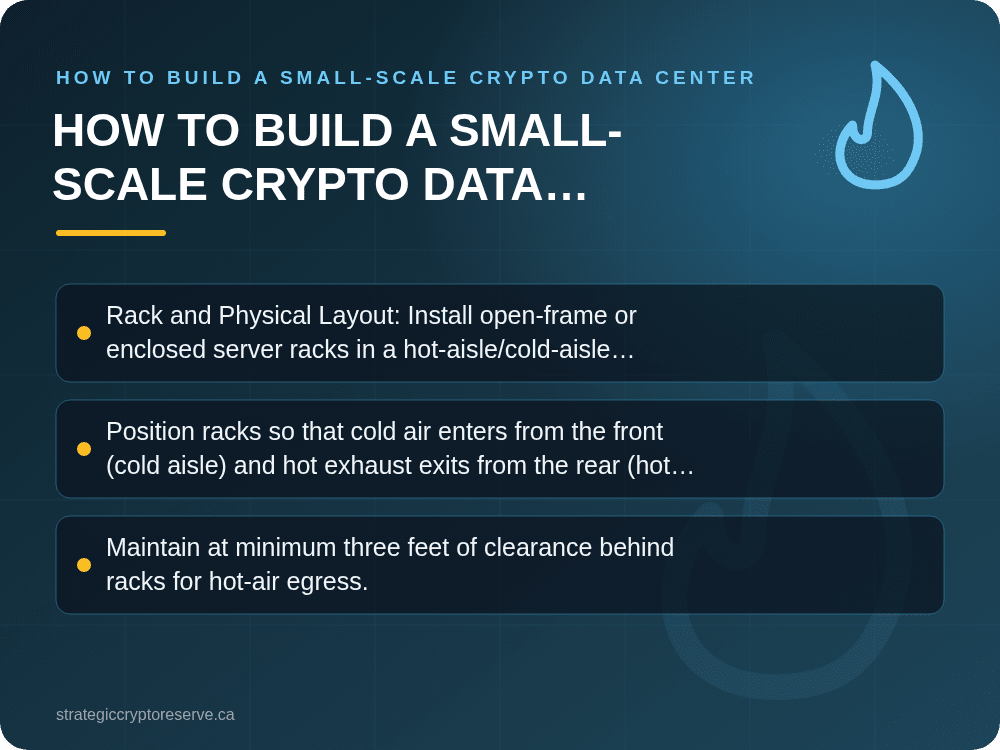
  2. Rack and Physical Layout: Install open-frame or enclosed server racks in a hot-aisle/cold-aisle arrangement. Position racks so that cold air enters from the front (cold aisle) and hot exhaust exits from the rear (hot aisle). Maintain at minimum three feet of clearance behind racks for hot-air egress. Fill every empty rack unit with a blanking panel — open rack units allow hot exhaust to recirculate into the cold aisle, significantly degrading cooling efficiency. Bolt floor-standing racks to the floor or wall for physical stability.
  3. Cooling System Deployment: Install your air conditioning or precision cooling unit, sized for at least 1.2× your hardware's total thermal output in BTUs per hour. Position the unit's cold-air supply to face the front of your server racks. Connect the cooling unit to a dedicated electrical circuit. Deploy temperature sensors at three minimum points: cold aisle inlet (target below 27°C / 80°F), hot aisle exhaust, and room ambient. Connect all sensors to your monitoring system on day one — thermal events that go undetected for hours can permanently damage hardware.
  4. Network Infrastructure Configuration: Mount your managed switch in a rack unit physically separated from your densest computing hardware. Run patch cables from each server, miner, or node to a dedicated switch port — avoid daisy-chaining patch cables between machines. Configure VLANs to segment blockchain traffic from your out-of-band management network. Your management VLAN — the one you use to access BMC/IPMI interfaces, hardware dashboards, and PDU controls — should carry the strictest access controls of any network segment in the facility.
  5. UPS and Power Protection: Install a UPS (Uninterruptible Power Supply) rated for at minimum 5–10 minutes of runtime at full load for your most critical systems. Connect your monitoring hardware, network switch, and router to the UPS first — these consume very little power but allow you to gracefully shut down heavier loads during a mains failure rather than experiencing a hard crash. For ASIC miners and GPU rigs, a UPS provides surge protection and brief ride-through during momentary power interruptions that would otherwise reset mining progress.
  6. Sequential Hardware Deployment, Testing, and Monitoring: Power on computing hardware units one at a time, not all simultaneously — simultaneous startup causes inrush current events that can trip breakers. After each unit powers on, verify its management interface is accessible, its temperature sensors are reading correctly, and its blockchain software is connecting to the network. Monitor inlet temperature, power draw, and network connectivity continuously for the first 72 hours before considering the installation stable. Document your physical layout, IP address assignments, serial numbers, and circuit mapping in a permanent log — this record is invaluable during troubleshooting.
Step-by-step crypto data center build — rack installation, hot-aisle cold-aisle cooling layout, and network configuration for small-scale blockchain infrastructure

Power and Cooling: The Two Variables That Determine Facility Success

Crypto data center power and cooling — PDUs, UPS systems, HVAC units, and hot-aisle cold-aisle thermal management for blockchain mining hardware

In any computing environment, hardware failure has two dominant causes: electrical events (surges, under-voltage, and power loss) and thermal events (overheating). A properly built small-scale crypto data center systematically eliminates both risks through engineered redundancy. In practice, this means you are designing against failure modes, not just optimal conditions.

On the power side, your objective is clean, stable, and protected power reaching every hardware unit. This requires proper panel grounding, surge protection at the panel and PDU levels, UPS ride-through for critical systems, and smart PDUs that provide real-time per-outlet monitoring and remote switching. Smart PDUs are particularly valuable for ASIC miners, which occasionally require a hard power cycle to recover from a hung state — a task that is trivial to perform remotely and requires a physical site visit without them.

On the cooling side, your objective is maintaining inlet air temperature below 27°C (80°F) for every hardware unit, at all times, including during peak summer ambient temperatures, peak computing load, and partial HVAC failure. Redundancy in cooling — a second standalone AC unit in standby, or a large-capacity portable unit stored on-site ready to deploy — is strongly recommended for any installation generating meaningful revenue.

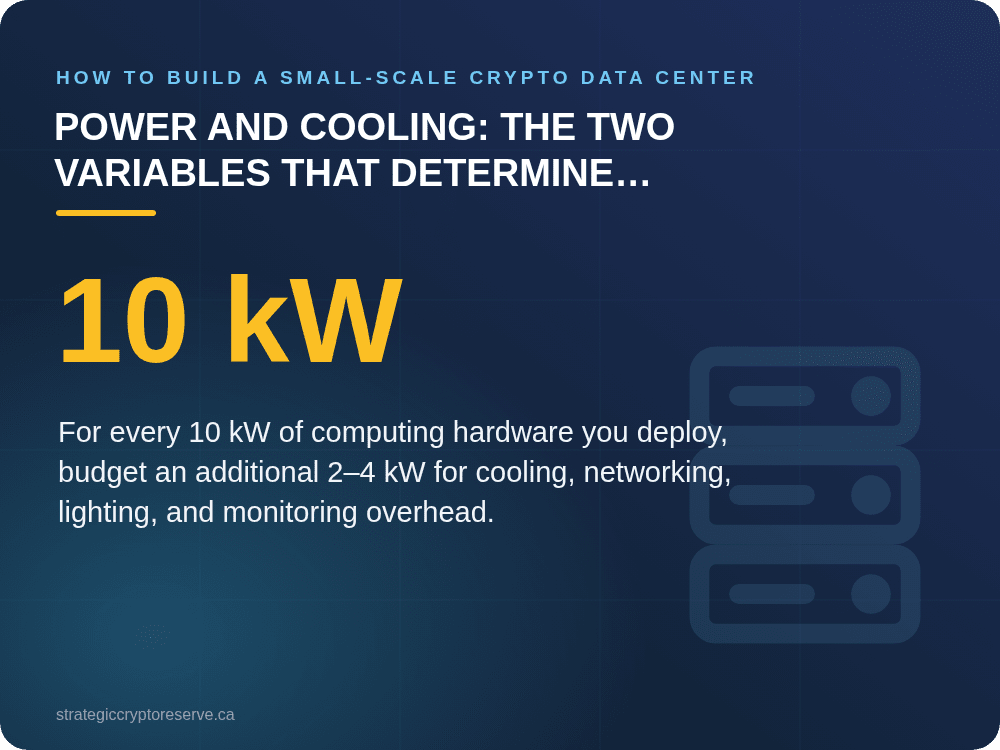
Power Usage Effectiveness (PUE) is the data center industry standard for energy efficiency. It is the ratio of total facility power draw to IT equipment power draw. A PUE of 1.0 is theoretically perfect; 1.2–1.4 is considered good for a small facility. For every 10 kW of computing hardware you deploy, budget an additional 2–4 kW for cooling, networking, lighting, and monitoring overhead. Accurate PUE calculation helps you model operational costs realistically before committing to a facility design.

Small-Scale Crypto Data Center Cost Breakdown (Canada, 2026)

The following table reflects typical infrastructure build costs for a 5–10 kW small-scale crypto data center in Canada. Computing hardware is excluded — this covers the facility and supporting infrastructure layer only.

Infrastructure Component Description Estimated Cost (CAD)
Server Racks (2×) 42U open-frame or enclosed racks with mounting hardware, blanking panels, and cable management $800 – $2,500
Smart PDUs (2×) Managed per-outlet PDUs with remote switching and real-time wattage monitoring per port $600 – $2,000
UPS Systems 1,500–3,000 VA UPS for critical systems; additional units for computing load protection $800 – $3,000
Electrical Upgrades Dedicated circuit installation, panel upgrades if required, licensed electrician labour $1,500 – $6,000
Cooling System Precision or split-system air conditioner rated for continuous duty; 12,000–24,000 BTU/h $2,000 – $8,000
Network Equipment Managed 24-port switch, firewall router, patch cables, and structured cabling $600 – $2,500
Monitoring and Sensors Temperature/humidity sensors, remote KVM, IP power strips, and monitoring software $400 – $1,500
Physical Security Access-controlled door lock, security camera with off-site recording, rack locks $400 – $1,500
Total Infrastructure Build (5–10 kW) Excluding computing hardware; small-scale production facility $7,100 – $27,000

Estimates reflect 2026 Canadian market pricing. Actual costs vary by region, electrical infrastructure complexity, and hardware specifications. Engage licensed trades professionals for electrical and mechanical work — do not attempt to self-install high-draw circuits.

Physical and Digital Security for Your Crypto Data Center

Physical and digital security are equally critical in a small-scale crypto data center. Your hardware represents significant capital value. The blockchain nodes and wallets that may operate within the facility represent potentially greater value still. A compromised data center is not just a hardware loss — it is a potential total loss of digital assets held in hot wallets or signing environments connected to that infrastructure.

  1. Physical Access Control: Install a PIN-controlled or keyed access mechanism on the data center room door. Limit physical access to the minimum necessary individuals. A security camera with off-site cloud recording provides both deterrence and evidence capture. Rack-level locks add a secondary physical barrier for the most sensitive hardware.
  2. Network Segmentation and Firewall Rules: Never place hot wallets, signing keys, or management interfaces on the same network VLAN as your public-facing blockchain nodes. Configure your firewall to deny all unsolicited inbound connections by default, then whitelist only the specific ports required by each blockchain protocol. Rate-limit inbound peer-to-peer connections to protect against DDoS traffic targeting public node endpoints.
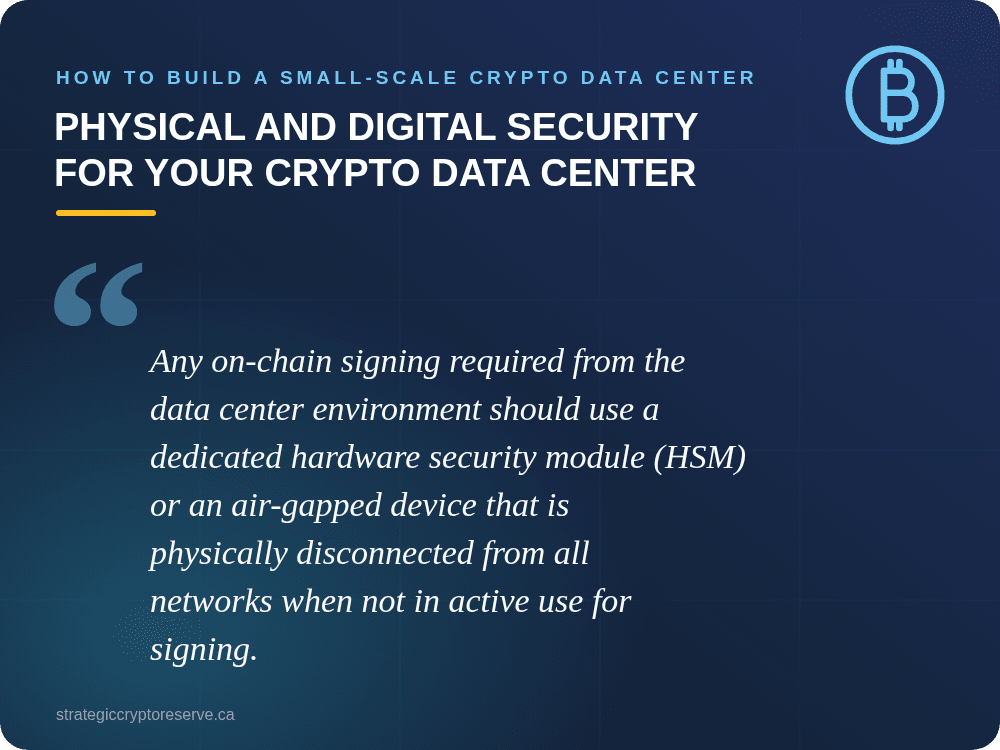
  3. Private Key and Seed Phrase Isolation: Never store private keys or seed phrases on hardware that is connected to your mining or node network. Any on-chain signing required from the data center environment should use a dedicated hardware security module (HSM) or an air-gapped device that is physically disconnected from all networks when not in active use for signing.
  4. Environmental Hazard Detection: Install water leak detectors near any HVAC condensate drainage lines or beneath any raised flooring. Deploy smoke detectors designed for high-airflow environments. Ensure your fire suppression plan is appropriate for electronic equipment — clean agent (FM-200 or equivalent) systems are preferred over water-based sprinklers in any space containing computing hardware of value.
  5. Remote Monitoring and Out-of-Band Management: Configure remote access to your hardware management interfaces (IPMI/BMC on servers, web dashboards on ASIC miners) so you can diagnose and respond to issues without requiring a physical site visit. Keep your out-of-band management network on a separate cellular or secondary broadband connection so it remains accessible even if your primary internet link goes down.
Crypto data center security best practices — physical access control, network segmentation, firewall, and environmental monitoring for blockchain infrastructure

Crypto Data Center Infrastructure in British Columbia: The SCR Approach

British Columbia offers some of the most favourable conditions in Canada for operating a small-scale crypto data center. The province's cooler average temperatures reduce cooling overhead — particularly during the six-to-eight months of the year when ambient conditions are below 15°C and free air cooling or economizer modes can dramatically reduce HVAC energy consumption. Certain utility zones offer industrial electricity tariffs that are materially cheaper than residential rates, changing the profitability calculus for continuous mining and node-hosting operations.

Strategic Crypto Reserve has built its crypto data center infrastructure in the Comox Valley, BC to serve the technical demands of its NFT drop pipeline, Polygon and Ethereum node operations, and blockchain media projects. The facility decisions we have made — from rack layout to cooling unit sizing to PDU selection — reflect hard-won operational experience rather than theoretical design, and that experience is the foundation of this guide.

Our team also operates experimental Bitcoin mining infrastructure on Vancouver Island, which has given us firsthand exposure to the power sourcing options, cooling challenges, and hardware logistics most relevant to small-scale crypto data center builders in the Pacific Northwest. The lessons from that operation — particularly around electrical provisioning timelines and cooling redundancy — directly inform the recommendations in this guide.

If you are in the early stages of planning your facility and still building your foundational understanding of the technology, our plain-language explainer on what a blockchain is and how it operates is the right starting point before committing capital to physical infrastructure designed to serve it.

Strategic Crypto Reserve blockchain infrastructure in British Columbia — small-scale crypto data center supporting NFT drops and node operations

Strategic Crypto Reserve Infrastructure Ecosystem

Crypto Data Center BC

Our Comox Valley facility supports NFT drops, blockchain node hosting, and on-chain infrastructure for the Strategic Crypto Reserve digital asset ecosystem on Polygon and Ethereum.

Vancouver Island Bitcoin Mining

Experimental Bitcoin mining operations on Vancouver Island provide firsthand experience with small-scale crypto infrastructure in BC — informing the practical guidance in this build guide.

Frequently Asked Questions: How to Build a Small-Scale Crypto Data Center

1. What equipment do I need to build a small-scale crypto data center?

A small-scale crypto data center requires computing hardware (ASIC miners, GPU rigs, or server nodes depending on your use case), server racks, smart Power Distribution Units (PDUs) with per-outlet monitoring, a UPS for power protection, a managed network switch and router, a commercial-grade cooling system, and temperature sensors connected to automated alerting. The exact specifications scale with your planned power draw and operational objectives. Strategic Crypto Reserve's crypto data center infrastructure in British Columbia provides a real-world reference point for how these components integrate into a professional facility designed for continuous unattended operation.

2. How much does it cost to build a small-scale crypto data center?

The infrastructure build cost — excluding computing hardware — for a 5–10 kW small-scale crypto data center typically ranges from $7,100 to $27,000 CAD in 2026. The major cost categories are: electrical upgrades and circuit installation ($1,500–$6,000), cooling system ($2,000–$8,000), server racks and PDUs ($1,400–$4,500), UPS protection ($800–$3,000), and managed network equipment ($600–$2,500). Monthly operating costs for electricity, internet connectivity, and maintenance add $500–$2,000 or more depending on local utility rates. Operators with access to competitive industrial electricity tariffs — as available in certain BC utility zones where our Vancouver Island Bitcoin mining operation benefits — can significantly improve their operating cost profile.

3. What power capacity do I need for a small crypto data center?

Power planning is the most critical pre-build step. Your total power draw equals the sum of all hardware rated wattage plus a 20% safety overhead. A single modern ASIC miner draws 3–5 kW continuously; ten units together require 30–50 kW. Even a modest 5 kW computing installation requires a dedicated 240V/30A circuit — more than most residential sub-panels have available without a panel upgrade. Engage a licensed electrician to audit your panel before ordering any hardware. Smart PDUs that display real-time per-outlet wattage are indispensable for ongoing power management and hardware health monitoring once the facility is live.

4. How do I cool a small-scale crypto data center effectively?

Effective cooling is built on two things: proper physical layout and adequate HVAC capacity. Use a hot-aisle/cold-aisle rack arrangement so cold air enters the rack front and hot exhaust exits the rear into a contained space where your AC removes it. Use blanking panels in every empty rack unit to prevent recirculation. Size your cooling unit for at least 1.2× your hardware's total thermal output. Target an inlet air temperature below 27°C (80°F) at all times — including during summer peak ambient temperatures. Deploy temperature sensors at rack inlet, rack exhaust, and room ambient, all connected to automated alerting. A cooling failure detected within minutes is an inconvenience; one detected after hours of runtime at 45°C inlet temperatures is a catastrophic hardware loss.

5. Can I build a small crypto data center at home or in a residential property?

It is possible, but significant due diligence is required before proceeding. A detached garage, basement, or outbuilding is the most practical location. Key factors to assess: electrical panel capacity and local building code compliance for high-draw circuits; zoning restrictions on commercial-grade equipment in residential areas; noise bylaws — ASIC miners and commercial cooling systems are loud, continuous noise sources; ISP terms of service regarding commercial bandwidth usage; and homeowner's insurance implications for high-draw electrical equipment. Many serious operators prefer light industrial or commercial-zoned spaces for precisely these reasons. Before making any location or infrastructure decision, it also helps to fully understand the blockchain technology you are building for — our guide on what a blockchain is and how it works covers the foundational concepts that should inform every infrastructure decision you make.