Infrastructure Map · Updated June 2026

Strategic Crypto Reserve Infrastructure: What's Real, and What's Concept

Strategic Crypto Reserve builds across a spectrum, from a real, modest Bitcoin mining setup on Vancouver Island to CryptoFarms PantingCreekside, an explicitly fictional "multi-zillion dollar" concept facility used for entertainment and brand storytelling. This page is the map: what's genuinely operating today, what's a planning guide for the future, and what's parody — so nobody has to guess which is which.


Strategic Crypto Reserve infrastructure overview

Digital Infrastructure

Real Mining · Concept Vision · Honest Labels

What's Actually Real Today

Strategic Crypto Reserve is, by design, a parody utility token project — the SCR token and its NFT redemption mechanic are openly disclosed as entertainment, not financial advice, not a security, and not a promise of returns. Most "crypto infrastructure" claims on the internet exaggerate; this site tries to do the opposite by separating what's genuinely real from what's conceptual, clearly and on purpose.

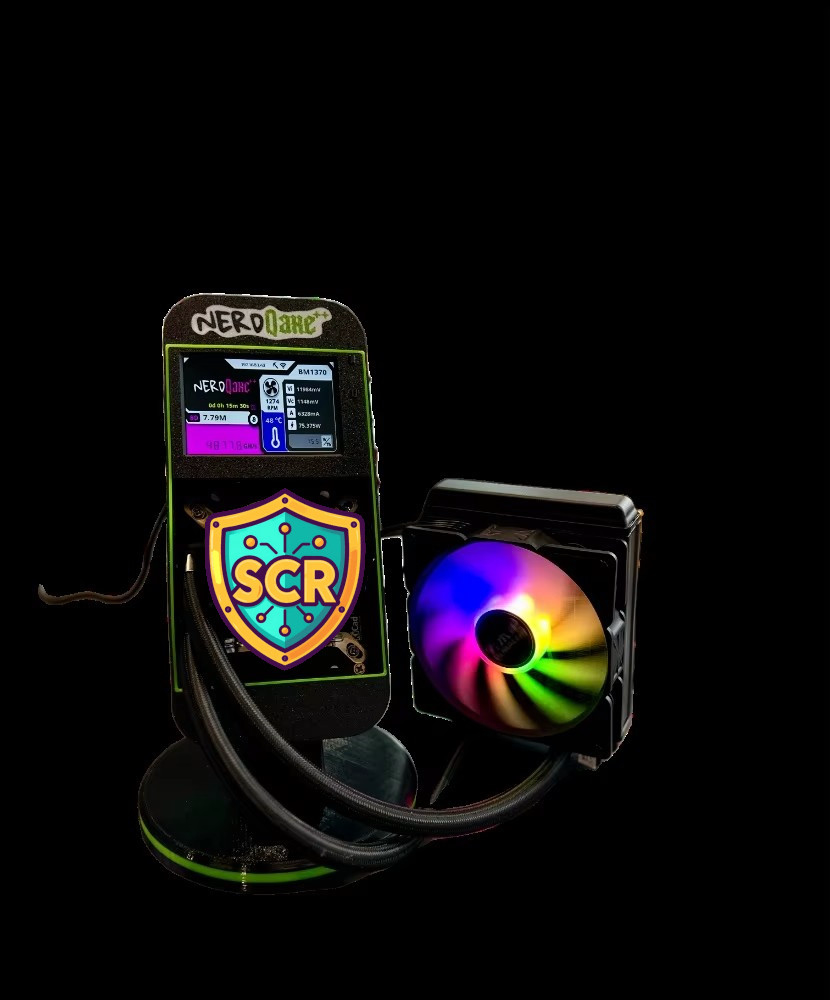
The one piece of infrastructure that is unambiguously real is a small Bitcoin mining setup in the Comox Valley on Vancouver Island, British Columbia — a single-digit number of ASIC units, run by one person, drawing power from a standard BC Hydro connection. It's documented in full, hardware and power numbers included, on the Bitcoin Mining Vancouver Island page, and it's the anchor for the broader Crypto Data Center hub, which also includes build guides, cost breakdowns, and BC Hydro power strategy for anyone planning a similar setup.

Everything else under the infrastructure umbrella sits somewhere between "in development" and "deliberate fiction," and this page exists specifically to label which is which — rather than letting visitors guess, or worse, assume the biggest and most dramatic claim is automatically the real one.

It's worth being explicit about why a small, modest mining setup gets this much documentation rather than a quick mention. Verifiability is the whole point — a single-digit ASIC count with a named location, a named utility provider, and a linked technical write-up is something a skeptical reader can actually evaluate, in a way that a vague "industrial-scale facility" claim never can be. Scale isn't the credibility signal here; specificity is.

Real Bitcoin mining hardware operated by Strategic Crypto Reserve

Three Tiers of Infrastructure

Rather than blur real hardware together with future plans and brand fiction, Strategic Crypto Reserve keeps three tiers clearly separate. Here's the honest breakdown.

Real: Bitcoin Mining & Data Center

A small, currently operating ASIC mining setup in the Comox Valley, plus genuine technical guides on building and powering similar infrastructure under BC Hydro's rate schedules.

Operating Today

Planning: AI Data Center

A roadmap-stage concept exploring how AI compute infrastructure could share space and cooling design with crypto mining hardware. Not a built facility — a direction the project is exploring.

In Development

Parody: CryptoFarms PantingCreekside

An explicitly fictional "multi-zillion dollar" mega-facility used for entertainment and worldbuilding — the project's own footer text calls out that a zillion dollars obviously doesn't exist.

Entertainment Only

Why label it this way at all? Because a project that mixes genuine infrastructure with parody content owes its readers a clear way to tell them apart. Anyone landing on this page looking for real Bitcoin mining specs should leave knowing exactly where to find them — and anyone enjoying the CryptoFarms PantingCreekside concept should know it's meant as fun, not a claim.

This three-tier structure isn't just disclaimer language — it's how the site is actually organized. The "Real" tier links to pages with concrete numbers: hash rates, kilowatt figures, BC Hydro rate schedules. The "Planning" tier links to roadmap and direction content without invented specifications. The "Parody" tier is written with the same exaggerated tone as the project's parody NFT drops, on purpose, so the register itself signals what it is.

Tier Status What You'll Find There Where to Go
Real Operating today Actual hardware, hash rate, BC Hydro power numbers, build and cost guides Crypto Data Center hub
Planning In development Roadmap direction for AI compute infrastructure, no built facility yet AI Data Center page
Parody Entertainment only Fictional mega-facility, intentionally exaggerated, openly disclosed as such CryptoFarms PantingCreekside

How to Evaluate Infrastructure Claims in Any Crypto Project

The three-tier labeling above isn't just about this project — it's a useful lens for reading any crypto project's infrastructure claims, including ones you're evaluating for the first time. Crypto media is full of "data center," "mining farm," and "AI compute" language attached to projects where none of it can actually be verified. Knowing what to look for is a basic piece of due diligence, the same way checking a company's filings is for traditional investing.

A few patterns are worth watching for. Vague or absent location data is one: a project that talks about "global data center capacity" without naming a single region, utility provider, or jurisdiction has nothing you can independently verify. Round, marketing-friendly numbers with no underlying source are another — "10,000 ASIC miners" or "50 megawatts" sound impressive, but mean little without a named facility, a utility account, or third-party confirmation behind them. The most important pattern, though, is whether a project distinguishes between what's built and what's planned. Roadmap items presented with the same confidence as operating infrastructure is one of the more common ways crypto marketing blurs reality.

Signal Common in Marketing-Only Claims Common in Verifiable Infrastructure
Location Never named, or vague ("global," "multiple sites") A named region or facility, even an approximate one
Hardware Round numbers with no model names Specific ASIC models, unit counts, hash rate
Power Source No reference to an actual utility or rate schedule Named utility and rate class (e.g., BC Hydro RS 1200)
Token Link Infrastructure value used to justify token price Infrastructure described independent of token mechanics
Build Status Roadmap items described as already operating Explicit "live" vs. "in development" vs. "concept" labels

This is also a self-check. Every row above is a test we apply to ourselves on this page: the Comox Valley mining setup is named, dated, and documented with real hardware and BC Hydro rate context; the AI Data Center is explicitly labeled as roadmap-stage; and CryptoFarms PantingCreekside is labeled parody rather than dressed up as something it isn't.

This kind of evaluation framework matters most when real money is involved. If you're researching strategic crypto reserve projects more broadly — how they're typically funded, what "reserve" actually means in a token context, and which assets tend to make up these structures — the guide to investing in a strategic crypto reserve and the overview of the strategic crypto reserve trend are good starting points, alongside the project whitepaper for SCR-specific mechanics.

Where AI Fits Into the Infrastructure Plan

Crypto mining and AI compute share more infrastructure overlap than most people expect — both demand dense, continuous power draw and serious cooling design, and both benefit from blockchain-based monitoring for transparent, auditable uptime and energy use. That overlap is the logic behind exploring AI data center capacity as a natural extension of the same physical groundwork the mining operation already requires.

This is forward-looking, roadmap-stage content rather than a description of built infrastructure — the project's AI Data Center page goes into more detail on the vision. As with everything on this overview, the honest answer to "is it built yet?" is no — it's a direction, not a deployed facility.

The practical reasoning behind the overlap is straightforward: both ASIC miners and GPU clusters generate substantial waste heat in compact form factors, both need reliable uninterrupted power, and both benefit from the same kind of blockchain-anchored uptime logging. None of that makes building an AI data center trivial — it's a different hardware category with its own cost structure — but it does mean the lessons from the real mining setup (power planning, cooling overhead, BC Hydro rate strategy) carry forward into how that future direction gets evaluated.

CryptoFarms PantingCreekside: The Parody Concept Facility

CryptoFarms PantingCreekside is the project's biggest swing, and it's deliberately a fictional one: a "multi-zillion dollar" industrial-scale mining and AI campus described with the same playful exaggeration as the project's NFT parody drops. It's not hidden — the site's own footer text addresses it directly, noting that a zillion dollars obviously doesn't exist, and pointing skeptical readers toward the whitepaper, which describes this kind of content as fictional.

Treat PantingCreekside the way you'd treat any piece of crypto-culture satire: entertaining brand worldbuilding, not a property listing. If you came here looking for real numbers — hardware, power draw, BC Hydro rates — the Crypto Data Center hub is where those actually live.

This kind of exaggerated, self-aware fiction isn't unique to PantingCreekside — it runs through other parts of the project too, including the parody political and culture-war NFT content over on Meme Wars. The throughline is consistent: when Strategic Crypto Reserve is being funny, it tries to be obviously funny.

Infrastructure Roadmap: What Comes Next

Laid out as a timeline, the three tiers above turn into four phases — two complete, one in progress, and one ongoing by design rather than something that ever "finishes."

Phase 1: Hobbyist Mining Setup

The Comox Valley Bitcoin mining operation — a small ASIC setup on a standard BC Hydro connection. Live and documented today.

Complete

Phase 2: Education & Tooling Cluster

The build guide, 300-unit cost breakdown, power strategy guide, and the BC Hydro-calibrated sizing calculator — published and maintained.

Complete

Phase 3: AI Compute Exploration

Evaluating whether GPU-based AI compute can share power and cooling design with the existing mining setup. Roadmap-stage, no facility built.

In Progress

Phase 4: CryptoFarms Worldbuilding

The parody PantingCreekside narrative continues alongside the real cluster, openly labeled as entertainment rather than a property claim.

Ongoing

Progress through these phases doesn't change how the SCR token works — moving from Phase 1 to Phase 3, for instance, doesn't create any new claim on infrastructure revenue for token holders, since the token and the physical infrastructure remain separate by design. The whitepaper is the canonical source for SCR mechanics regardless of where the infrastructure side of the project stands at any given time.

How Infrastructure Connects to $SCR and NFTs

Whether real, planned, or parody, none of Strategic Crypto Reserve's infrastructure is financially linked to the SCR token. SCR is a parody utility token used for NFT redemption — holding it does not grant any claim on mining proceeds, AI compute revenue, or anything tied to PantingCreekside. The two sides of the project are connected by ownership and branding, not by a profit-sharing mechanism.

If you're here for the NFT and token side of the project rather than the infrastructure side, the whitepaper is the right starting point, and the current NFT collections are a good next stop.

And if you're not sure which page on this site actually answers your question, this overview is a reasonable place to start every time — it links out to the real infrastructure, the in-development plans, and the parody content, with nothing presented as something it isn't.

That same approach extends to how the site is organized more broadly: NFT and token pages are written and labeled distinctly from infrastructure pages, infrastructure pages distinguish real hardware from roadmap items, and parody content is written in a deliberately different, more exaggerated voice than everything else. None of that is accidental — it's the same evaluation framework outlined above, applied consistently across the whole project rather than just this one page.

How to Evaluate Crypto Infrastructure Claims: A Practical Checklist

The three-tier labeling above isn't unique to this project — it's a useful lens for reading any crypto project's infrastructure claims. Here's the five-step framework, with specific examples from Strategic Crypto Reserve showing how it applies in practice.

Step 1: Named Location

Real infrastructure names a specific region and utility provider — not just "global operations." SCR names the Comox Valley on Vancouver Island, served by BC Hydro, with a linked page documenting the setup in detail.

See the Comox Valley operation →

Step 2: Specific Hardware

Verifiable infrastructure cites ASIC models, unit counts, and hash rate. SCR's real operation runs roughly 4.8 TH/s from a small number of consumer- and prosumer-grade units — not a round "10,000 miners" marketing figure.

Hardware detail →

Step 3: Named Power Source

A named utility and rate schedule (BC Hydro RS 1100) is a far stronger signal than "renewable energy" without a source. Check whether the numbers in that rate schedule are consistent with the claimed capacity.

Power grid strategy →

Step 4: Operating vs. Roadmap

Any project presenting roadmap items with the same confidence as live hardware is blurring an important line. SCR uses explicit "Operating Today / In Development / Entertainment Only" labels on every infrastructure page.

Key Signal

Step 5: Token-Infrastructure Link

Marketing-only projects use infrastructure to imply token value without defining a mechanism. SCR explicitly separates the two: the SCR token is a parody utility token with no claim on mining proceeds or infrastructure revenue.

How SCR tokens work →

Apply this checklist to Strategic Crypto Reserve itself. Named location: Comox Valley, Vancouver Island. Named utility: BC Hydro, RS 1100 schedule. Hardware: small-digit ASIC count at approximately 4.8 TH/s. Token separation: documented in the whitepaper and on every infrastructure page. Roadmap labeling: this overview page. If something doesn't check out — hold us to the same standard.

Frequently Asked Questions: Infrastructure

1. What counts as Strategic Crypto Reserve's infrastructure?

Three things: a real, small-scale Bitcoin mining operation in the Comox Valley on Vancouver Island; a set of educational guides on building and powering crypto data centers in BC; and CryptoFarms PantingCreekside, an explicitly fictional, parody-scale concept facility used for entertainment and worldbuilding within the project.

2. Is CryptoFarms PantingCreekside a real facility?

No. CryptoFarms PantingCreekside is openly described as a parody, fictional concept — the project's own footer text calls it a "multi-zillion dollar" facility and notes that obviously a zillion dollars doesn't exist. It exists for entertainment and brand storytelling, not as a claim about real infrastructure.

3. What's the difference between this page and the Crypto Data Center hub?

The Crypto Data Center hub is the deep, technical cluster covering the real Bitcoin mining setup, build guides, cost breakdowns, power strategy, and a sizing calculator. This Infrastructure Overview page is the wider map — it shows how that real cluster relates to the separate AI Data Center concept and the parody CryptoFarms PantingCreekside facility.

4. Does any of this infrastructure generate returns for $SCR token holders?

No. None of Strategic Crypto Reserve's infrastructure — real or conceptual — is financially linked to the SCR token. SCR is a parody utility token used for NFT redemption, with no claim on mining proceeds or infrastructure revenue of any kind.

5. Is the AI Data Center already operating?

No. The AI Data Center is roadmap-stage content — a direction Strategic Crypto Reserve is exploring because of the infrastructure overlap between GPU compute and the existing Bitcoin mining setup, not a built or operating facility. The AI Data Center page tracks the current state of that plan.