Interactive Tool · Updated June 2026

Crypto Data Center Calculator: BC Infrastructure Sizing, CapEx & Power Cost Estimator

The crypto data center calculator below is the only BC-calibrated interactive sizing tool available for blockchain infrastructure operators in British Columbia. Enter your planned grid allocation, BC Hydro rate, and cooling configuration to instantly model your facility's maximum ASIC compute capacity, upfront CapEx, and daily electricity operating cost — no spreadsheet or consultant required. The calculator is free to use and downloadable as a standalone HTML widget for offline use and website embedding.


Use the Calculator
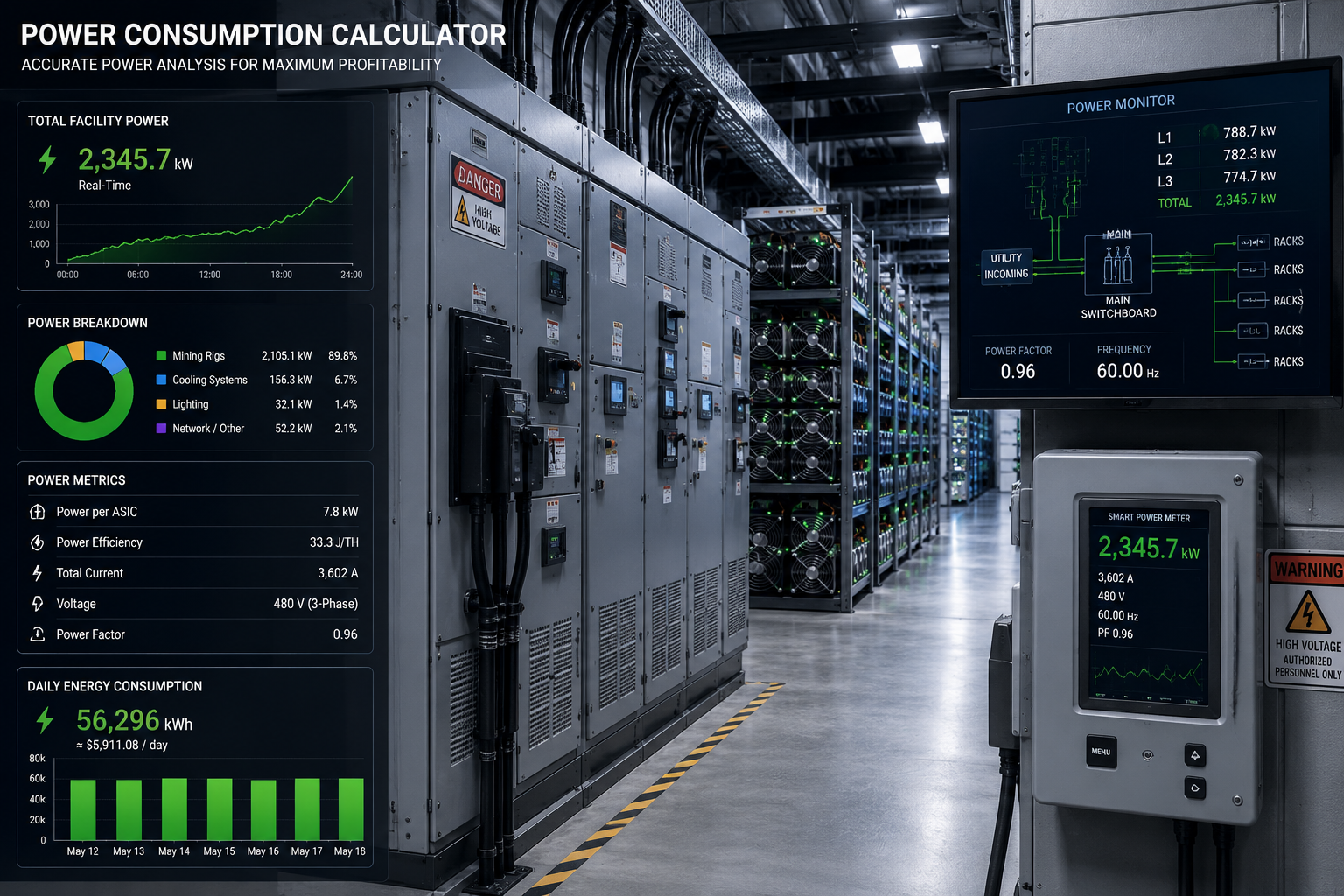
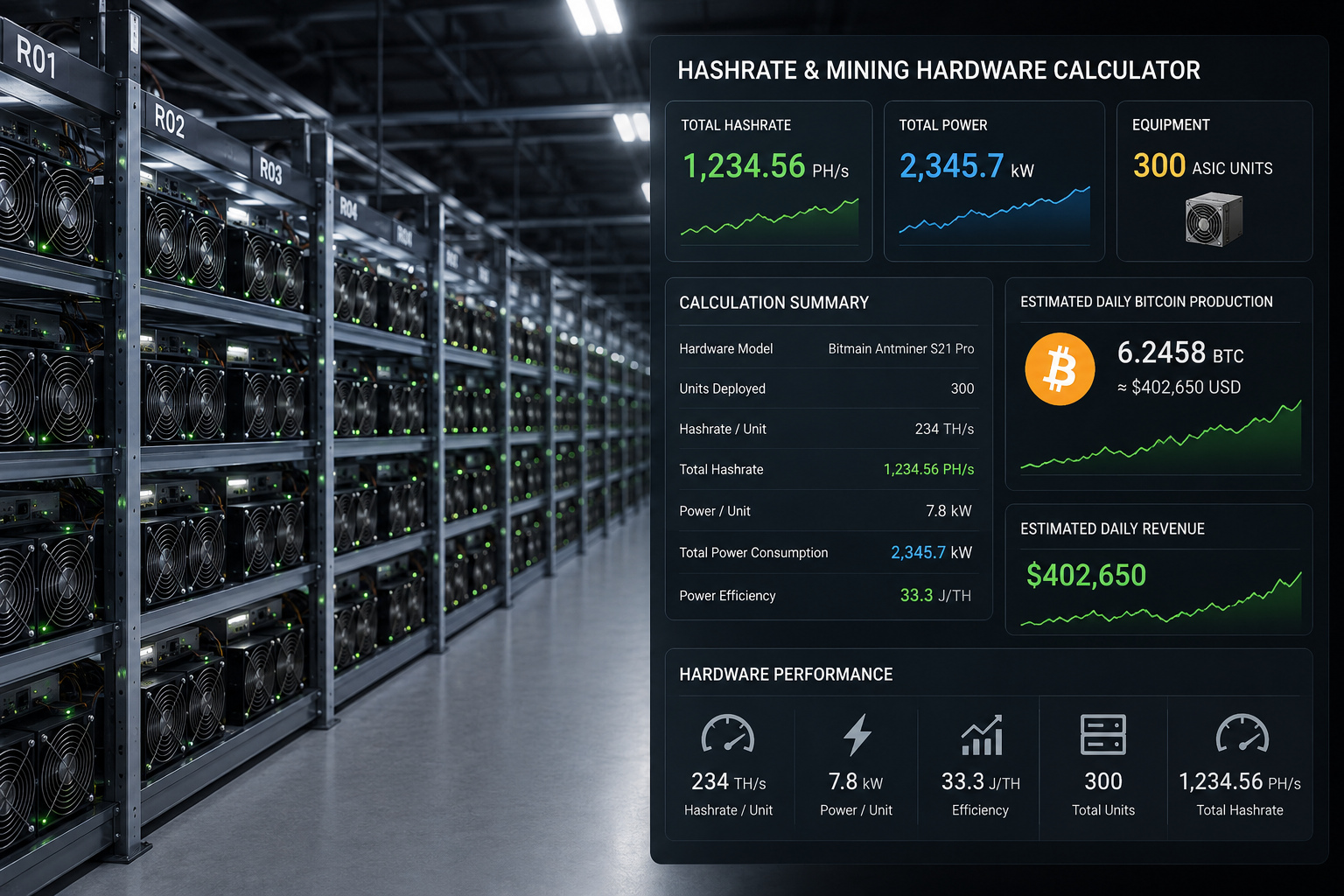
Crypto Data Center Calculator — BC infrastructure sizing and cost estimator tool from Strategic Crypto Reserve

BC-Calibrated Tool

ASIC · CapEx · BC Hydro

BC Hydro Crypto Data Center Calculator

Estimate your facility sizing parameters, upfront hardware/infrastructure CapEx, and daily utility OpEx based on current BC Hydro industrial rate frameworks and cooling configurations. Adjust sliders in real time to model different scenarios.

500 kW
100 kW (RS 1200) 1,500 kW (Transmission)
$0.065 / kWh
$0.04 (Industrial) $0.12 (Standard Commercial)
Smart PDU load management sequencing (−12% Demand Cost)

Estimated Metrics Dashboard

Total Supported ASIC Compute Capacity
142 Units
Based on continuous ~3.5 kW enterprise miner configurations.
Estimated Upfront Project CapEx
$604,000 CAD
Includes hardware procurement and infrastructure build costs.
Daily Power OpEx Cost Baseline
$780 CAD
Derived from daily continuous consumption patterns.
Notice: Modelled values are for strategic budgeting. Final deployment pricing requires engineering line-item quotes and verified BC Hydro rate confirmation. View our crypto data center for real-world context.

 Download This Calculator as a Standalone Widget

Free · No login · Embed on your site or use offline · BC Hydro-calibrated constants included

 Embed this calculator on your website:

<iframe src="https://strategiccryptoreserve.ca/crypto-data-center-calculator.html" width="100%" height="700" frameborder="0" title="Crypto Data Center Calculator"></iframe>

What Is a Crypto Data Center Calculator and Why Does Every BC Operator Need One?

A crypto data center calculator is a planning instrument that takes three fundamental inputs — available grid allocation, electricity rate per kilowatt-hour, and cooling infrastructure type — and returns the three financial metrics that determine whether a blockchain mining or infrastructure facility is viable: the maximum number of computing units the power budget supports, the estimated capital expenditure required to build the facility, and the ongoing daily electricity cost of running it. These three numbers are the go/no-go framework for any serious infrastructure planning conversation.

What distinguishes a genuinely useful crypto data center cost calculator from a generic mining profitability tool is jurisdictional calibration. Most online mining calculators model US electricity rates, USD hardware prices, and single-tier flat-rate power billing. They are structurally incapable of producing accurate estimates for British Columbia operators, because BC's power landscape is fundamentally different from the US market in three ways that matter enormously: BC Hydro's tiered rate schedules (which bill continuous 24/7 loads like mining at Step 2 energy rates plus a demand charge component), BC's temperate climate (which materially reduces cooling energy overhead and allows economizer modes for months of the year), and the CAD/USD pricing differential on both hardware and infrastructure.

The Strategic Crypto Reserve crypto data center calculator is built on 2026 Canadian market pricing constants and BC Hydro rate structures, making it the only publicly available interactive tool specifically calibrated for blockchain infrastructure operators building in BC. Every output — ASIC unit capacity, CapEx estimate, and daily OpEx — reflects what BC operators actually pay and build with, not a US-market proxy.

The calculator is designed for three specific planning moments: before you sign a facility lease (to confirm the space's power capacity supports your business case), before you order hardware (to calibrate your procurement budget against your grid allocation), and before you submit your BC Hydro service application (to confirm the scale of service entrance upgrade required). At each of these moments, the calculator's outputs give you the data confidence to proceed — or to revise your plan before capital is committed.

Crypto data center calculator explained — what it estimates and how it helps BC operators plan blockchain infrastructure projects

How to Use the Crypto Data Center Calculator: Five Steps

How to use the crypto data center calculator — step-by-step guide to entering grid allocation, BC Hydro rate, and cooling type

The crypto data center calculator has four inputs and produces three outputs in real time. Here is how to use each input for the most accurate results:

  1. Set Your Target Grid Allocation: Move the first slider to the continuous kilowatt draw your facility will operate at. Set this based on your available electrical service capacity, as confirmed with BC Hydro's commercial services team. If you have not yet engaged BC Hydro, set this to the load you are planning to apply for — the calculator will tell you immediately how many ASIC units that supports.
  2. Select Your Blended BC Hydro Rate: Move the second slider to your expected effective electricity rate per kilowatt-hour. The slider range spans $0.04 (available to qualifying large industrial operations) to $0.12 (standard commercial rate for non-qualifying accounts). Use the BC Hydro Rate Reference table below to identify your applicable rate schedule, or use $0.065/kWh as a conservative planning baseline if your rate is unconfirmed.
  3. Choose Your Cooling Infrastructure Type: Select Air-Cooled or Immersion from the dropdown. Air-cooled is the default — it is appropriate for most facilities and reflects standard hot-aisle/cold-aisle HVAC configurations. Immersion cooling applies a 35% infrastructure cost premium to the CapEx output, reflecting the additional capital cost of dielectric tank systems. Select immersion only if you are specifically planning this configuration.
  4. Toggle Active Demand Peak Shaving: Check or uncheck this option based on whether you plan to implement smart PDU load management and participate in BC Hydro's demand response programs. When enabled, the calculator reduces daily power OpEx by 12% to reflect the billing savings achievable through disciplined demand ceiling management. If you are uncertain, leave it enabled — it represents best-practice operation.
  5. Read and Apply Your Dashboard Results: The three output metrics update instantly. ASIC capacity tells you how many miners your grid supports. CapEx gives you a CAD hardware-plus-infrastructure budget baseline. Daily OpEx gives you the electricity cost foundation for your monthly profit-and-loss model. Take these numbers into your financial model as first-order estimates, then refine with professional quotes.

Understanding Your Crypto Data Center Calculator Results

Each of the three output metrics the calculator produces answers a specific planning question. Here is what each metric means and how to use it:

ASIC Compute Capacity

This figure tells you the maximum number of enterprise-grade ASIC mining units your planned grid allocation can sustain continuously. The calculator assumes 3.5 kW per unit — a representative draw for mid-range 2026 production miners. If your target hardware model draws more or less, divide your grid allocation by your unit's rated wattage to get a custom figure.

Hardware Planning

Estimated Project CapEx

The CapEx output models your total upfront investment: hardware procurement cost (units times a 2026 mid-range per-unit cost in CAD) plus infrastructure build cost (a per-kW infrastructure multiple applied to your grid allocation). Immersion cooling adds a 35% premium to the infrastructure component. This figure excludes site lease, legal, and permit costs.

Capital Budgeting

Daily Power OpEx

The daily OpEx metric is your baseline daily electricity bill: grid allocation in kilowatts times your rate per kilowatt-hour times 24 hours. When demand peak shaving is enabled, a 12% reduction models the billing savings from smart load management. Multiply by 30 for monthly OpEx and by 365 for annual cost.

Operating Cost Model

What Is Not Modelled

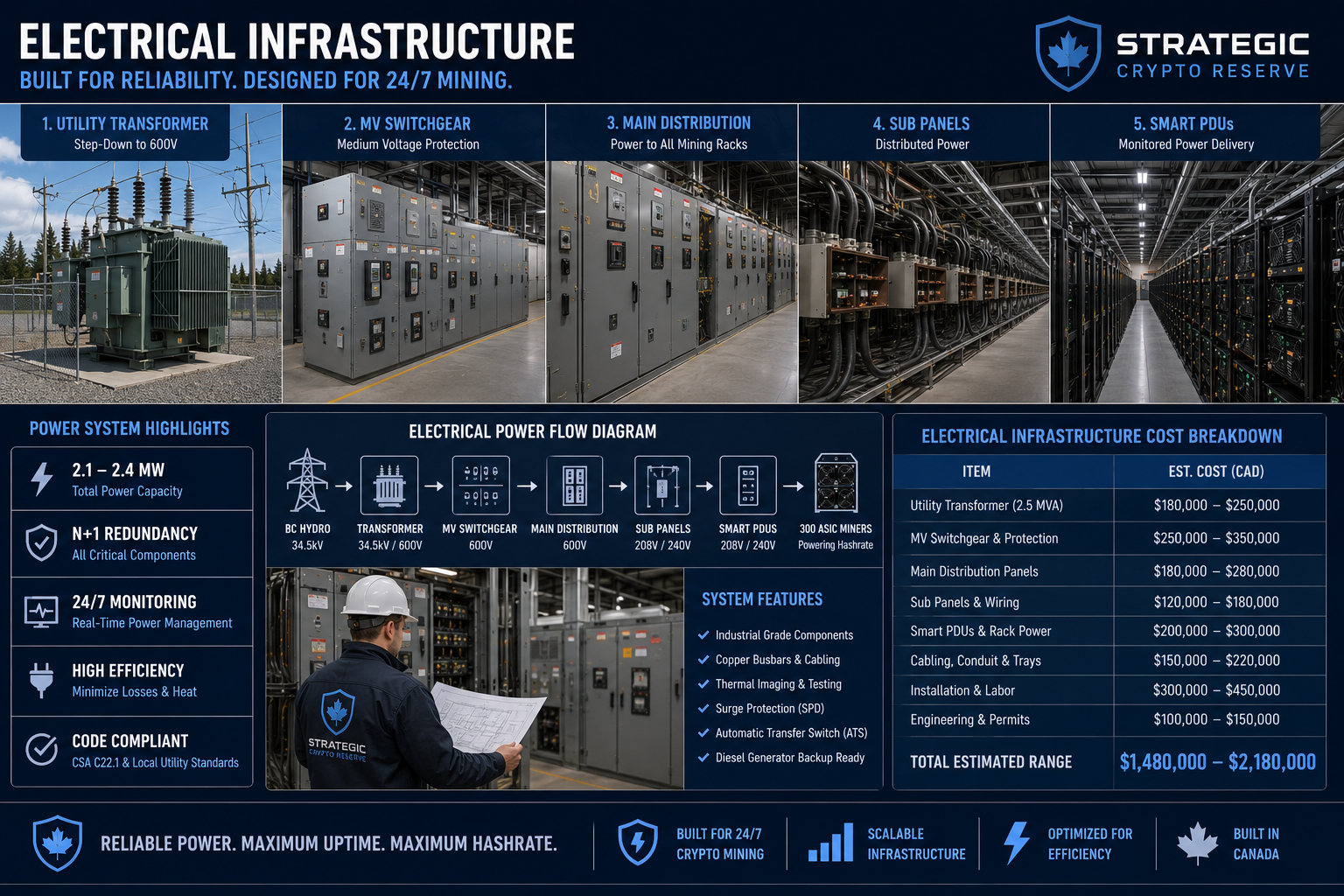
The calculator does not model mining revenue, Bitcoin price, network difficulty, or facility-level PUE beyond the peak shaving adjustment. It also excludes lease, insurance, staff, and internet costs. For a complete monthly operating cost model, use our detailed 300-unit facility cost breakdown as a reference.

Scope Awareness

From Calculator to Confidence: A crypto data center calculator output is a planning tool, not a binding quote. The correct workflow is: run the calculator to establish your planning baseline, engage BC Hydro to confirm your service capacity and rate schedule, obtain licensed electrical engineer and HVAC contractor quotes for the infrastructure, then compare professional quotes to the calculator's estimate to calibrate your confidence. Operators who follow this sequence make consistently better capital deployment decisions than those who move from a calculator directly to hardware orders without professional validation.

BC Hydro Rate Reference: Which Rate to Enter in the Calculator

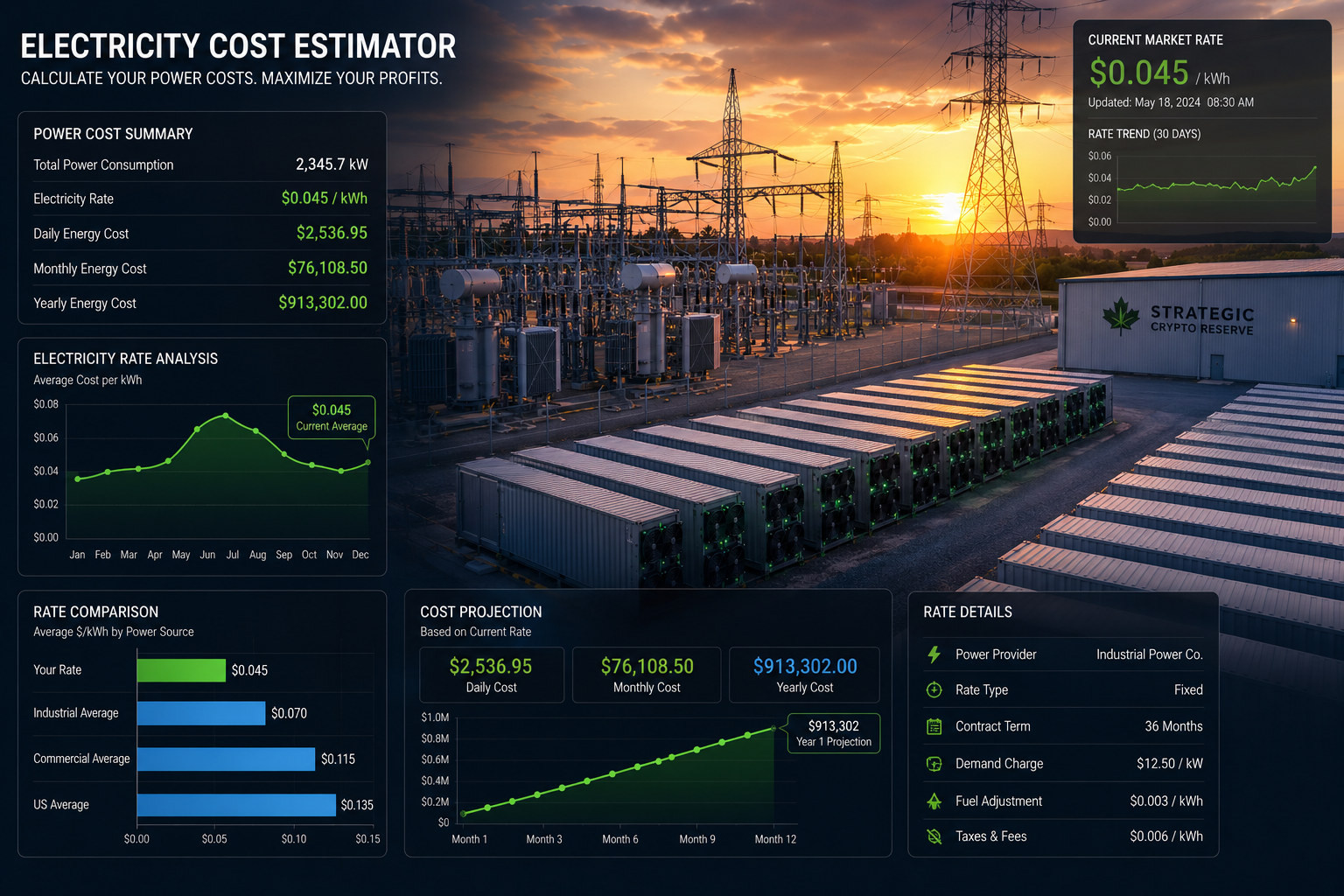
The electricity rate you enter into the crypto data center calculator has more impact on your daily OpEx output than any other input variable. The difference between entering $0.065/kWh and $0.095/kWh on a 500 kW facility is approximately $175 per day — or $63,875 per year. Getting this input right is essential for a meaningful planning output.

BC Hydro's commercial rate structure uses multiple tiers based on peak demand and annual consumption. For crypto mining facilities that draw power 24 hours a day, 365 days a year, virtually all consumption falls into Step 2 energy rates plus a demand charge component. The table below summarises the most relevant rate bands for BC crypto data center operators:

BC Hydro rate reference table for crypto data center calculator — RS 1100 RS 1200 Transmission Service and industrial tariff rates
BC Hydro Rate Schedule Demand Threshold Typical Blended Rate (24/7 Mining) Calculator Input Range Qualifying Profile
RS 1100 — General Service Small Under 35 kW ~$0.10 – $0.12 / kWh $0.10 – $0.12 Very small operations only — 5 to 10 miners maximum
RS 1200 — General Service Large 35 kW – 999 kW ~$0.07 – $0.10 / kWh $0.07 – $0.10 Most commercial mining facilities — 10 to 200+ miners
RS 1600 — Transmission Service 1,000 kW + ~$0.055 – $0.08 / kWh $0.055 – $0.08 Large commercial operations — 200+ miners, dedicated transformer
Industrial Tariff (Qualifying) By application ~$0.04 – $0.065 / kWh $0.04 – $0.065 Operations meeting BC Hydro's industrial application criteria — best available rate

Use $0.065 as your default: If you have not yet confirmed your BC Hydro rate schedule, enter $0.065/kWh as a conservative-optimistic planning baseline. This reflects a qualifying RS 1200 or Transmission Service account operating with good demand management practices — achievable by most mid-scale BC mining facilities that apply for the appropriate tariff. Do not use residential or standard commercial rates for mining OpEx modelling; these overstate your true cost if you qualify for industrial pricing. Confirm your applicable rate with BC Hydro's commercial services team before finalising any financial projection.

Air Cooling vs. Immersion Cooling: What Changes in the Calculator

Air cooling vs immersion cooling comparison in crypto data center calculator — capital cost and PUE impact for BC blockchain infrastructure

The cooling technology selection in the calculator affects the CapEx output only — it does not change the ASIC capacity estimate (which is driven by power allocation, not cooling type) or the daily OpEx baseline (which is driven by electricity rate and load). Here is what the two options represent and when each is appropriate:

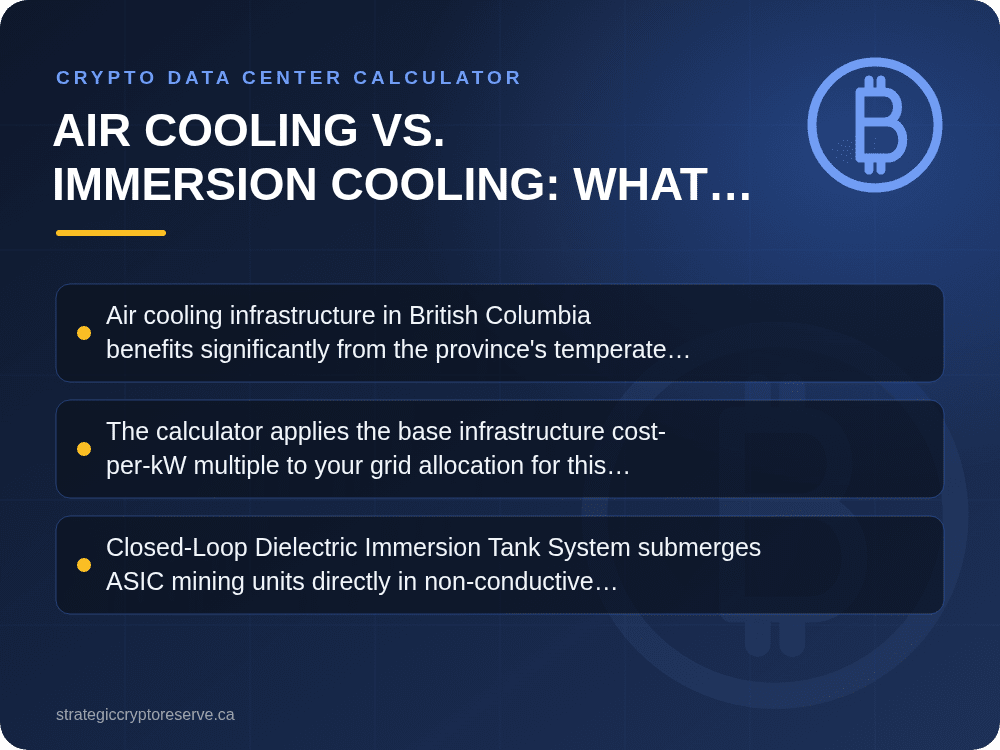
Air-Cooled Modular Container Pod is the standard configuration for commercial crypto mining facilities and the right choice for most first-phase builds under 1 MW of continuous computing load. It uses hot-aisle/cold-aisle containment with commercial-grade precision air conditioning or CRAC units, sized to handle the facility's total heat rejection load. Air cooling infrastructure in British Columbia benefits significantly from the province's temperate climate — ambient temperatures remain below 15℃ for seven to nine months of the year, enabling economizer-mode cooling that dramatically reduces compressor energy consumption during the cooler months. The calculator applies the base infrastructure cost-per-kW multiple to your grid allocation for this option.

Closed-Loop Dielectric Immersion Tank System submerges ASIC mining units directly in non-conductive dielectric fluid that absorbs heat and transfers it through a closed-loop heat exchanger. Immersion systems achieve Power Usage Effectiveness (PUE) ratios as low as 1.03 — meaning nearly all power drawn from the grid goes directly to computing, with almost none wasted on cooling overhead. This makes immersion compelling for high-density facilities above 500 kW where every percentage point of PUE improvement translates to meaningful annual electricity savings. The calculator applies a 35% premium to the infrastructure cost component when immersion is selected, reflecting the higher capital cost of fluid tanks, heat exchangers, and fluid procurement.

In practice, the long-run operational savings from immersion cooling's better PUE can justify the capital premium for large facilities over a three-to-five-year horizon. For smaller facilities or those with access to BC Hydro's most competitive industrial rates, the break-even period may be longer, making air cooling the more conservative capital allocation choice. For a complete technical comparison of both cooling architectures including real-world build cost data, see the cooling section of our complete small-scale crypto data center build guide.

From Calculator Results to a Real Crypto Data Center Build Plan

The crypto data center calculator is the starting point, not the endpoint, of your infrastructure planning. Once you have run the calculator and your outputs pass your business case threshold — your CapEx is within capital budget, your daily OpEx supports profitability at a conservative Bitcoin price, and your unit count is large enough to justify the facility overhead — the next three actions are:

  1. Submit Your BC Hydro Service Application: The utility service application is the highest-priority task that determines your entire project timeline. In the Vancouver and broader BC area, utility service upgrades for commercial mining loads can take four to twelve months from application to energized switchgear. The calculator's grid allocation input directly tells you which service class you need to apply for — use it to frame your BC Hydro service capacity request on day one of your project, before any other commitment is made.
  2. Obtain Engineering Quotes for Electrical and Cooling: Engage a licensed electrical engineer to design your service entrance and distribution infrastructure for the grid allocation the calculator modelled. Engage a mechanical engineer to size and specify your cooling system. These quotes will confirm whether the calculator's CapEx estimate is accurate for your specific site — and typically land within 10 to 20% of the calculator's output for standard BC configurations.
  3. Order Hardware in Alignment with Power Availability: Hardware ordering should be timed to align with your expected utility service energization date. A common and expensive mistake is ordering all hardware immediately after running a calculator, then paying months of storage costs because the facility's power connection is not ready. Use the calculator's ASIC capacity output to size your hardware order; use the BC Hydro service timeline to determine when to place it.

Where to Go Next: For the foundational engineering decisions that follow this calculator — how to lay out your racks, design your power distribution, configure your cooling, and segment your network — our complete guide to building a small-scale crypto data center covers every decision in the order you will face it. For BC Hydro-specific power grid strategy — rate schedule selection, demand charge minimisation, power factor correction, and backup power — our complete guide to power grid strategies for crypto mining in Vancouver provides the operational framework that turns calculator outputs into real monthly electricity bill savings.

From crypto data center calculator to real build plan — BC Hydro service application, engineering quotes, and hardware ordering timeline

Why Strategic Crypto Reserve Built a BC-Calibrated Crypto Data Center Calculator

Strategic Crypto Reserve crypto data center in British Columbia — the operational context behind the BC-calibrated crypto data center calculator

Most crypto mining calculators are built by US-based teams for US-based operators. They use US dollar hardware pricing, flat-rate US utility costs, and mining revenue models centred on NASDAQ-listed mining companies that have nothing in common with a small-to-mid-scale BC operator trying to figure out whether a specific facility can support a 50-unit mining operation at current Bitcoin network difficulty.

Strategic Crypto Reserve operates blockchain infrastructure and a crypto data center in British Columbia, with real operational exposure to BC Hydro billing cycles, BC contractor pricing, and the specific engineering challenges of building crypto infrastructure in the Pacific Northwest. We built this calculator because we kept encountering BC operators who had made foundational planning errors — leasing facilities with insufficient electrical service capacity, ordering hardware before confirming power availability, or budgeting US electricity rates instead of BC Hydro industrial tariffs — because no BC-specific planning tool existed.

The calculator's constants — $3,200 CAD per unit hardware cost, $300 CAD per kW infrastructure build rate, the 35% immersion premium, and the 12% demand management savings — are derived from real 2026 Canadian market data, not theoretical estimates. They will not be accurate for every operator in every situation, but they are far more accurate starting points for BC planning than any US-benchmarked tool.

We made the calculator freely downloadable and embeddable because we believe the BC blockchain infrastructure ecosystem grows stronger when more operators have access to quality planning tools. Better-planned facilities have better capital efficiency, lower risk of costly mid-build changes, and stronger long-term operating margins — and that raises the overall quality of BC's blockchain infrastructure sector, which benefits everyone building here.

View SCR Data Center

Strategic Crypto Reserve Infrastructure Ecosystem

Crypto Data Center BC

Strategic Crypto Reserve operates blockchain infrastructure and data center facilities in the Comox Valley, British Columbia — supporting NFT drops, blockchain node hosting, and on-chain operations on Polygon and Ethereum. The real-world cost data behind this calculator comes from operating that facility.

BC Infrastructure Guides

Pair this calculator with our complete small-scale crypto data center build guide, 300-unit facility cost breakdown, and Vancouver power grid strategies guide — a comprehensive resource cluster for BC blockchain infrastructure operators at every scale.

Frequently Asked Questions: Crypto Data Center Calculator

1. What does a crypto data center calculator estimate?

A crypto data center calculator estimates three core financial and operational metrics for a planned blockchain mining or infrastructure facility: (1) ASIC compute unit capacity — how many mining units your planned electrical grid allocation can support based on per-unit power draw; (2) upfront capital expenditure (CapEx) — a modelled estimate of hardware procurement cost plus infrastructure build cost including electrical systems, cooling, racks, and networking; and (3) daily electricity operating cost (OpEx) — your estimated daily power bill based on total facility draw and the electricity rate you input. The Strategic Crypto Reserve crypto data center calculator is calibrated specifically for British Columbia operators using BC Hydro rate frameworks and 2026 Canadian market pricing, making it uniquely relevant for Vancouver-area and broader BC mining facility planners. For real-world data center context behind the calculator's constants, see Strategic Crypto Reserve's crypto data center infrastructure in British Columbia.

2. How accurate is a crypto data center cost calculator for British Columbia operators?

A well-designed crypto data center calculator provides first-order estimates suitable for strategic budgeting and go/no-go decision-making, but should not replace professional engineering quotes for final project budgets. The Strategic Crypto Reserve calculator uses 2026 Canadian market pricing constants for hardware procurement, infrastructure build costs, and BC Hydro rate structures — producing outputs that typically land within 10 to 20% of actual professional quotes for standard BC configurations. The most impactful accuracy variable is the electricity rate you input: using your confirmed BC Hydro rate schedule rather than an assumed rate produces daily OpEx outputs within 10% of actual billing for most standard operations. For full CapEx accuracy, always obtain licensed electrical engineer and HVAC contractor quotes before committing capital. For a complete line-item cost framework, our 300-unit crypto mining facility cost breakdown provides detailed Canadian pricing across every infrastructure category.

3. What BC Hydro rate should I enter into the crypto data center calculator?

The BC Hydro rate you should input depends on your facility's demand profile and qualifying rate schedule. Operations under 35 kW fall under General Service Small (RS 1100) with a blended effective rate of approximately $0.10 to $0.12 per kWh. Operations between 35 kW and 1,000 kW fall under General Service Large (RS 1200) with a blended rate of approximately $0.07 to $0.10 per kWh for continuous 24/7 operations. Operations above 1,000 kW qualifying for Transmission Service can achieve blended rates of $0.055 to $0.08 per kWh. Operations that qualify for BC Hydro's industrial tariff arrangements can achieve blended rates as low as $0.04 to $0.065 per kWh. Use $0.065/kWh as a conservative planning baseline if your qualifying rate is unconfirmed. For a complete breakdown of how power grid strategy and rate optimisation interact with operating costs, read our guide to best power grid strategies for crypto mining in Vancouver.

4. What is the difference between air cooling and immersion cooling in the crypto data center calculator?

In the crypto data center calculator, selecting immersion cooling applies a 35% premium to the infrastructure component of the CapEx estimate, reflecting the higher capital cost of dielectric fluid immersion tanks and closed-loop heat exchanger systems compared to standard air-cooled configurations. The daily power OpEx output does not change based on cooling type in the calculator model, even though immersion cooling in practice delivers better Power Usage Effectiveness (PUE) and lower cooling energy consumption. Air cooling is the lower capital cost option and is appropriate for most first-phase builds and facilities under 500 kW. Immersion cooling is best suited to high-density deployments above 500 kW where thermal efficiency savings justify the capital premium over a multi-year horizon. For a technical comparison of both cooling architectures with real-world BC build cost data, see the cooling section of our small-scale crypto data center build guide.

5. Can I download the crypto data center calculator as a standalone widget for offline or embedded use?

Yes — the Strategic Crypto Reserve crypto data center calculator is available as a fully standalone, self-contained HTML widget that can be downloaded for free and used offline without an internet connection, embedded in your own website as an iFrame, or shared with your project team for collaborative facility planning sessions. The downloadable widget includes all calculator functionality, BC Hydro rate-calibrated constants, and attribution links back to Strategic Crypto Reserve. It does not collect any data and requires no login, API key, or software installation. Click the Download Calculator Widget button above the embed code section on this page to receive the standalone HTML file immediately. For website embedding, the iframe embed code on this page allows direct integration into any site with no backend configuration required. The tool is provided for educational and strategic planning use under a free-to-use, attribution-required license.