
Three stories from the past seven days show where Canada's AI data centre build-out actually stands. Meta's $13 billion Alberta project just got its own $4.6 billion dedicated gas plant. At least eight Ontario municipalities have reached eight different answers on whether to allow new data centres, with zero provincial framework tying any of them together. And a fresh market report puts 119 data centers already running nationwide, with 36 more underway, on track for a 10GW target by 2031. This isn't hyperscalers testing the market. This is the buildout, arriving faster than most rulebooks can keep up.
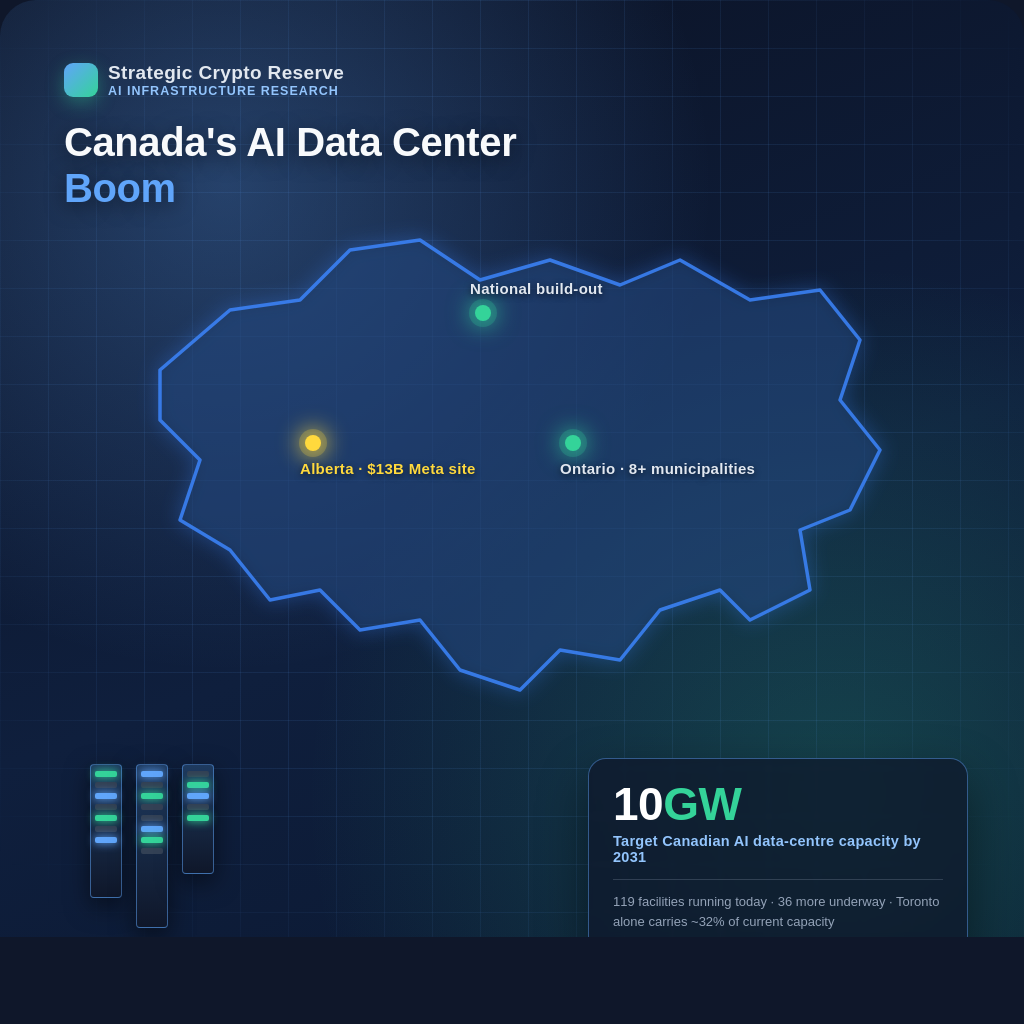
National target, 2031
10GW · 35+ projects
Everything below is drawn from public reporting published in the seven days ending September 21, 2026. Figures described as reported come from third-party press coverage and may be revised; see Sources for the original articles.
Meta's roughly $13 billion AI data centre near Sturgeon County, just north of Edmonton, Alberta, now has a power source built specifically for it. Reports this week (September 21, 2026) say Pembina Pipeline is moving ahead on a roughly $4.6 billion natural gas power plant sized and sited to feed the Meta project directly, rather than the site drawing from the general grid queue.
Capital Power has publicly argued that the arrangement does more than power one hyperscaler's campus: it makes Alberta the reference case for every other hyperscaler shopping for grid capacity. A dedicated, purpose-built gas plant sidesteps the multi-year interconnection queues that slow projects in tighter grids, and Alberta's deregulated power market makes that kind of bespoke, behind-the-meter deal easier to strike than in provinces where a single utility controls generation.
Why this matters for site selection. Nobody in this story is debating clean energy targets. They are building gas plants, on a timeline measured in months of negotiation rather than years of interconnection studies. That is the same dynamic SCR's own AI Data Center Economics research tracks across provinces and states: the build model that wins is the one that solves power first. Alberta's answer is dedicated generation; British Columbia's is a capped, competitive allocation process through BC Hydro (see BC Hydro Electricity Rates for Crypto Mining 2026 and Power Grid Strategies for Crypto Mining, Vancouver). Same industry, two very different power strategies.
While Alberta solves for power, Ontario is fighting over land use, town by town. Sault Ste. Marie's city council approved a motion pausing approval of large-scale AI data centre applications on September 21, 2026 -- the same week Milton went the other way and rejected an interim control bylaw that would have done the same thing locally. There is still no unified Ontario or federal rulebook deciding any of this.
| Municipality | Decision | When |
|---|---|---|
| Sault Ste. Marie | Paused approval of new applications (moratorium) | September 21, 2026 |
| Mississauga | Unanimous one-year ban on new data centres | September 16, 2026 |
| Oakville | Ban on new data centre applications | August 2026 |
| Milton | Rejected an interim control bylaw (freeze not adopted) | Week of September 21, 2026 |
| Hamilton | Voted down a similar freeze | Earlier in 2026 |
| Burlington | Voted down a similar freeze | Earlier in 2026 |
That is six municipalities with clear, opposite rulings, plus Toronto (which already carries roughly a third of the country's current capacity) and a growing list of neighbouring townships weighing their own bylaws -- easily eight-plus separate answers inside one province. This isn't a debate about whether Canada wants data centres. It's a fight over who gets to say no, fought one council chamber at a time, because no provincial or federal framework has stepped in to set a single standard.
A market research report released September 18, 2026 puts hard numbers on what "the buildout" actually means. It tracks 119 data centers currently operating in Canada, plus 36 upcoming facilities through 2031, targeting roughly 10 gigawatts of future capacity across 35 or more announced and upcoming projects. Toronto alone holds an estimated 378MW, about 32% of the country's current total, with Microsoft and AWS expanding their own footprints alongside established operators like Vantage, eStruxture, Cologix and Equinix.
Read against the Alberta and Ontario stories above, the pattern is consistent: capital and demand are moving faster than either the power grid or the permitting process, and every jurisdiction is improvising its own fix -- dedicated generation in Alberta, municipal freezes in Ontario, capacity-capped allocation in British Columbia. Nobody is coordinating this nationally yet.
British Columbia. BC Hydro's competitive power-allocation process for AI and data centre projects remains capped at roughly 400MW for its first two years -- an active grid-constraint story that predates this week's news and continues to shape which projects in BC can even get a power commitment. See BC Hydro Electricity Rates for Crypto Mining 2026 for the current tiers, rates and the province's mining ban.
Quebec. Hydro-Québec's proposal to roughly double electricity rates for large data centres continues to draw commentary, though the underlying rate filing itself dates to earlier this summer. Neither story moved this specific week, but both remain live constraints on where the next wave of Canadian capacity actually lands.
119 data centers are currently operating in Canada, according to a market research report released September 18, 2026. The same report tracks 36 more facilities underway, with Toronto alone holding roughly 378 megawatts, about 32% of the country's current total capacity.
Industry tracking published September 18, 2026 points to a target of roughly 10 gigawatts (GW) of AI and cloud data centre capacity across 35 or more announced and upcoming projects by 2031, up from the 119 facilities running today.
Reports from September 21, 2026 say Pembina Pipeline is moving ahead on a roughly $4.6 billion natural gas power plant built specifically to supply Meta's $13 billion AI data centre near Sturgeon County, north of Edmonton, Alberta. Capital Power has publicly said the project strengthens Alberta's pitch to other hyperscalers shopping for power-backed sites, since a dedicated gas plant sidesteps the multi-year wait many projects face for grid interconnection.
As of September 21, 2026, Sault Ste. Marie has paused approval of large-scale AI data centre applications, joining Mississauga (a unanimous one-year ban passed September 16, 2026) and Oakville (a ban passed in August 2026). In the same period, Milton rejected an interim control bylaw that would have paused approvals, and Hamilton and Burlington had already voted down similar freezes earlier in 2026 — eight-plus municipalities, each reaching its own answer.
No single federal or Ontario-wide framework governs where AI data centres can be built; each Ontario municipality is deciding for itself, producing at least eight different rulings across neighbouring towns as of September 2026. Other provinces regulate through the power side instead: British Columbia runs a competitive, capacity-capped allocation process for large loads through BC Hydro, and Quebec's Hydro-Québec has proposed roughly doubling electricity rates for large data centres. Strategic Crypto Reserve is not a government body and this page is not legal or regulatory advice; confirm current rules directly with the relevant municipality, province or utility before committing to a site.
See how Strategic Crypto Reserve sources and verifies research on the E-E-A-T principles page, and browse every page on the site via the full sitemap.