Google E-E-A-T Principles

Google's E-E-A-T Principles Explained: Experience, Expertise, Authoritativeness and Trust

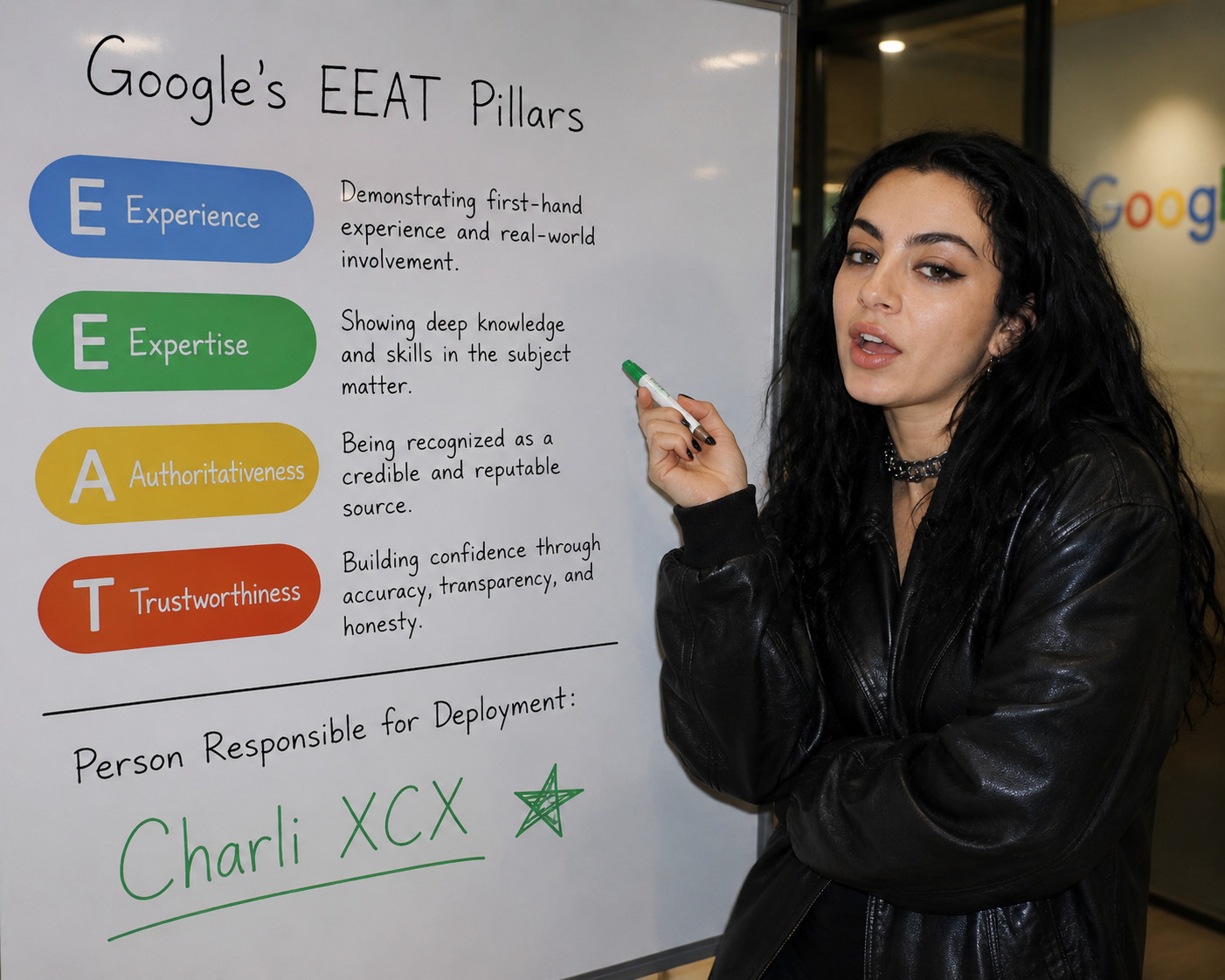
E-E-A-T — Experience, Expertise, Authoritativeness, and Trust — is the framework Google's human Search Quality Raters use to judge whether a page is reliable enough to deserve a place in front of searchers. It is not a button you can switch on with a plugin, and it is not a ranking factor in the way page speed or a meta tag is a ranking factor. It is a description of what good content and a credible publisher actually look like, translated into a rubric. This guide breaks down each pillar, how Google's own raters apply them, and what that means in practice for a publisher building a content site in a YMYL-adjacent space like crypto and blockchain.

Google's E-E-A-T principles — Experience, Expertise, Authoritativeness and Trust illustrated as four pillars supporting a search results page

Framework

Experience • Expertise • Authority • Trust

What Is Google's E-E-A-T and Where Did It Come From?

E-E-A-T first appeared in 2018 as E-A-T — Expertise, Authoritativeness, Trustworthiness — inside Google's Search Quality Rater Guidelines, the internal document used to train the thousands of human contractors who sample search results and report back on quality. In December 2022, Google added a second E for Experience, reflecting a simple observation: a page can be technically expert and still miss the mark if it has no first-hand familiarity with what it describes. A product review written by someone who has actually used the product carries something a purely academic description cannot replicate.

It is important to be precise about what E-E-A-T actually is. Google's own search liaison has said plainly that E-E-A-T is not a ranking factor that gets plugged into the algorithm the way page load speed or a canonical tag does. Quality raters do not have the power to move a page up or down in search results. Their job is closer to a feedback panel: they sample pages, score them against the E-E-A-T rubric, and that aggregate feedback tells Google's engineers whether a proposed algorithm change is moving search quality in the right direction.

What makes E-E-A-T valuable to publishers, despite not being a direct lever, is that it is the clearest public description Google has ever given of what its automated systems are trying to reward. The algorithm cannot read a byline and feel reassured — but it can detect signals that correlate with the qualities raters are trained to look for. Treating E-E-A-T as a self-assessment checklist, rather than a knob to twist, is the correct way to use it.

Diagram showing how Experience, Expertise, and Authoritativeness all feed into Trust, the central E-E-A-T pillar

Pillar One: Experience

The Experience pillar of E-E-A-T — a creator with first-hand, direct involvement in the subject they are writing about

Experience asks a narrow but important question: did the person who created this content actually live it? Google's guidelines give the example of tax-return advice versus a tax-software review. For the former, you want an accountant's expertise. For the latter, you may value a forum post from someone who has actually used three different filing tools and can describe what broke and what didn't — that is Experience doing work Expertise alone cannot.

For crypto and blockchain publishers, Experience shows up as concrete, specific detail that could only come from direct involvement: a real wallet address shown mid-transaction, an actual mining facility with photographed equipment and recorded power costs, a documented step-by-step record of claiming an NFT rather than a generic description copied from a whitepaper. Raters are explicitly trained to notice the difference between a page that demonstrates direct use and one that reads like it was assembled entirely from other people's summaries.

Pillar Two: Expertise

Expertise is about demonstrated knowledge and skill in the subject matter — not necessarily formal credentials. Google's guidelines distinguish between formal expertise (a licensed doctor writing about medicine, a securities lawyer writing about token-sale structure) and everyday expertise (a hobbyist who has spent a decade restoring vintage tools and writes with genuine command of the subject). Both can satisfy the Expertise pillar; what matters is that the depth is real and it shows in the work, not just claimed in an "About" page.

On a technical site, Expertise is demonstrated less by adjectives and more by precision: correct terminology used consistently, accurate explanations of how a consensus mechanism or a token-redemption ratio actually works, and content that goes beyond the surface-level explanation available on a dozen other sites. Shallow, templated explanations that could apply to any topic with the nouns swapped out are the opposite of what raters are trained to reward.

The Expertise pillar of E-E-A-T — demonstrated subject-matter skill and precise, accurate explanation

Pillar Three: Authoritativeness

The Authoritativeness pillar of E-E-A-T — reputation as a go-to source recognized by other sites and experts

Authoritativeness is about reputation beyond your own site — whether other sources, experts, and publishers treat you as a credible reference point. Google's guidelines use the example of a government passport-renewal page: there may not be one official source for every topic, but where one exists, it is given outsized weight. For most publishers, authoritativeness is built rather than declared — it accumulates through citations, mentions, and links from other sites that already have it.

This is also where off-page signals — backlinks, press mentions, citations from other publishers — do more work than any amount of on-page polish. A page can be flawlessly written and still read as unauthoritative if nothing on the wider web treats the site as a credible source on the topic. Authoritativeness is the pillar most directly tied to a domain's accumulated reputation rather than any single page's content quality.

Pillar Four: Trust — The One That Matters Most

Google's own documentation is unusually direct on this point: Trust is the most important member of the E-E-A-T family. Experience, Expertise, and Authoritativeness all exist, in Google's framing, to support Trust — a page can show genuine first-hand experience and deep subject knowledge and still fail if it is inaccurate, deceptive, or unsafe for the reader to rely on. Trust is the pillar the other three are ultimately in service of.

Trust signals include accurate, verifiable claims; honest disclosure of a site's nature and limitations; secure, accessible pages; clear contact and ownership information; and the absence of manipulative or deceptive design patterns. The amount of trust required scales with the stakes of the topic — an entertainment blog needs less of it than a page giving financial guidance. This scaling is formalized in Google's guidelines through the concept of YMYL, covered in the next section.

The Trust pillar of E-E-A-T shown as the central, load-bearing signal supported by Experience, Expertise, and Authoritativeness

Why E-E-A-T Matters More for YMYL Topics — Including Crypto

YMYL — Your Money or Your Life — content standards applied to cryptocurrency, NFT, and financial topics

YMYL stands for "Your Money or Your Life" — Google's term for topic categories where low-quality or inaccurate information could cause real financial, physical, or societal harm. Medical advice, legal guidance, and personal finance are the classic examples. Cryptocurrency and NFT content sits close to this category by nature: readers arrive making decisions about where to put real money, which means raters are instructed to hold the content to a noticeably stricter standard than they would a recipe blog or a gaming fan site.

For a publisher in this space, the practical implication is direct: every claim should be defensible, every disclaimer should be visible rather than buried, and any language that could read as a guaranteed return or financial promise works directly against E-E-A-T rather than for it. Parody and entertainment framing can be entirely legitimate, but it needs to be unambiguous to both readers and raters — clarity about what a page is and is not is itself a Trust signal.

How Google's Search Quality Raters Actually Evaluate a Page

Search Quality Raters are independent contractors trained against Google's official Search Quality Rater Guidelines — a lengthy, regularly updated public document. Raters do not influence rankings directly; instead they perform sample searches, review the resulting pages, and assign Page Quality and Needs Met ratings on a scale from Lowest to Highest. That aggregate data tells Google's engineers whether an algorithm change is producing better or worse results, the same way a restaurant uses comment cards rather than letting any individual diner set the menu.

  1. Identify the page's purpose: Raters first ask whether the page exists to genuinely help people, as opposed to existing primarily to capture search traffic.
  2. Assess the "Who, How, and Why": Who created this, how was it produced, and why does it exist? Clear bylines and transparent sourcing answer all three.
  3. Score Main Content quality: Raters evaluate whether the core content is original, substantial, and free of padding or filler.
  4. Apply YMYL scaling: If the topic touches money, health, safety, or wellbeing, the bar for E-E-A-T is raised substantially.
  5. Weigh reputation: Raters are encouraged to research what the wider web says about a site or author before finalizing a rating.

The single most useful thing any publisher can do with this process is read it directly rather than rely on secondhand summaries. Google publishes its full guidance at Google's official guidance on creating helpful, reliable, people-first content, which distills the rater guidelines into a self-assessment checklist any creator can apply to their own pages.

Google Search Quality Raters reviewing search results and scoring page quality against the Search Quality Rater Guidelines

Backlinks and Off-Site Authority: The Signal On-Page Work Can't Replace

Backlinks from other websites building off-site authority as a core E-E-A-T trust signal

A page can have flawless schema markup, a comprehensive FAQ, and beautifully structured prose and still fail the Authoritativeness pillar if nothing else on the web treats it as credible. Backlinks from independent, relevant sites remain the clearest off-page signal Google has for "do other people already trust this source." This is also why content depth alone has a ceiling: structured data and on-page optimization help Google understand a page, but they do not, by themselves, establish that the wider web considers the site authoritative.

For newer domains in particular, the realistic path is a combination of genuinely useful content that other sites want to cite, direct outreach to relevant publishers, and patience — domain-level authority accumulates over months, not days, and no individual page-level change closes that gap on its own. Treating backlink building as a parallel, ongoing workstream rather than an afterthought to publishing is the difference between content that eventually ranks and content that stays technically excellent but invisible.

Author Bylines, Citations, and the On-Page Signals That Matter

Google's own creator guidance asks a direct question: do pages carry a byline where one might be expected, and does that byline lead to further background about who wrote it? Adding accurate authorship information is one of the few concrete, controllable actions a publisher can take that maps directly onto how raters are trained to evaluate the "Who" behind a piece of content.

Practical signal checklist: visible publish and update dates, an accurate author or organization attribution, links to supporting primary sources for factual claims, a genuine "About" page explaining who runs the site and why, and citations that point to first-party or official sources rather than other secondary summaries.

None of these signals work as decoration. A byline with no further information behind it, or citations that lead nowhere specific, read as performative rather than trustworthy — and Google's guidelines explicitly caution raters to look past surface-level claims of expertise toward whether the underlying content actually demonstrates it.

Author byline, publish date, and citation links shown as on-page E-E-A-T trust signals

E-E-A-T Self-Assessment Checklist

Google explicitly invites creators to self-assess against the rater guidelines rather than guess. The following condenses that guidance into a working checklist for any content page:

  1. Original value: Does the page provide information, analysis, or reporting that isn't just a rehash of what already ranks?
  2. Substantial coverage: Is the topic addressed completely enough that a reader doesn't need to leave for the basics?
  3. Clear authorship: Is it obvious who produced this and what their relevant background is?
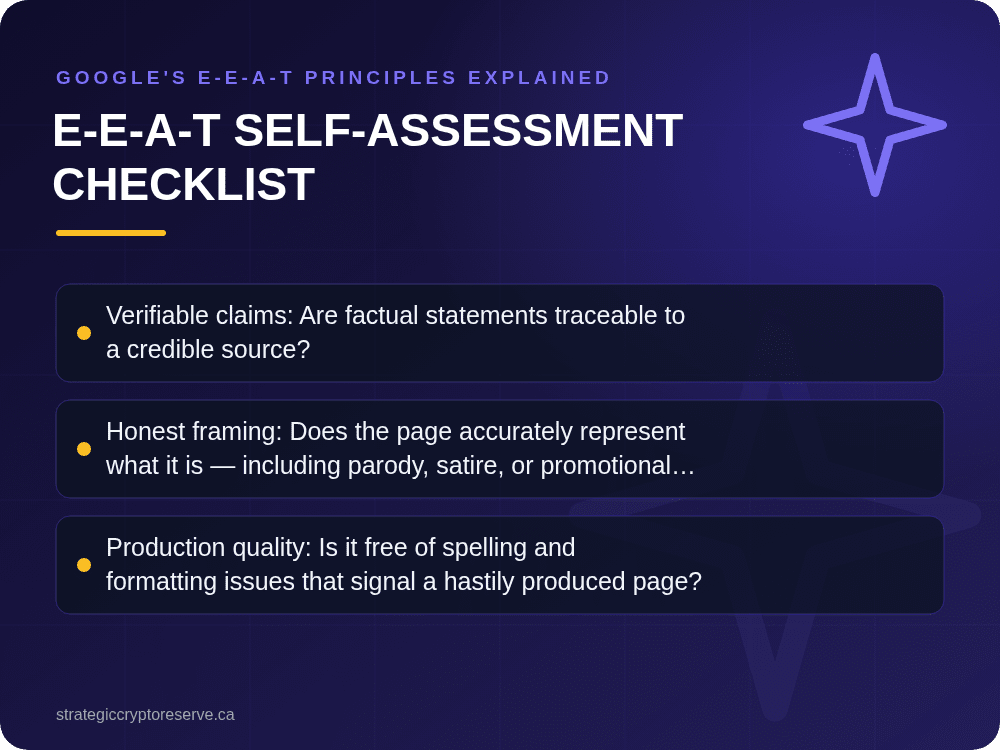
  4. Verifiable claims: Are factual statements traceable to a credible source?
  5. Honest framing: Does the page accurately represent what it is — including parody, satire, or promotional content?
  6. Production quality: Is it free of spelling and formatting issues that signal a hastily produced page?
  7. Would you bookmark it: Google's guidelines literally ask raters to consider whether they'd want to bookmark or recommend the page.

Run any page through these seven questions honestly, and the gaps that show up are usually the same gaps a quality rater would flag — which is the entire point of the exercise.

Frequently Asked Questions About Google's E-E-A-T Principles

1. What does E-E-A-T stand for?

E-E-A-T stands for Experience, Expertise, Authoritativeness, and Trust. It is the framework Google's human Search Quality Raters use to assess whether a page demonstrates first-hand experience with its subject, genuine subject-matter knowledge, a reputation as a go-to source, and overall trustworthiness. The original three-letter version, E-A-T, was introduced in 2018; Google added the second "E" for Experience in December 2022.

2. Is E-E-A-T a direct Google ranking factor?

No. Google has stated repeatedly that E-E-A-T is not itself a ranking factor that gets fed into the algorithm. It is a framework used by human quality raters to evaluate how well Google's automated ranking systems are performing. The algorithm cannot directly "read" Experience or Trust — but it does look for measurable signals that correlate with those qualities, such as authorship information, citations, backlink profiles, and content depth.

3. What is a YMYL page and why does it matter for E-E-A-T?

YMYL stands for "Your Money or Your Life" — topic categories where inaccurate or low-quality information could cause real financial, physical, or societal harm. Examples include medical advice, legal guidance, personal finance, and cryptocurrency investment content. Google's Search Quality Rater Guidelines instruct raters to apply much stricter E-E-A-T standards to YMYL pages than to low-stakes topics like hobbies or entertainment.

4. Which E-E-A-T pillar matters most?

Trust. Google's own guidance describes Trust as the most important member of the E-E-A-T family, because Experience, Expertise, and Authoritativeness all exist to support it — a page can show real experience and deep expertise, but if it is inaccurate, deceptive, or unsafe, none of that matters. Trust is the central, load-bearing pillar that the other three feed into.

5. How can a website demonstrate E-E-A-T in practice?

Practical signals include clear author bylines with background information, citations to authoritative primary sources, transparent "About" and contact information, original analysis rather than rehashed content, accurate and regularly updated facts, a visible editorial or disclaimer policy where relevant, and a credible off-site reputation reflected in backlinks and mentions from other trusted sites.

6. Does E-E-A-T apply differently to crypto and NFT content?

Yes. Cryptocurrency and NFT content sits close to YMYL territory because it touches personal finance and investment decisions, so raters are instructed to hold it to a higher standard than purely entertainment content. Sites publishing in this space benefit from clear disclaimers about the nature of the content, transparent sourcing, accurate technical explanations, and avoiding language that could be read as an investment guarantee or return claim.