Rate Data · British Columbia · Published July 2026

BC Hydro Electricity Rates for Crypto Mining in 2026: What It Actually Costs

Most articles about crypto mining in British Columbia get two things wrong: they quote the cheap Tier 1 electricity rate that miners almost never actually pay, and they gloss over the fact that BC has permanently banned new grid connections for crypto mining. This page fixes both. We operate a real, small-scale Bitcoin mining setup in the Comox Valley, we pay these rates on real BC Hydro bills, and below is the honest math: current 2026 rate figures, per-ASIC cost tables at the marginal rate, time-of-day pricing worked out for a 24/7 load, and exactly what the ban does and doesn't cover.


BC Hydro electricity meter and ASIC mining hardware operated by Strategic Crypto Reserve on Vancouver Island

Comox Valley, BC

Real Bills · Real Rates

BC Hydro Residential Rates in 2026: The Numbers That Matter

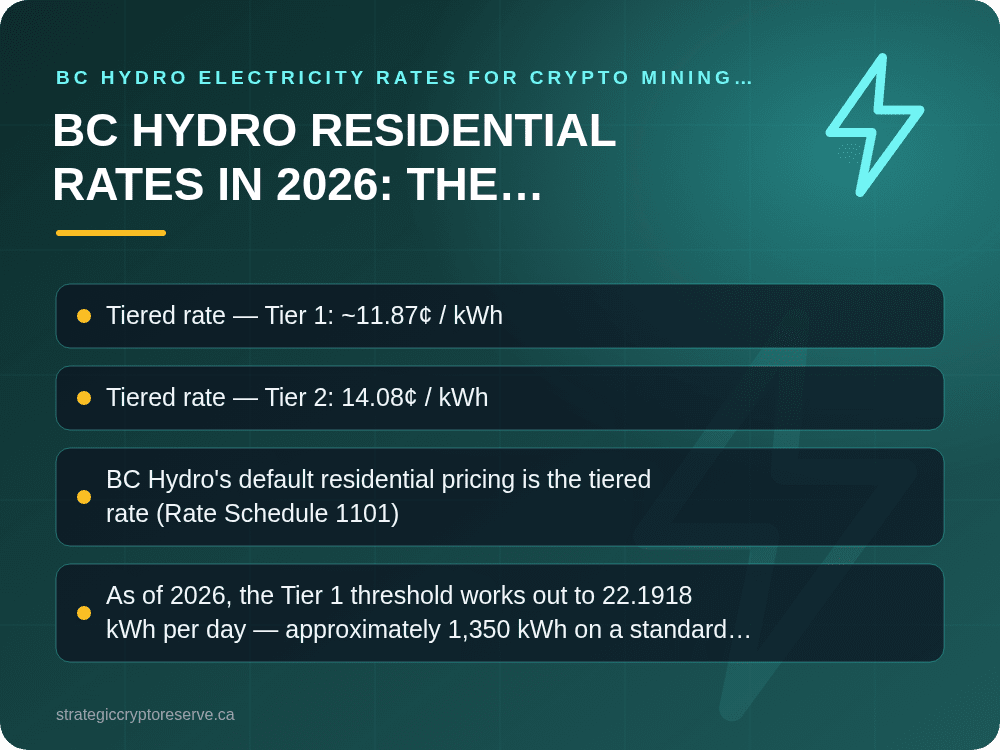
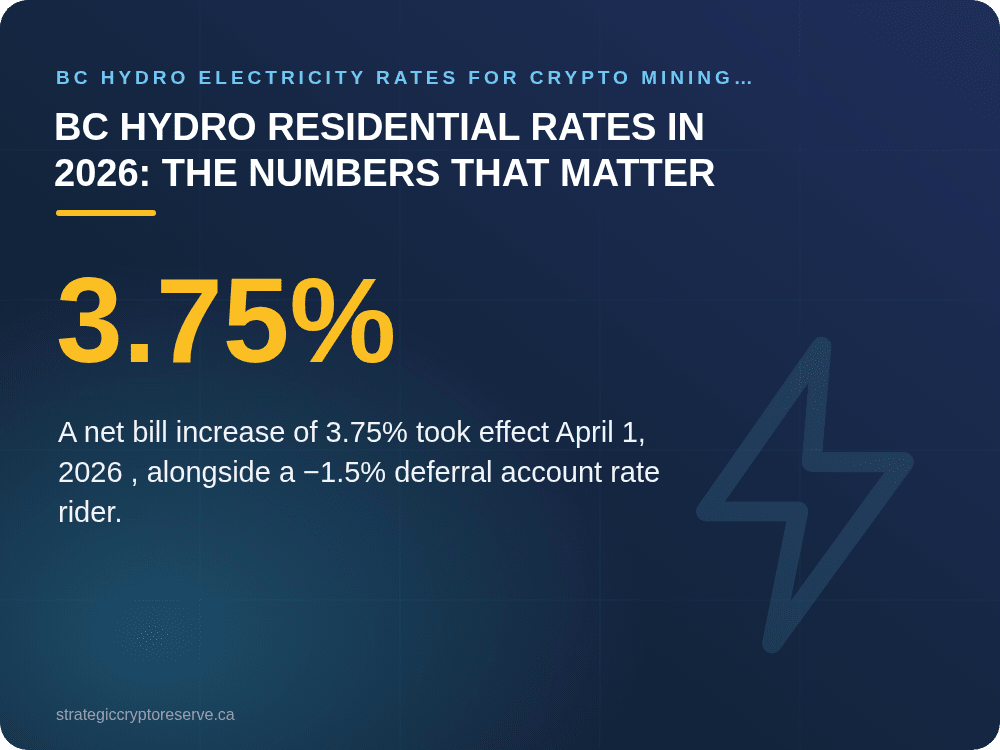
BC Hydro's default residential pricing is the tiered rate (Rate Schedule 1101). You pay a lower price for a baseline block of electricity in each billing period, and a higher price for everything above it. As of 2026, the Tier 1 threshold works out to 22.1918 kWh per day — approximately 1,350 kWh on a standard two-month bill, or about 675 kWh on a monthly bill. The Tier 2 energy charge is held at 14.08 cents per kWh under the rate design the B.C. Utilities Commission approved in February 2025, with Tier 1 sitting at roughly 11.87 cents per kWh. A net bill increase of 3.75% took effect April 1, 2026, alongside a −1.5% deferral account rate rider.

BC Hydro also offers a flat rate plan (Rate Schedule 1151) — one fixed price per kWh regardless of volume — and an optional time-of-day overlay that discounts overnight consumption and surcharges the evening peak. For high-consumption households, the flat rate frequently beats the tiered rate, which matters a great deal for anyone running hardware that never sleeps. We work through that math in the sections below.

Rate Component2026 FigureNotes
Tiered rate — Tier 1~11.87¢ / kWhUp to ~22.2 kWh/day (~1,350 kWh per two-month bill)
Tiered rate — Tier 214.08¢ / kWhAll consumption above the Tier 1 threshold; held constant under the 2025 BCUC-approved design
Flat rate (RS 1151)Single fixed price / kWhNo tiers; often better for high-usage customers — confirm the current figure with BC Hydro
Time-of-day overnight discount−5¢ / kWh11 p.m. – 7 a.m., optional add-on to tiered or flat plans
Time-of-day evening surcharge+5¢ / kWh4 p.m. – 9 p.m. peak window
April 2026 adjustment+3.75% net bill increaseEffective April 1, 2026; includes rate rider changes

Context worth knowing: even after the 2026 increase, British Columbia remains one of the cheapest electricity jurisdictions in North America — BC Hydro's rates ranked third lowest among 22 utilities surveyed in Hydro-Québec's 2024 rates comparison. Cheap, overwhelmingly hydroelectric power is precisely why crypto miners flooded BC with connection requests — and why the province eventually slammed the door. All figures on this page are approximate and provided for general information; always confirm current rates directly with BC Hydro before making any decisions.
The Marginal Rate Trap: Why Miners Pay 14.08 Cents, Not 11.87

Here is the single most common error in crypto mining cost articles about British Columbia: quoting the Tier 1 rate as "the BC Hydro rate." It isn't — not for a miner, and understanding why will save you from badly underestimating your operating costs.

The Tier 1 threshold of roughly 22.2 kWh per day was set at about 90% of the median usage of homes in BC. In other words, a normal household already consumes most or all of its Tier 1 allowance just running the fridge, the lights, the laundry, and — in winter — the heat. Now bolt on a single modern ASIC miner drawing 3 to 3.5 kilowatts continuously. That one machine alone consumes 72 to 84 kWh per day, more than three times the entire Tier 1 allowance, before the household uses a single watt.

The consequence is simple: mining consumption is incremental consumption, stacked on top of whatever the household already uses. Nearly every kilowatt-hour a miner draws lands above the threshold and is billed at the Tier 2 marginal rate of 14.08 cents per kWh. That is the honest number to use for every cost calculation, and it's the number we use for our own Comox Valley operation. This is also why BC Hydro's flat rate plan is worth a serious look for anyone with sustained high consumption: when virtually all of your usage is Tier 2 anyway, a single fixed price below 14.08 cents wins. Run your own numbers with BC Hydro's rate estimator — the right answer depends on your household baseline.

What One ASIC Actually Costs on BC Hydro in 2026

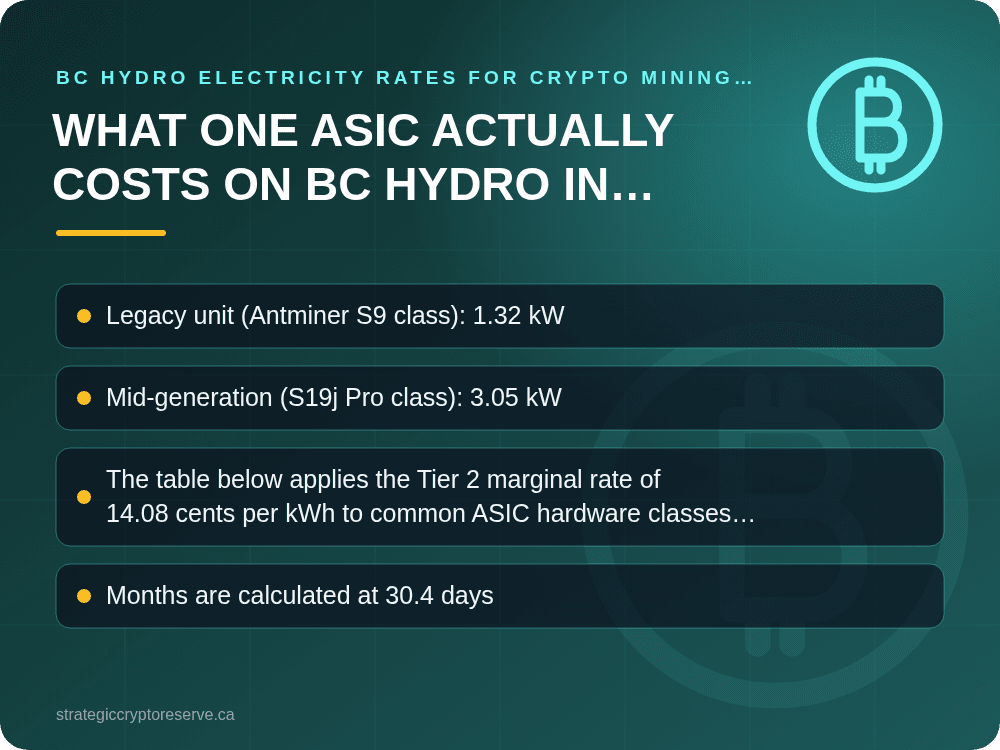
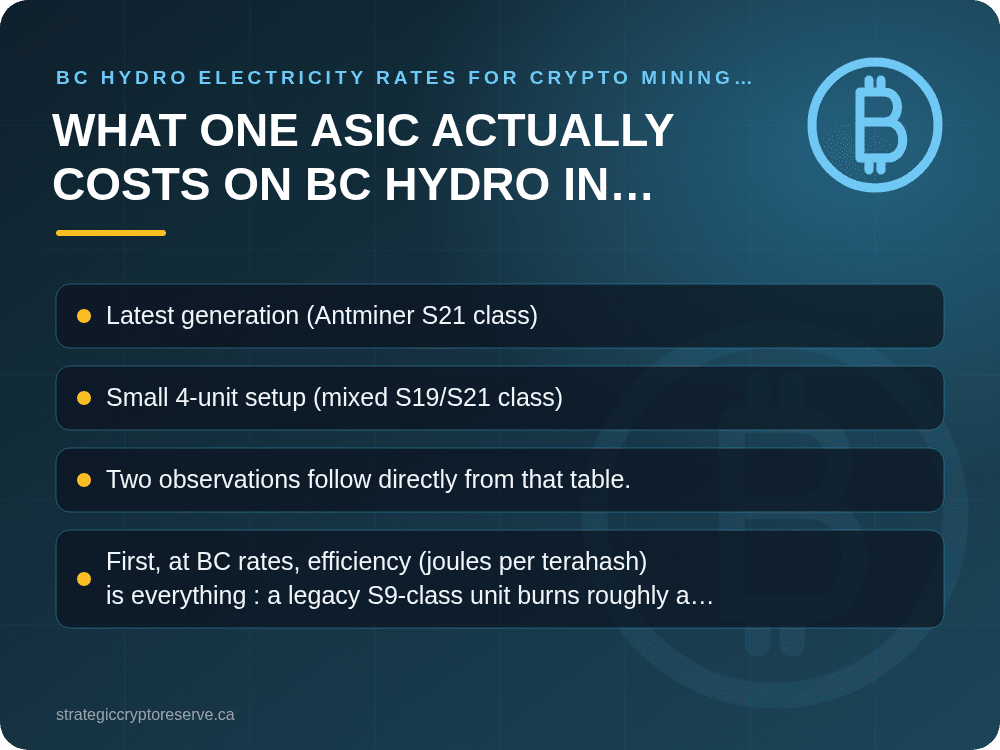
The table below applies the Tier 2 marginal rate of 14.08 cents per kWh to common ASIC hardware classes, assuming 24/7 operation. Power draws are manufacturer-nominal figures; real-world draw varies with firmware, ambient temperature, and power mode. All costs are in Canadian dollars. Months are calculated at 30.4 days.

Hardware ClassNominal DrawkWh / DayCost / Day (CAD)Cost / Month (CAD)
Legacy unit (Antminer S9 class)1.32 kW31.7$4.46~$136
Mid-generation (S19j Pro class)3.05 kW73.2$10.31~$313
Current generation (Whatsminer M50 class)3.30 kW79.2$11.15~$339
Latest generation (Antminer S21 class)3.50 kW84.0$11.83~$360
Small 4-unit setup (mixed S19/S21 class)~13 kW~312~$43.93~$1,335

Two observations follow directly from that table. First, at BC rates, efficiency (joules per terahash) is everything: a legacy S9-class unit burns roughly a third of the power of an S21 but produces a far smaller fraction of the hashrate, which is why old hardware that still pencils out in 3-cent jurisdictions is a money pit at 14 cents. Second, even a modest four-unit setup is a four-figure monthly electricity commitment — which is exactly why our own operation stays deliberately small and why we published a full cost breakdown of what a 300-unit facility would require for anyone tempted to extrapolate upward. For interactive what-if numbers, use the crypto data center calculator.

Whether those electricity costs are recovered by mining revenue depends on Bitcoin's price, network difficulty, and pool or solo strategy — all of which move constantly. We deliberately do not publish profitability projections: this page is about the cost side, which is knowable, not the revenue side, which is speculation.

Time-of-Day Pricing for a 24/7 Load: The Math Nobody Publishes

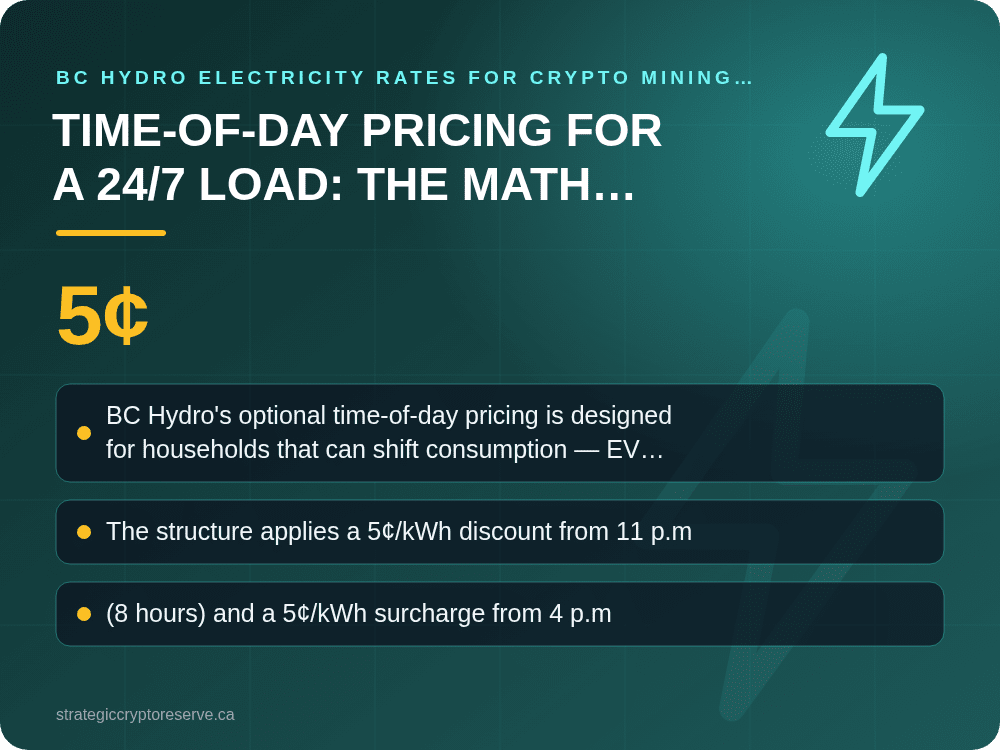
BC Hydro's optional time-of-day pricing is designed for households that can shift consumption — EV charging overnight, laundry after 9 p.m. A mining load can't shift; it runs around the clock. So does time-of-day pricing help, hurt, or wash out for a constant load? Here's the arithmetic.

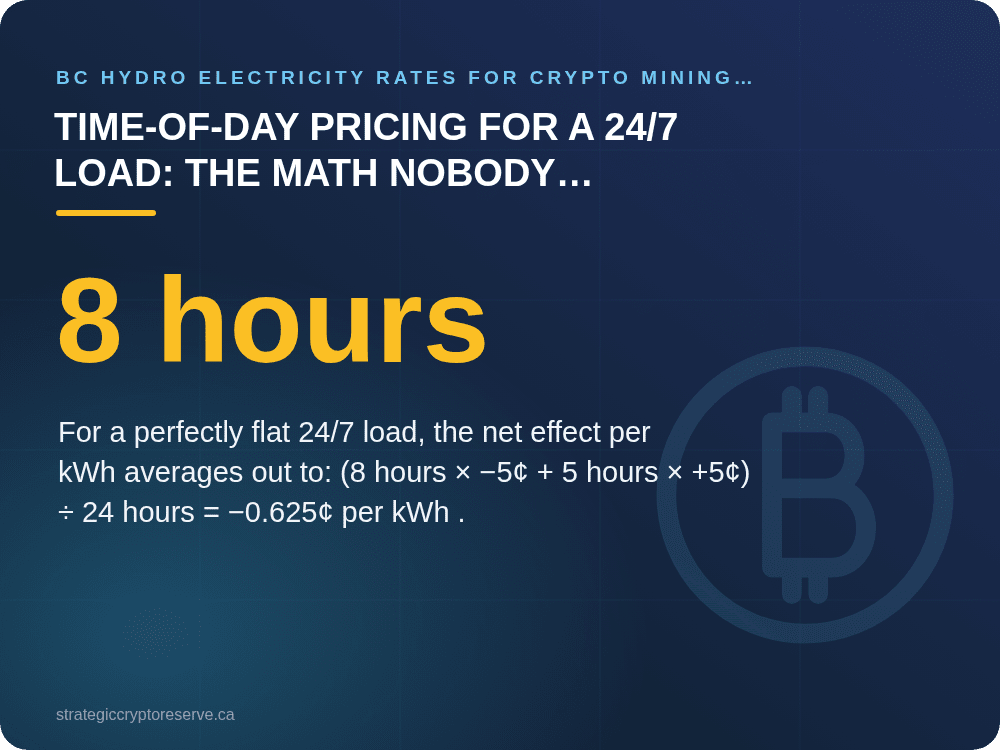
The structure applies a 5¢/kWh discount from 11 p.m. to 7 a.m. (8 hours) and a 5¢/kWh surcharge from 4 p.m. to 9 p.m. (5 hours), with the remaining 11 hours at the standard rate. For a perfectly flat 24/7 load, the net effect per kWh averages out to: (8 hours × −5¢ + 5 hours × +5¢) ÷ 24 hours = −0.625¢ per kWh. Against a 14.08¢ Tier 2 rate, that's roughly a 4.4% reduction — about $16 per month on a single S21-class unit. Real, but modest.

The more interesting play is peak curtailment: pausing hardware during the 4–9 p.m. surcharge window. A miner that runs 19 hours a day and skips the peak entirely captures the full overnight discount while paying zero surcharge — the effective discount jumps to about 2.1¢ per kWh on the hours it does run, at the cost of losing roughly 21% of daily hashing time. Whether that trade is worth it depends on your hardware and the network, but it's the same load-shaping logic we cover in depth in our power grid strategies guide. As with everything on this page: time-of-day terms are optional rate structures that can change, so confirm the current program details with BC Hydro before building a strategy around them.

BC's Permanent Ban on New Crypto Mining Connections: What It Covers

You cannot write honestly about BC Hydro rates for crypto mining without addressing the policy elephant: British Columbia has permanently closed its grid to new cryptocurrency mining connections. Here's the timeline and, more importantly, the boundaries of what the ban actually does.

December 2022

BC Hydro suspends new crypto mining connection requests for 18 months. At the time, 21 projects were requesting a combined 1,403 megawatts — enough to power roughly 570,000 homes. Operational miners and a small number of far-advanced projects were exempt.

Temporary Suspension

2023–2024

The Energy Statutes Amendment Act gives Cabinet direct authority over electricity allocation. The suspension is extended to 36 months in spring 2024. Court challenges to the policy fail twice, with judges siding with the province's public-interest mandate.

Extended & Upheld

October 2025

The province announces the ban on new BC Hydro grid connections for crypto mining will be made permanent via the Cryptocurrency Power Regulation — the first Canadian province to do so. Pending crypto projects would have demanded over 11,700 GWh per year.

Permanent Ban

January 2026

AI and data centers get a different deal: a competitive allocation process capped at 400 MW every two years — 300 MW for AI, 100 MW for other data centers. Traditional resource industries keep uncapped access. Crypto mining gets nothing.

Competitive Framework

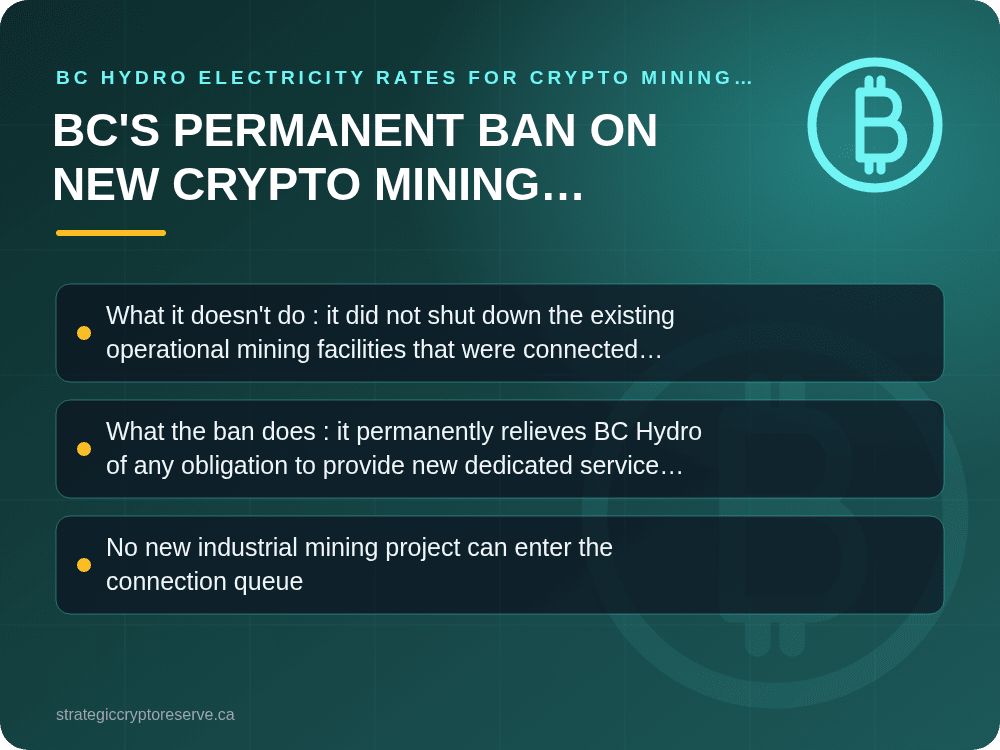
What the ban does: it permanently relieves BC Hydro of any obligation to provide new dedicated service connections to cryptocurrency mining operations. No new industrial mining project can enter the connection queue. What it doesn't do: it did not shut down the existing operational mining facilities that were connected before December 2022, and it does not make owning or running mining hardware illegal in British Columbia.

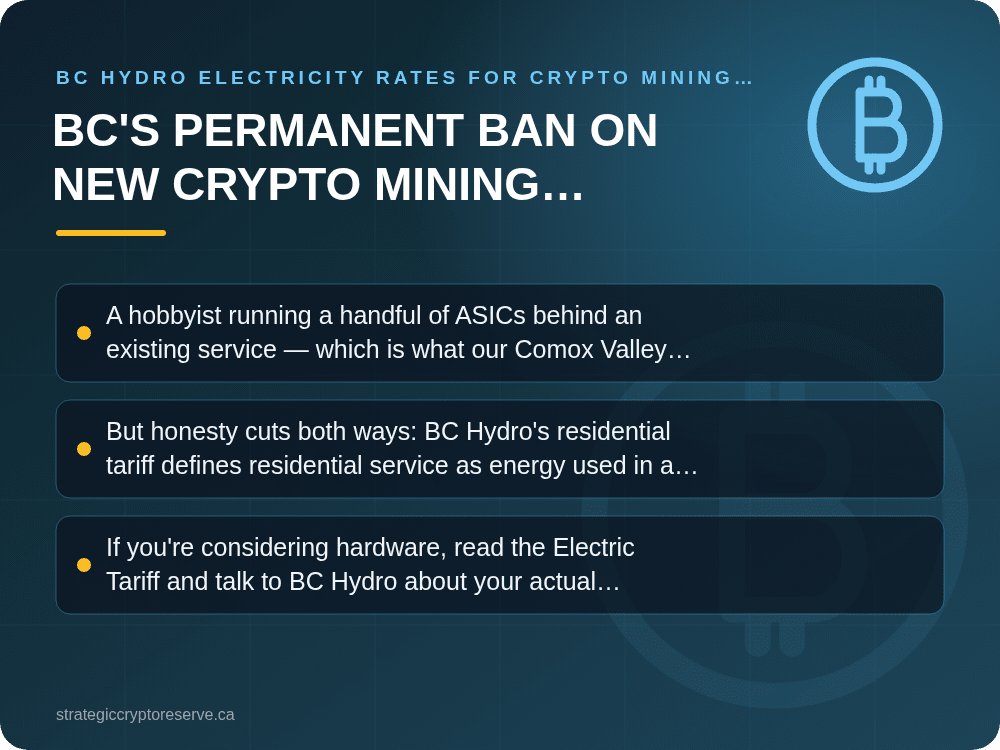
Where does that leave small-scale operators? A hobbyist running a handful of ASICs behind an existing service — which is what our Comox Valley setup is — is simply not the thing the regulation was written to stop; the policy targets new connection applications from operations demanding megawatts. But honesty cuts both ways: BC Hydro's residential tariff defines residential service as energy used in a dwelling, and scaling up commercial-grade consumption on a residential rate can put you offside the tariff's terms. If you're considering hardware, read the Electric Tariff and talk to BC Hydro about your actual situation. This page is information, not an instruction manual for working around provincial energy policy — and frankly, the policy's logic is hard to argue with: crypto mining consumes enormous power and creates few local jobs, and BC chose to spend its clean hydro on electrification instead. We think the honest response is to be small, transparent, and upfront about it, which is the entire editorial position of this site.

How BC Compares: Quebec, Alberta, and the U.S.

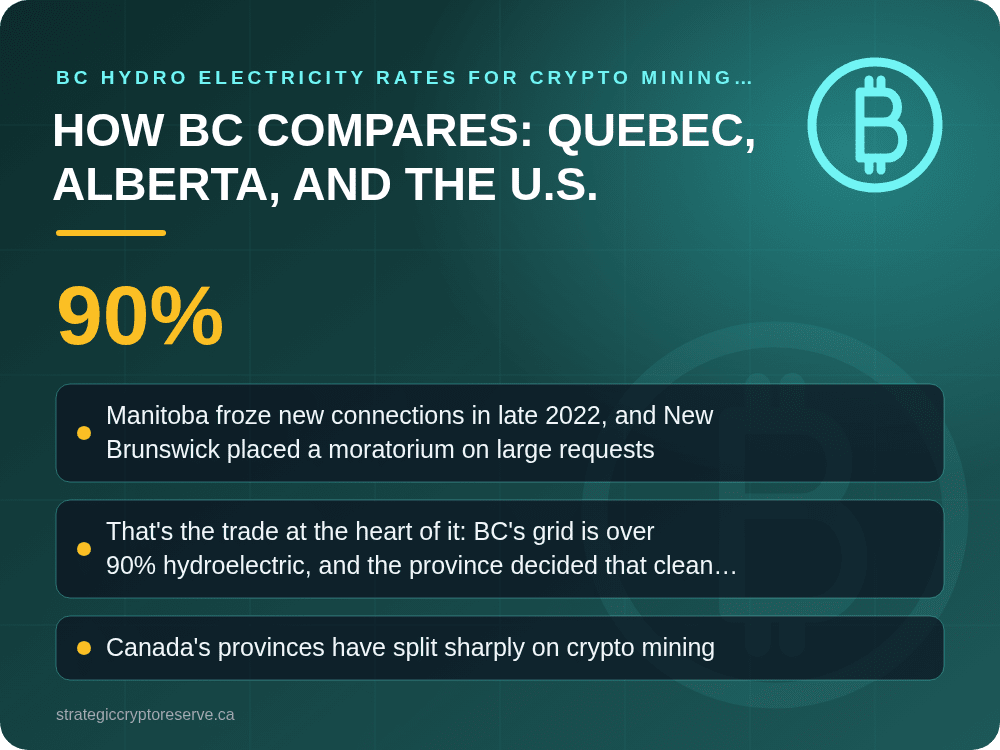
Canada's provinces have split sharply on crypto mining. Quebec restricted the sector early: Hydro-Québec capped allocations and imposed higher rates on crypto loads after its own flood of applications. Manitoba froze new connections in late 2022, and New Brunswick placed a moratorium on large requests. British Columbia went furthest — the first province to make its ban permanent.

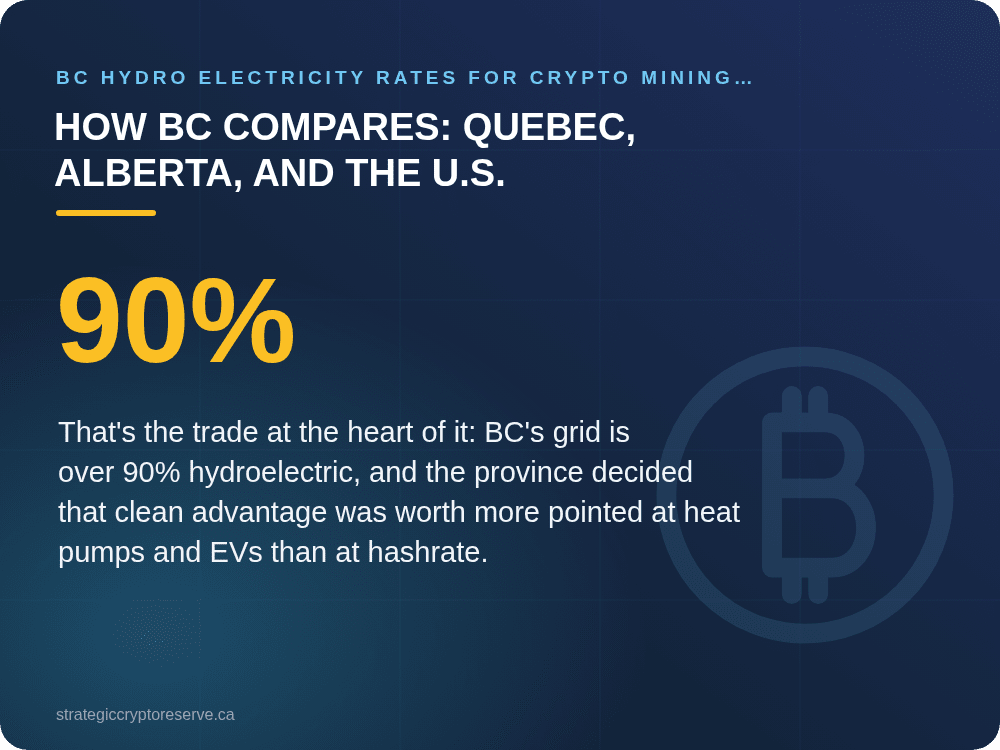
The outlier is Alberta, whose deregulated market lets miners buy power on the open market — often gas-generated — without connection restrictions, which is why displaced Canadian mining capacity has drifted east. In the U.S., Texas and central Washington remain the reference mining hubs, with industrial power contracts that can undercut BC's residential rates, though with grids that are far less clean. That's the trade at the heart of it: BC's grid is over 90% hydroelectric, and the province decided that clean advantage was worth more pointed at heat pumps and EVs than at hashrate. For a small operator already here, 14.08¢/kWh of nearly carbon-free power on an existing connection is the deal on the table — decent by residential standards, uncompetitive against industrial mining contracts, and the reason we treat mining as real infrastructure rather than a business model.

How This Connects to the SCR Token Ecosystem

The Bitcoin mining operation whose electricity bills inform this page and the SCR token are related by ownership — both are part of the same Strategic Crypto Reserve project — but they are not financially linked. SCR is a parody utility token used for NFT redemption within the ecosystem. Holding SCR tokens grants no claim on mining proceeds, hash power, or block rewards, and there is no profit-sharing mechanism between the two.

What the mining operation provides is the raw material for pages like this one: real BC Hydro bills, real rate data, and firsthand operating knowledge from Vancouver Island. For the rest of the project's blockchain infrastructure, see the project whitepaper — and treat the token and NFT side, as it describes itself, as entertainment and community engagement rather than an investment vehicle.

Frequently Asked Questions: BC Hydro Rates for Crypto Mining

1. How much does BC Hydro electricity cost for crypto mining in 2026?

On BC Hydro's residential tiered rate in 2026, electricity costs approximately 11.87 cents per kWh up to the Tier 1 threshold (about 1,350 kWh per two-month billing period) and 14.08 cents per kWh above it. Because ASIC miners run 24/7 and a single modern unit consumes roughly 2,200–2,600 kWh per month on its own, mining load lands almost entirely in Tier 2 — so 14.08 cents per kWh is the realistic marginal rate to use for cost planning. A net bill increase of 3.75% took effect April 1, 2026. Always confirm current rates directly with BC Hydro before making decisions.

2. Is crypto mining banned in British Columbia?

New grid connections for cryptocurrency mining operations are permanently banned. BC Hydro first suspended new crypto mining connection requests in December 2022, extended the suspension to 36 months in spring 2024, and in October 2025 the provincial government announced the ban on new BC Hydro connections for crypto mining would be made permanent through the Cryptocurrency Power Regulation. Existing operational mining facilities were not shut down by the policy — the ban applies to new connection requests. It does not make owning or running mining hardware illegal in BC; it removes BC Hydro's obligation to provide new dedicated service connections for crypto mining projects.

3. Why do crypto miners pay BC Hydro's Tier 2 rate instead of the cheaper Tier 1 rate?

BC Hydro's tiered residential rate charges a lower price for roughly the first 22.2 kWh per day and a higher price (14.08 cents per kWh) for everything above that. A typical household's normal usage — lights, appliances, heating — already consumes most or all of the Tier 1 allowance. Any mining hardware added on top of that baseline is incremental consumption, so nearly every kilowatt-hour a miner draws is billed at the Tier 2 rate. This is why the marginal rate, not the blended or Tier 1 rate, is the honest number for mining cost calculations.

4. Does BC Hydro's time-of-day pricing save money for a 24/7 mining load?

Slightly, in theory. BC Hydro's optional time-of-day pricing applies a 5 cent per kWh discount overnight (11 p.m. to 7 a.m.) and a 5 cent per kWh surcharge during the evening peak (4 p.m. to 9 p.m.). For a constant 24/7 load, that works out to 8 discounted hours and 5 surcharged hours per day — a net average reduction of roughly 0.6 cents per kWh, or about 4% off the Tier 2 rate. A load that pauses during the 4–9 p.m. peak window would save meaningfully more. Confirm the current time-of-day terms with BC Hydro, as optional rate structures can change.

5. Can a small hobby miner still operate on BC Hydro's grid?

The permanent ban targets new dedicated grid connection requests from cryptocurrency mining operations — the industrial-scale projects that were requesting over 1,400 megawatts collectively. A small-scale hobbyist running a modest number of ASICs behind an existing service, like Strategic Crypto Reserve's Comox Valley setup, is a different situation than a new industrial connection application. That said, BC Hydro's residential tariff defines residential service as energy used in a dwelling, and running commercial-scale equipment on a residential rate can violate tariff terms. Anyone considering mining hardware should review BC Hydro's Electric Tariff and confirm their situation directly with BC Hydro rather than assuming.