AI Markets · Live Charts · Updated September 27, 2026

AI Data Center Stocks: The Complete 2026 List With Live Charts

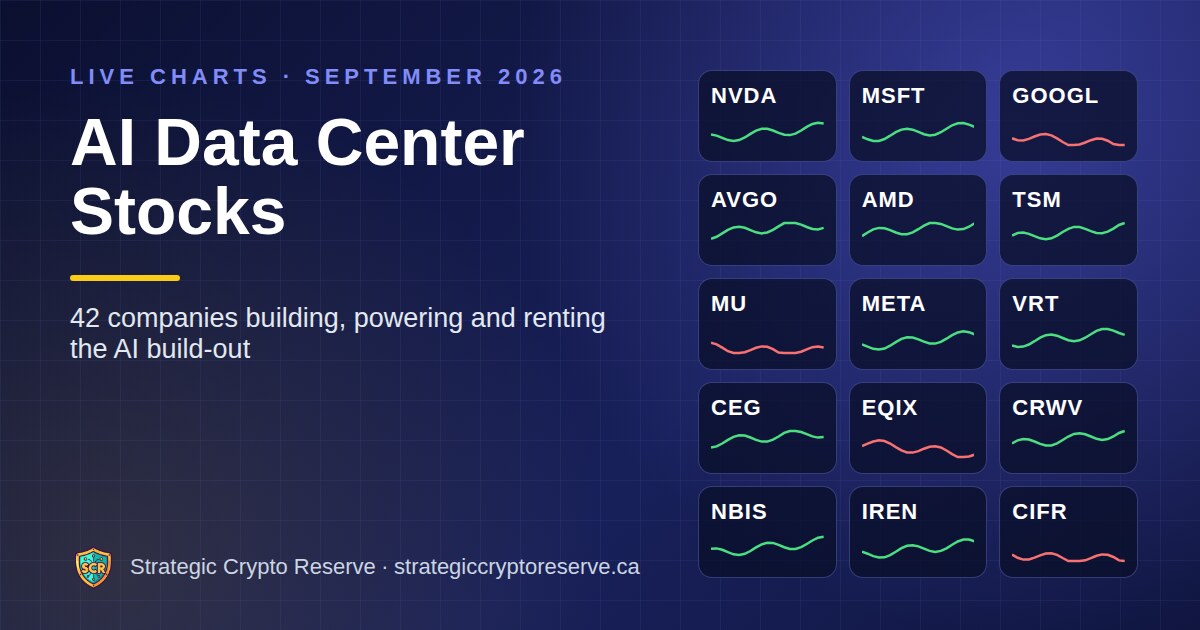
The AI boom is being built out of concrete, copper, silicon and electricity. This page lists 42 AI data center stocks across the eight layers of that build-out, from the hyperscalers paying for it to the chip makers, optics suppliers, power producers, landlords and converted bitcoin miners selling into it. Every stock has its own live chart and a plain-English summary of how it makes money from AI data centers, updated with the news that moved it in September 2026.


AI data center stocks 2026: NVDA, MSFT, GOOGL, AVGO, AMD, TSM and more with live charts

What Counts as an AI Data Center Stock?

An AI data center stock is any listed company whose revenue rises when more AI computing capacity gets built, powered or rented. That is a wider group than most lists admit. The obvious names are the chip designers, led by Nvidia, but a single AI campus also needs optical links, servers, switches, transformers, turbines, liquid cooling, a long-term power contract and a landlord, and each of those is a separate public market with its own leaders.

We group the 42 stocks below into eight layers, ordered roughly by where the money flows: the hyperscalers who spend it, the chip makers and connectivity suppliers who capture most of each budget, the server and networking companies who assemble it, the power and cooling equipment makers, the power producers selling electrons, the data center REITs, and the neoclouds and converted bitcoin miners that rent capacity directly.

The live charts load one-month price history from TradingView as you scroll, so you can compare how each layer has traded. Market values in the summaries are a Finnhub snapshot from September 27, 2026. If you are costing a build rather than buying shares, our AI Build Configurator models the same chips, power and cooling line by line, and the state tariff library covers the utility rules each campus has to live with.
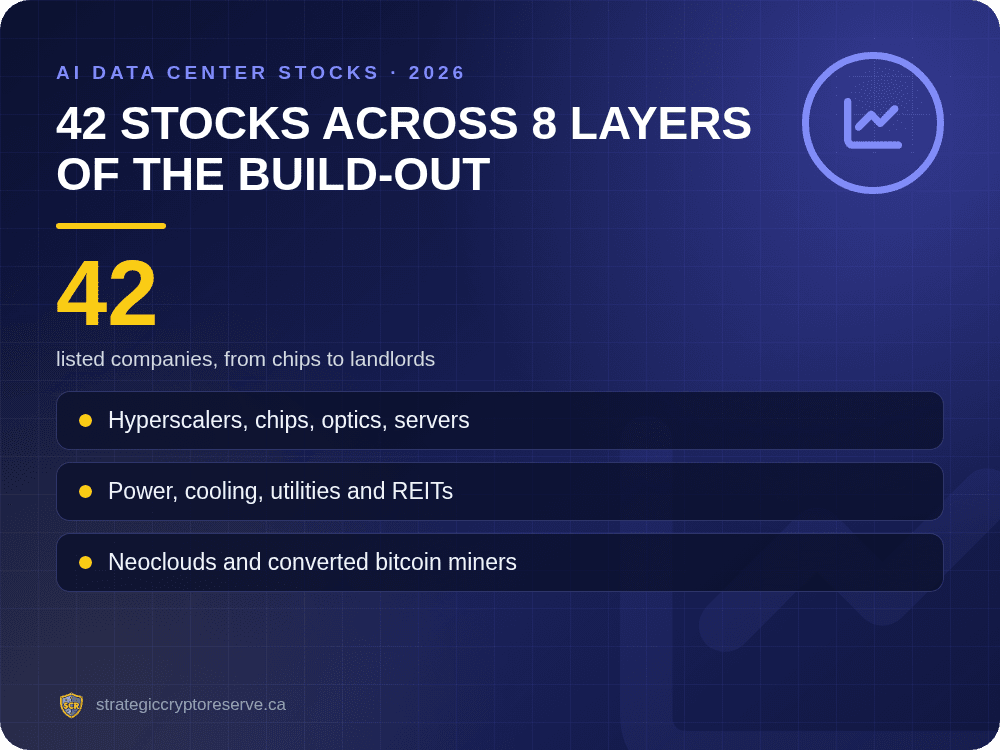
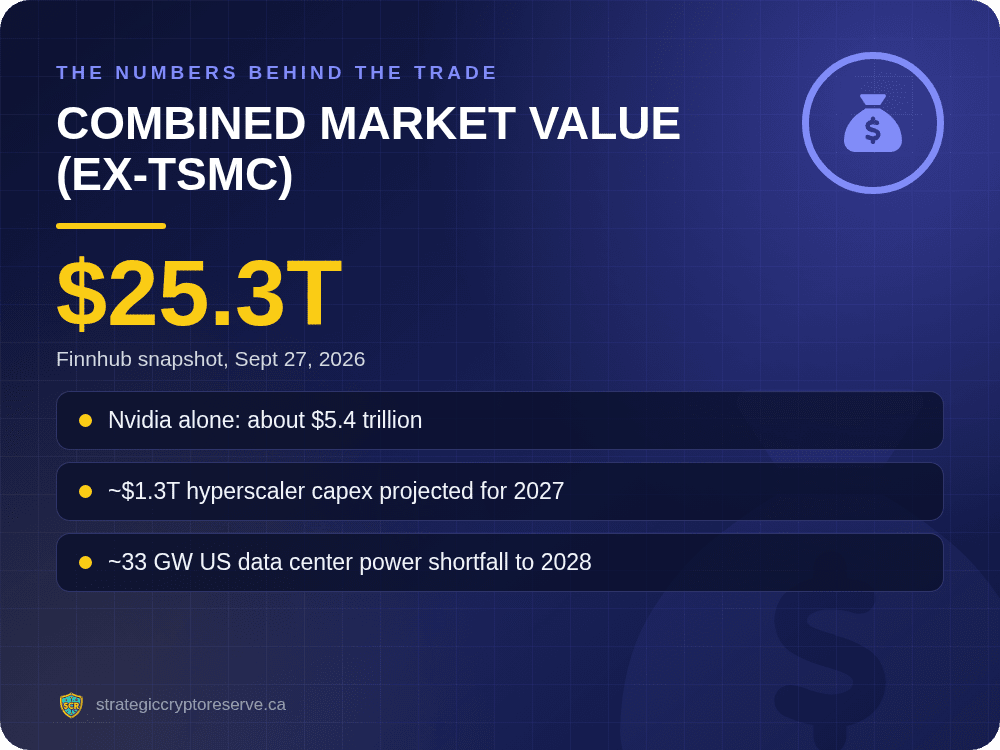
42 AI data center stocks across 8 layers: hyperscalers, chips, optics, servers, power, cooling, REITs and neoclouds AI data center stocks combined market value, Finnhub snapshot September 27 2026

The Full List of AI Data Center Stocks at a Glance

Tap any ticker to jump to its live chart and summary.

1. Hyperscalers: The Companies Paying for the Build-Out

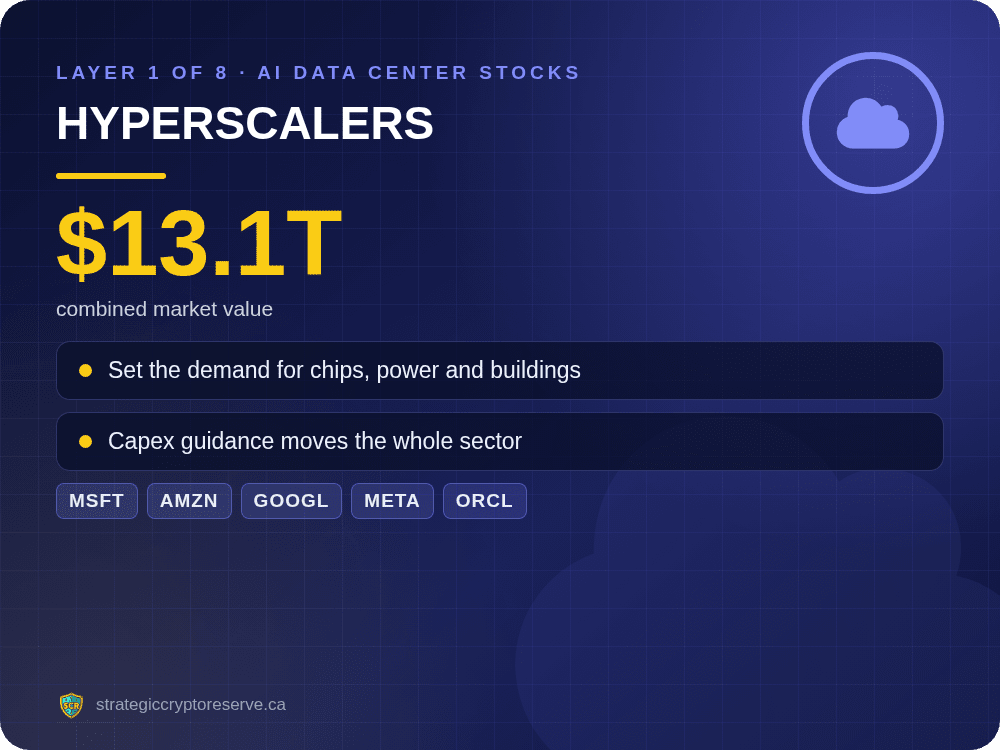
Five companies write most of the cheques. Their combined AI capital spending is what every other stock on this list is ultimately selling into, so their quarterly capex guidance is the single most important number in the sector. Analysts now project hyperscaler spending at around $1.3 trillion for 2027, and a growing share of it is financed with debt: September 2026 brought what commentators called a record tech bond boom as these companies borrowed to keep building.

MSFT
Microsoft · ~$3.83T
AMZN
Amazon · ~$2.69T
GOOGL
Alphabet (Google) · ~$4.21T
META
Meta Platforms · ~$1.91T
ORCL
Oracle · ~$415B
AI data center stocks layer 1 of 8: Hyperscalers, MSFT, AMZN, GOOGL, META, ORCL

Microsoft MSFTMkt cap ~$3.83T

Microsoft is the most aggressive renter of outside AI capacity in the market. Beyond its own Azure regions, it has signed multi-billion-dollar GPU capacity contracts with neoclouds including Nebius and IREN, which is why several smaller stocks on this page trade on Microsoft headlines. Azure is the cloud behind OpenAI's workloads and the Copilot products, and reporting in late September 2026 put Azure growth on a path toward 45% a year. For an investor, Microsoft is the lowest-risk way to own AI data center demand: the build-out is funded by one of the strongest balance sheets in the world, and the stock does not depend on any single tenant paying its bills.

MSFTNASDAQ
LIVE
  Loading live MSFT chart…
1-month chart · MSFT on TradingView
AMZNNASDAQ
LIVE
  Loading live AMZN chart…
1-month chart · AMZN on TradingView

Amazon AMZNMkt cap ~$2.69T

Amazon Web Services is the largest public cloud and the second pillar of AI infrastructure spending. AWS designs its own Trainium training chips and Graviton CPUs to reduce its dependence on Nvidia, and it is the largest outside investor in Anthropic, whose planned IPO commentators have called a $300 billion test for Amazon. AWS also leases capacity from converted bitcoin miners, including Cipher Digital. The risk to watch is concentration: when Anthropic signed an $11.6 billion cloud deal with Akamai in September 2026, Amazon shares dipped, a reminder that its AI story is tied to keeping its biggest model customer in-house.

Alphabet (Google) GOOGLMkt cap ~$4.21T

Alphabet is the only hyperscaler that owns a mature second source of AI silicon: its Tensor Processing Units (TPUs), co-designed with Broadcom, now power both Gemini and outside customers through Google Cloud. Google is also one of the busiest data center builders in North America, with campuses covered on our tariff pages in Iowa, Minnesota, Missouri, Oklahoma and Arkansas. In September 2026 it fast-tracked Project Suncatcher, an experimental satellite carrying its AI chips to test orbital data centers. Google has also provided financial backstops for leases signed by bitcoin-miner conversions, which makes it an indirect credit support for several small caps below.

GOOGLNASDAQ
LIVE
  Loading live GOOGL chart…
1-month chart · GOOGL on TradingView
METANASDAQ
LIVE
  Loading live META chart…
1-month chart · META on TradingView

Meta Platforms METAMkt cap ~$1.91T

Meta is building some of the largest single AI campuses in the world, including the planned $50 billion, 5 GW Hyperion site in Richland Parish, Louisiana, detailed on our Louisiana tariff page, plus projects in Alabama, New Mexico and Wyoming. The September 2026 launch of its Muse AI agent changed the narrative around the stock almost overnight: Wall Street coverage described Meta going from AI laggard to leader in a week, and the rally pushed its value near $2 trillion. Muse also lifted chip and networking suppliers such as Arm and Credo, showing how one hyperscaler product can move the whole supply chain.

Oracle ORCLMkt cap ~$415B

Oracle turned itself into an AI landlord through Oracle Cloud Infrastructure and its role in the OpenAI Stargate program, which includes the flagship campus near Abilene, Texas. That transformation has been financed heavily with debt, and September 2026 exposed the risk: Oracle issued a force majeure notice on its Project Jupiter AI data center, citing delays in the natural gas pipeline meant to supply it. It then reaffirmed its roughly 2.4 GW fuel cell contract with Bloom Energy for the site, which calmed the market, but the episode is the clearest example yet that power delivery, not chips, is now the constraint on AI data center timelines.

ORCLNYSE
LIVE
  Loading live ORCL chart…
1-month chart · ORCL on TradingView

2. AI Chips and Accelerators: The Compute Layer

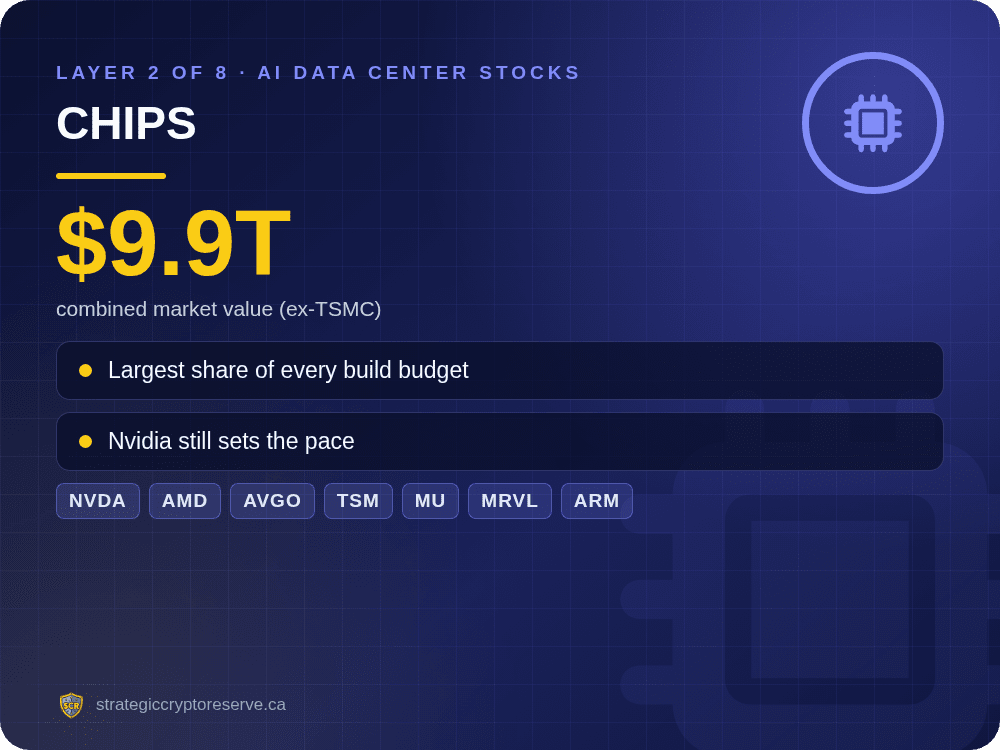
Every AI data center is, at its core, a building designed around accelerators. This layer captures the largest share of each dollar spent: a GPU cluster can account for more than half of a facility's total cost. It is also the most crowded trade on the list, which is why these seven names carry the highest valuations and the sharpest swings when capex expectations change.

NVDA
NVIDIA · ~$5.42T
AMD
Advanced Micro Devices · ~$1.03T
AVGO
Broadcom · ~$1.68T
TSM
Taiwan Semiconductor (TSMC) · ~TWD 64.2T
MU
Micron Technology · ~$1.22T
MRVL
Marvell Technology · ~$230B
ARM
Arm Holdings · ~$327B
AI data center stocks layer 2 of 8: Chips, NVDA, AMD, AVGO, TSM, MU, MRVL, ARM
NVDANASDAQ
LIVE
  Loading live NVDA chart…
1-month chart · NVDA on TradingView

NVIDIA NVDAMkt cap ~$5.42T

Nvidia is the defining AI data center stock and, at about $5.4 trillion, the largest company on this list. Its GPUs, NVLink interconnect and CUDA software are the default platform for training and running frontier models, and its next platform, Vera Rubin, began shipping in partner systems in September 2026. Nvidia increasingly invests in its own customers: it pledged up to $10 billion to Anthropic in 2025 and has been reported to be weighing a further stake in the Anthropic IPO, a structure critics describe as buying its own demand. The stock's risk is simply expectations, because any slowdown in hyperscaler capex hits the market leader first.

Advanced Micro Devices AMDMkt cap ~$1.03T

AMD crossed $1 trillion in market value in 2026 on two engines: its Instinct accelerators, now deployed by OpenAI, Meta and Microsoft as the main merchant alternative to Nvidia, and its EPYC server CPUs. The CPU side has become a surprise second AI story. Agentic AI products such as Meta's Muse run far more general-purpose compute alongside GPUs, and Bank of America argued in September 2026 that AMD could win a $211 billion data center CPU race. For investors, AMD offers AI exposure with less concentration in one product line than Nvidia, but it remains the challenger and trades on execution against each new Nvidia generation.

AMDNASDAQ
LIVE
  Loading live AMD chart…
1-month chart · AMD on TradingView
AVGONASDAQ
LIVE
  Loading live AVGO chart…
1-month chart · AVGO on TradingView

Broadcom AVGOMkt cap ~$1.68T

Broadcom is the leader in custom AI accelerators (often called XPUs or ASICs), co-designing chips such as Google's TPUs and building custom silicon for other hyperscalers and OpenAI. It also sells the Tomahawk and Jericho Ethernet switch chips that connect GPU clusters, so it earns money on both compute and networking. Custom chips are the main way hyperscalers try to lower their cost per token compared with buying Nvidia GPUs, which makes Broadcom the purest play on that shift. Its large VMware software business adds steady cash flow, giving it a more balanced profile than most chip stocks on this list.

Taiwan Semiconductor (TSMC) TSMMkt cap ~TWD 64.2T

TSMC manufactures almost every leading-edge AI chip in the world, including the GPUs and custom accelerators from Nvidia, AMD and Broadcom, and it controls the advanced CoWoS packaging that stacks those chips with high-bandwidth memory. That makes it the one company that gets paid whichever chip designer wins. It is expanding in the United States, with a Phoenix fab complex now valued at $165 billion that ramps from about 200 MW toward 1,000 MW of load, as covered on our Arizona tariff page. The main risk is geopolitical: most of its capacity is still in Taiwan, which keeps US-China relations front of mind for holders.

TSMNYSE
LIVE
  Loading live TSM chart…
1-month chart · TSM on TradingView
MUNASDAQ
LIVE
  Loading live MU chart…
1-month chart · MU on TradingView

Micron Technology MUMkt cap ~$1.22T

Micron is the only US maker of high-bandwidth memory (HBM), the stacked DRAM that sits beside every AI accelerator and limits how large a model a GPU can hold. HBM demand has turned memory, historically a boom-and-bust commodity, into one of the tightest parts of the AI supply chain, and Micron's market value passed $1.2 trillion in 2026. Late September brought a sharp rally in memory names alongside Sandisk. Its competitors are South Korea's SK Hynix and Samsung, which are not US-listed. Memory cycles have historically been cyclical, so investors should watch pricing and supply additions closely.

Marvell Technology MRVLMkt cap ~$230B

Marvell supplies two things AI data centers cannot run without: custom accelerator and CPU designs for hyperscalers, and the electro-optical DSP chips inside the transceivers that carry data between servers. In September 2026 it unveiled a 2nm optical platform aimed at the bandwidth and power limits of large AI clusters. It competes directly with Broadcom for custom silicon, and investors track which hyperscaler programs each company wins. Marvell is more exposed than Broadcom to any single customer slowing a program, which makes it more volatile, but also more leveraged to the optical upgrade cycle from 800G to 1.6T.

MRVLNASDAQ
LIVE
  Loading live MRVL chart…
1-month chart · MRVL on TradingView
ARMNASDAQ
LIVE
  Loading live ARM chart…
1-month chart · ARM on TradingView

Arm Holdings ARMMkt cap ~$327B

Arm does not sell chips. It licenses the CPU architecture used in Nvidia's Grace and Vera CPUs, AWS Graviton, Google Axion and Microsoft Cobalt, and it earns a royalty on each one shipped. That has made it a quiet winner as AI data centers add more general-purpose compute beside every GPU, a trend that accelerated with agentic AI products such as Meta's Muse. The stock rose on AI CPU demand in September 2026, though some sessions saw pressure as investors questioned whether royalty rates keep up as chips pack in more cores. Arm is majority-owned by SoftBank, a heavy AI investor in its own right.

3. Connectivity Silicon and Optics: Moving Data Between GPUs

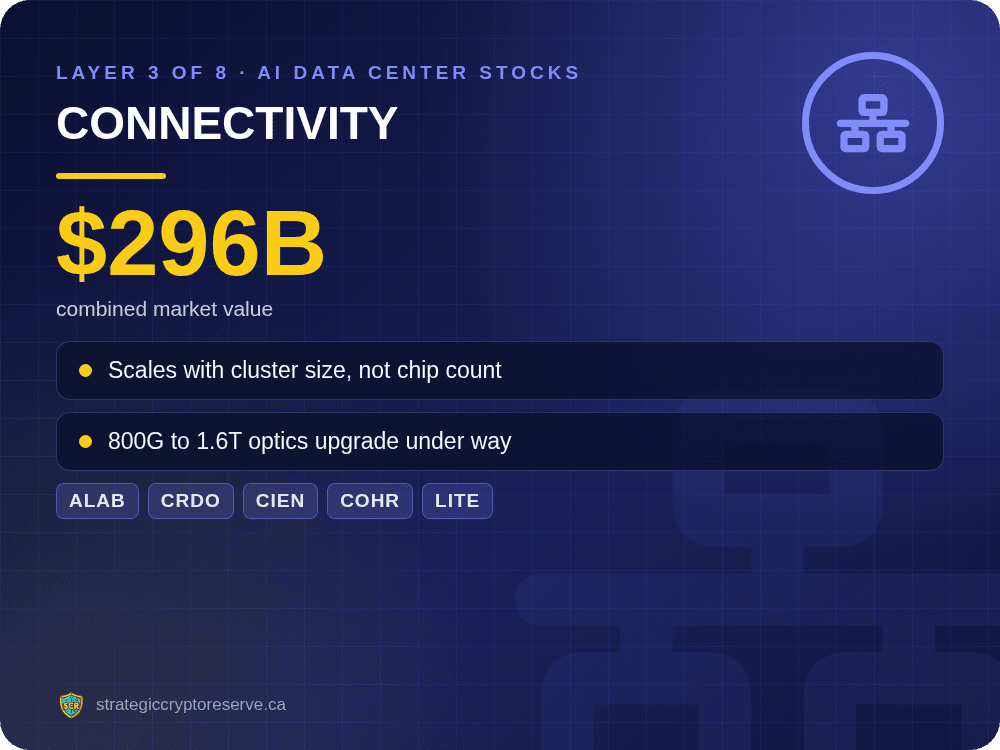
An AI cluster is only as fast as the links between its chips. As clusters grow from thousands to hundreds of thousands of GPUs, the cables, retimers, lasers and optical transceivers that connect them have become one of the fastest-growing corners of the market. The shift from 800G to 1.6T optics is the upgrade cycle driving these five stocks in 2026.

ALAB
Astera Labs · ~$63.3B
CRDO
Credo Technology · ~$39.7B
CIEN
Ciena · ~$50.6B
COHR
Coherent · ~$57.9B
LITE
Lumentum · ~$84.5B
AI data center stocks layer 3 of 8: Connectivity, ALAB, CRDO, CIEN, COHR, LITE

Astera Labs ALABMkt cap ~$63.3B

Astera Labs makes the connectivity chips that keep data flowing inside AI servers: PCIe and CXL retimers that extend signal reach, Scorpio fabric switches, and Leo CXL memory controllers, a line it expanded in September 2026 for AI and cloud memory pooling. Nearly every rack-scale AI system uses parts like these, which is why the company grew from its March 2024 IPO into a $63 billion business. It is one of the most direct plays on the number of accelerators being installed, but its customer base is concentrated among a few hyperscalers and server makers, so a delay in one platform shows up quickly in results.

ALABNASDAQ
LIVE
  Loading live ALAB chart…
1-month chart · ALAB on TradingView
CRDONASDAQ
LIVE
  Loading live CRDO chart…
1-month chart · CRDO on TradingView

Credo Technology CRDOMkt cap ~$39.7B

Credo built its business on active electrical cables (AECs), the thick copper links that connect servers to switches inside AI racks at lower power and cost than optics. It also sells SerDes and optical DSP chips, and in September 2026 launched its 1.6T ZeroFlap optical transceivers, combining 224G DSPs with silicon photonics. That gives Credo exposure to both copper and optical links as clusters scale. Analysts credited Meta's Muse launch with validating the AI trade for suppliers like Credo. Like Astera Labs, it depends on a small number of very large customers.

Ciena CIENMkt cap ~$50.6B

Ciena makes the coherent optical systems that connect data centers to each other over long distances. As AI training spreads across multiple campuses and power constraints push new sites far from cities, data center interconnect has become a growth business for a company once seen as a slow telecom supplier. Evercore raised its rating in September 2026 on the AI-driven optical networking boom, and Ciena launched a venture fund to invest in AI networking. It is a less crowded way to own AI infrastructure, though it still carries exposure to traditional telecom spending.

CIENNYSE
LIVE
  Loading live CIEN chart…
1-month chart · CIEN on TradingView
COHRNYSE
LIVE
  Loading live COHR chart…
1-month chart · COHR on TradingView

Coherent COHRMkt cap ~$57.9B

Coherent is one of the largest makers of the optical transceivers and lasers that plug into AI switches and servers, supplying 800G and 1.6T modules to hyperscalers. In September 2026 it launched PhotonLink, an integrated optics platform designed for AI infrastructure. Coherent also benefits from policy: US lawmakers are pushing to limit Chinese-made optical components in sensitive systems, which favours domestic suppliers. The company has spent the past two years refocusing on data center and communications products, and investors track its margins as well as its volume.

Lumentum LITEMkt cap ~$84.5B

Lumentum supplies the lasers (EMLs and VCSELs) inside optical transceivers and is moving into optical circuit switches, which let operators reconfigure AI clusters without rewiring. Its market value climbed to about $84 billion as AI optics demand outran supply. In September 2026 it demonstrated high-density chip-to-chip optical links with Corning and Qualcomm at ECOC 2026, pointing to the next step, where optics move closer to the chip itself (co-packaged optics). It has one of the highest-beta profiles among the optics names, so moves in both directions tend to be sharp.

LITENASDAQ
LIVE
  Loading live LITE chart…
1-month chart · LITE on TradingView

4. Servers and Networking Systems: Racks, Switches and Integration

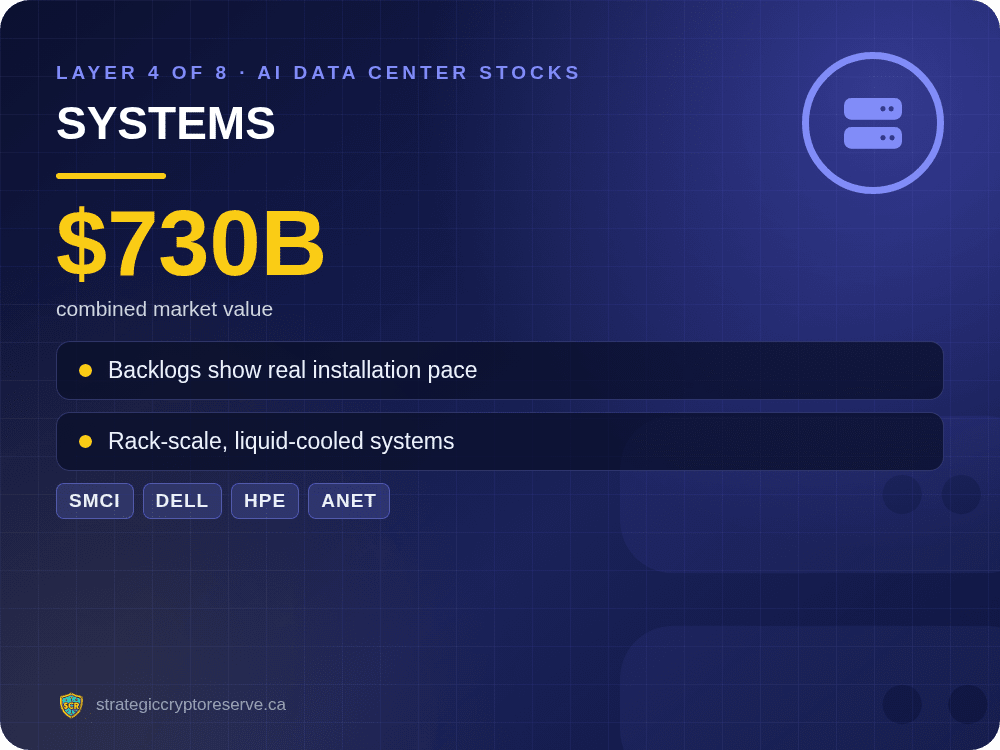
Chips have to be built into servers, racks and networks before they do any work. These four companies assemble and connect the hardware, and increasingly deliver entire liquid-cooled racks ready to plug in. Margins are thinner than in chips, but order backlogs here are one of the best real-time signals of how fast AI capacity is actually being installed.

SMCI
Super Micro Computer · ~$28.4B
DELL
Dell Technologies · ~$358B
HPE
Hewlett Packard Enterprise · ~$83.6B
ANET
Arista Networks · ~$261B
AI data center stocks layer 4 of 8: Systems, SMCI, DELL, HPE, ANET
SMCINASDAQ
LIVE
  Loading live SMCI chart…
1-month chart · SMCI on TradingView

Super Micro Computer SMCIMkt cap ~$28.4B

Super Micro builds GPU servers and complete liquid-cooled racks, and it is usually among the first to ship Nvidia's newest platforms. It reported a record AI backlog including more than $60 billion of new fourth-quarter orders, and it is expanding capacity to over 6,000 racks a month, with Vera Rubin systems starting to ship in September 2026. The stock carries a history of governance concerns after its 2024 auditor resignation and delayed filings, and it trades at a discount to rivals partly for that reason. It remains one of the highest-volatility names on this list.

Dell Technologies DELLMkt cap ~$358B

Dell has become one of the largest suppliers of AI servers to neoclouds and enterprises, building PowerEdge XE systems for customers such as CoreWeave and xAI. AI servers now drive its growth, and on September 10, 2026 it raised $5 billion in an investment-grade bond sale that drew as much as $23 billion in orders. Dell's advantage over smaller rivals is its enterprise sales force and financing capacity, which matter as companies outside Big Tech start building their own AI infrastructure. Its PC business adds stability, but also ties part of the stock to the consumer cycle.

DELLNYSE
LIVE
  Loading live DELL chart…
1-month chart · DELL on TradingView
HPENYSE
LIVE
  Loading live HPE chart…
1-month chart · HPE on TradingView

Hewlett Packard Enterprise HPEMkt cap ~$83.6B

Hewlett Packard Enterprise sells AI servers and Cray supercomputers, and its 2025 acquisition of Juniper Networks made it a serious player in data center networking as well. That combination lets it sell complete AI systems to governments, research labs and large enterprises that want on-premises AI rather than renting cloud GPUs. HPE is often compared with Dell and Super Micro, and it trades at a lower valuation than both, reflecting slower growth but a steadier customer base. Its sovereign and supercomputing exposure gives it a different demand driver from the hyperscaler-heavy names.

Arista Networks ANETMkt cap ~$261B

Arista makes the high-speed Ethernet switches that connect GPU clusters, and it counts Meta and Microsoft among its largest customers. As AI back-end networks shift from Nvidia's InfiniBand to Ethernet, Arista has been a major beneficiary, and in September 2026 it raised its full-year revenue outlook on continued AI data center demand. It competes with Nvidia's own Spectrum-X Ethernet and with Cisco, and investors weigh its faster AI growth against a valuation that runs at about twice Cisco's earnings multiple. Arista's customer concentration is its main risk.

ANETNYSE
LIVE
  Loading live ANET chart…
1-month chart · ANET on TradingView

5. Power and Cooling Equipment: Keeping the Racks Alive

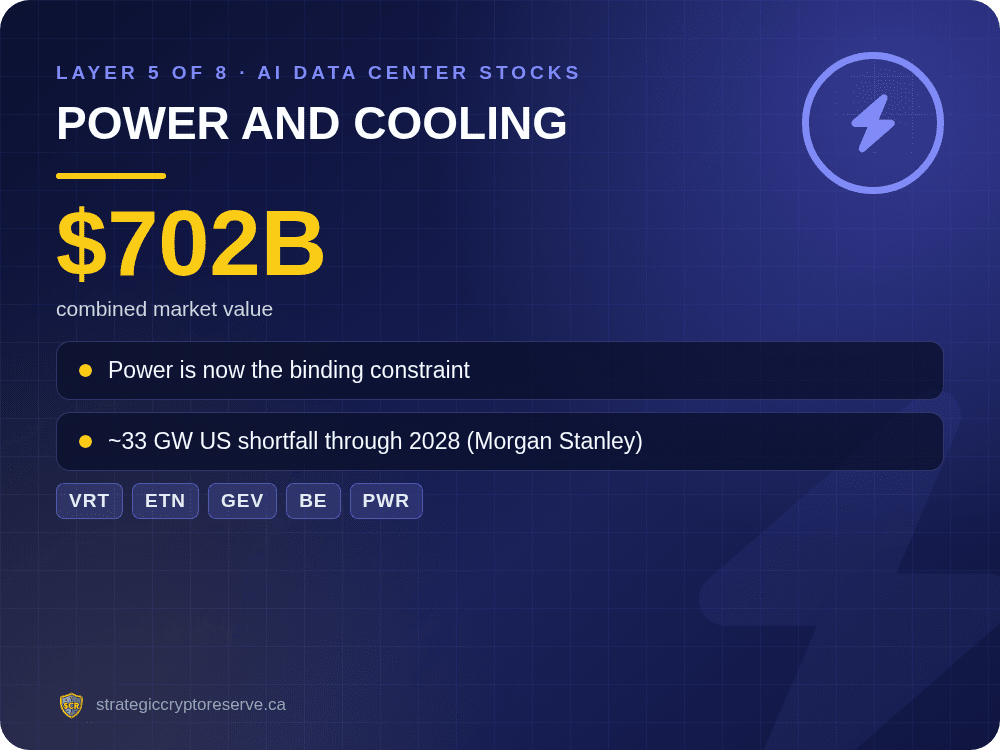
Power has replaced chips as the bottleneck. Morgan Stanley estimated in September 2026 that the United States faces a roughly 33 GW power shortfall for data centers through 2028, even after on-site generation. These five companies supply the turbines, fuel cells, switchgear, UPS systems, liquid cooling and grid construction that every campus needs before a single GPU is switched on.

VRT
Vertiv · ~$93.0B
ETN
Eaton · ~$171B
GEV
GE Vernova · ~$255B
BE
Bloom Energy · ~$85.0B
PWR
Quanta Services · ~$97.6B
AI data center stocks layer 5 of 8: Power and cooling, VRT, ETN, GEV, BE, PWR
VRTNYSE
LIVE
  Loading live VRT chart…
1-month chart · VRT on TradingView

Vertiv VRTMkt cap ~$93.0B

Vertiv is the leading pure play on data center power and thermal management: UPS systems, power distribution, and the coolant distribution units behind liquid-cooled GPU racks. It has worked closely with Nvidia on reference designs, and Nvidia qualified Vertiv products for its new AI-factory standard in September 2026. The same week, Vertiv agreed to acquire King Environmental Services to expand its liquid-cooling service business. Because nearly every new AI rack needs liquid cooling, Vertiv's order book is a direct read on new capacity, which also makes the stock sensitive to any sign of slowing construction.

Eaton ETNMkt cap ~$171B

Eaton supplies the electrical backbone of a data center: switchgear, transformers, busway, UPS systems and power management software. Data centers have become its fastest-growing market, and it has been buying capacity and technology to serve them. In September 2026 it agreed to acquire COL Group for an enterprise value of about $923 million to expand manufacturing for data center and utility customers in Europe, the Middle East and Africa. Eaton is a more diversified industrial than Vertiv, with aerospace and vehicle businesses, so it offers AI power exposure with less volatility.

ETNNYSE
LIVE
  Loading live ETN chart…
1-month chart · ETN on TradingView
GEVNYSE
LIVE
  Loading live GEV chart…
1-month chart · GEV on TradingView

GE Vernova GEVMkt cap ~$255B

GE Vernova makes the gas turbines that many AI campuses now rely on for power, along with grid equipment and electrification systems. Its turbine order book is effectively sold out for years, which gives it pricing power while utilities and data center developers compete for delivery slots. It is frequently named as a winner of the Morgan Stanley power-shortfall thesis, and commentators note that it benefits whether OpenAI, Anthropic or anyone else wins the model race. The risks are execution on a huge backlog and any public backlash that slows data center approvals, a trend it has so far navigated.

Bloom Energy BEMkt cap ~$85.0B

Bloom Energy makes solid-oxide fuel cells that generate power on-site from natural gas, letting a data center start operating before the local grid can serve it. That pitch has made it one of the biggest winners of the power bottleneck: its market value reached about $85 billion. Its largest single commitment is a roughly 2.4 GW fuel cell contract with Oracle for the Project Jupiter AI campus. When Oracle issued a force majeure notice on that project in September 2026, Bloom shares fell, then jumped about 8% after Oracle reaffirmed the contract, a good illustration of how tied it is to a few very large customers.

BENYSE
LIVE
  Loading live BE chart…
1-month chart · BE on TradingView
PWRNYSE
LIVE
  Loading live PWR chart…
1-month chart · PWR on TradingView

Quanta Services PWRMkt cap ~$97.6B

Quanta Services is the largest specialty contractor building the transmission lines, substations and electrical systems that connect data centers to the grid. It is the picks-and-shovels play on the power build-out: whichever utility or developer wins, Quanta's crews tend to do the work. In September 2026 it added Ellen Rubin, an AI and cloud infrastructure veteran with Amazon Web Services experience, to its board, signalling how central data centers have become to its business. Quanta's revenue depends on labour and project execution rather than technology, which makes it steadier but lower-margin than equipment makers.

6. Power Producers: Selling Electrons to Data Centers

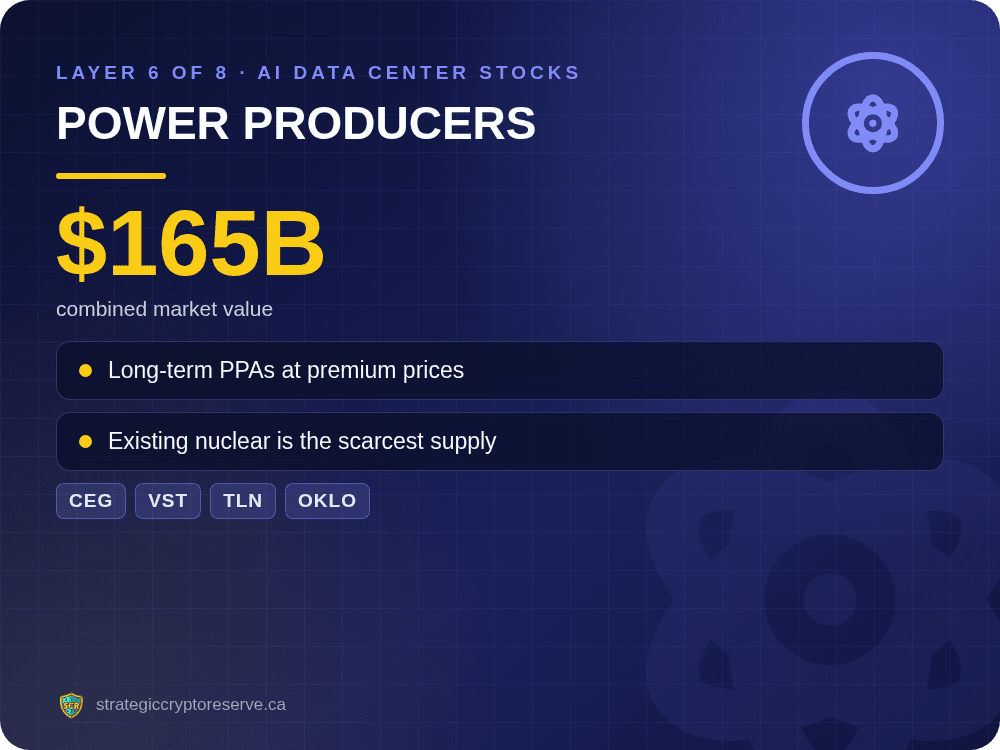
Hyperscalers want clean, firm power that runs around the clock, and existing nuclear plants are the scarcest supply of it. These independent power producers sell electricity directly to data centers through long-term power purchase agreements (PPAs), often at premium prices. Our state tariff library explains how each utility is changing its rules for these large loads.

CEG
Constellation Energy · ~$93.3B
VST
Vistra · ~$49.7B
TLN
Talen Energy · ~$14.6B
OKLO
Oklo · ~$7.1B
AI data center stocks layer 6 of 8: Power producers, CEG, VST, TLN, OKLO

Constellation Energy CEGMkt cap ~$93.3B

Constellation owns the largest nuclear fleet in the United States and has signed some of the landmark data center power deals of the AI era, including the agreement with Microsoft to restart Three Mile Island Unit 1 as the Crane Clean Energy Center and a long-term deal with Meta for its Clinton plant. Its purchase of Calpine, agreed in 2025, added a large gas fleet, and in September 2026 it agreed to buy a 609 MW Rhode Island gas plant from Shell, expanding its New England footprint. Constellation is the most established way to own nuclear power sold to AI data centers.

CEGNASDAQ
LIVE
  Loading live CEG chart…
1-month chart · CEG on TradingView
VSTNYSE
LIVE
  Loading live VST chart…
1-month chart · VST on TradingView

Vistra VSTMkt cap ~$49.7B

Vistra owns a large Texas generation fleet, including the Comanche Peak nuclear plant, plus gas plants across the ERCOT and PJM markets. In September 2026 its Luminant affiliate signed a 20-year power purchase agreement to supply 200 to 207 MW to a Texas data center project developed by New Era Energy & Digital, and it has also worked with Meta. Despite that, the stock traded about 36% below its all-time high in late September, as a softer ERCOT outlook cooled the AI power trade. Vistra offers more direct Texas exposure than Constellation, with more price volatility.

Talen Energy TLNMkt cap ~$14.6B

Talen owns the Susquehanna nuclear plant in Pennsylvania, next to the data center campus it sold to Amazon Web Services, and it expanded that relationship into a long-term supply agreement with AWS. That deal made Talen one of the first power producers to sell nuclear electricity directly to a hyperscaler campus. Pennsylvania is now actively courting data centers: a new permitting framework for loads over 25 MW gives preferential treatment to projects that bring their own power, as covered on our Pennsylvania tariff page. Talen is smaller and more concentrated than Constellation or Vistra.

TLNNASDAQ
LIVE
  Loading live TLN chart…
1-month chart · TLN on TradingView
OKLONYSE
LIVE
  Loading live OKLO chart…
1-month chart · OKLO on TradingView

Oklo OKLOMkt cap ~$7.1B

Oklo is developing small advanced nuclear reactors, its Aurora powerhouses, designed to supply data centers directly. It is the most speculative stock on this list: it does not yet generate commercial power, and its value depends on licensing progress with the Nuclear Regulatory Commission and on converting non-binding customer interest into contracts. Commentators in September 2026 described the AI power trade around Oklo as getting more tangible as its engineering and operating organisation matures. Treat it as a long-dated option on nuclear power for AI rather than a current earner.

7. Data Center REITs: The Landlords

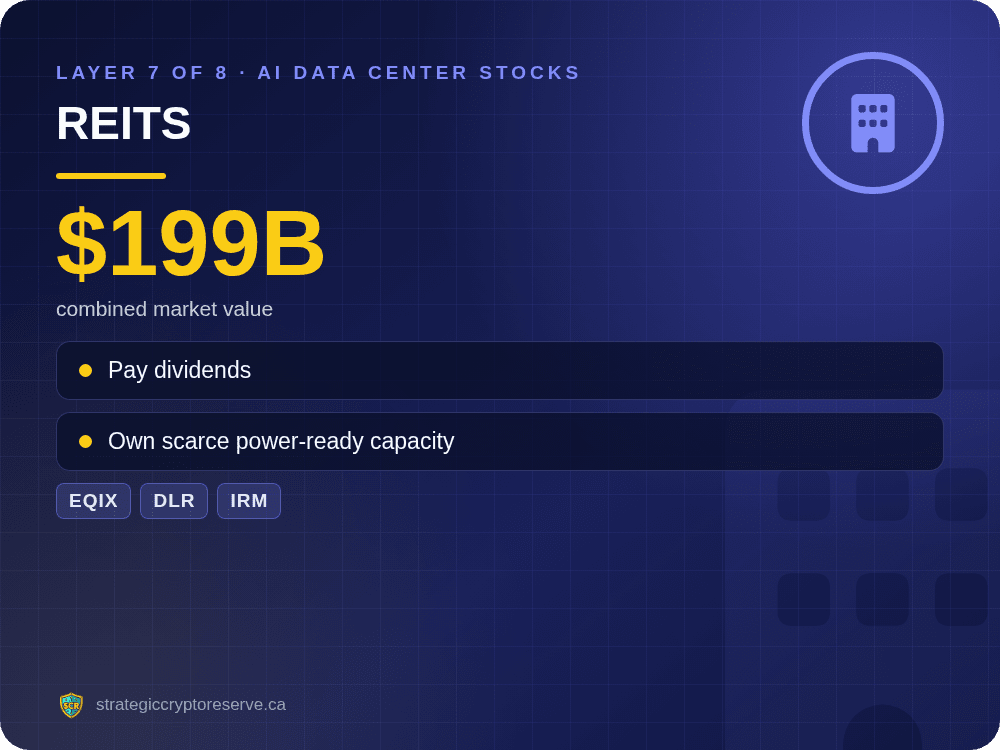
Data center real estate investment trusts own the buildings, power connections and interconnection hubs, and lease them to cloud providers and enterprises. They pay dividends, carry less technology risk than chip stocks, and benefit when power-ready capacity is scarce, which in 2026 it is.

EQIX
Equinix · ~$99.5B
DLR
Digital Realty · ~$66.3B
IRM
Iron Mountain · ~$33.2B
AI data center stocks layer 7 of 8: REITs, EQIX, DLR, IRM

Equinix EQIXMkt cap ~$99.5B

Equinix is the world's largest retail colocation and interconnection provider, with more than 260 data centers where enterprises, clouds and networks connect to each other. Its xScale joint ventures build larger campuses for hyperscalers. In September 2026 management said it plans to invest $5 billion to $7 billion a year in new capacity as AI demand accelerates, concentrated in markets where it already runs interconnection ecosystems. Equinix is less exposed to giant training clusters than to enterprise AI inference, which needs to sit close to users and data, and it pays a dividend.

EQIXNASDAQ
LIVE
  Loading live EQIX chart…
1-month chart · EQIX on TradingView
DLRNYSE
LIVE
  Loading live DLR chart…
1-month chart · DLR on TradingView

Digital Realty DLRMkt cap ~$66.3B

Digital Realty is the other global data center REIT heavyweight, operating around 300 facilities and focusing more on large wholesale leases to hyperscalers than Equinix does. It has been positioning its platform as the place enterprises deploy AI, and its September 2026 surveys found enterprises moving from AI strategy to execution, with infrastructure as the top barrier. Digital Realty's large development pipeline gives it direct exposure to hyperscale AI leasing, and like other REITs it is sensitive to interest rates, which matter more now that long-term bond yields have climbed.

Iron Mountain IRMMkt cap ~$33.2B

Iron Mountain is best known for records storage, but it has built a fast-growing data center business with campuses in Northern Virginia, Arizona and other markets, and data centers are now its main growth engine. It has also been expanding in Saudi Arabia through an AI digital partnership. That mix makes Iron Mountain a lower-volatility way to add data center exposure, since the legacy storage business produces steady cash flow and supports its dividend. The flip side is that its AI upside is diluted compared with a pure-play REIT.

IRMNYSE
LIVE
  Loading live IRM chart…
1-month chart · IRM on TradingView

8. Neoclouds and Bitcoin-Miner Conversions: The Pure Plays

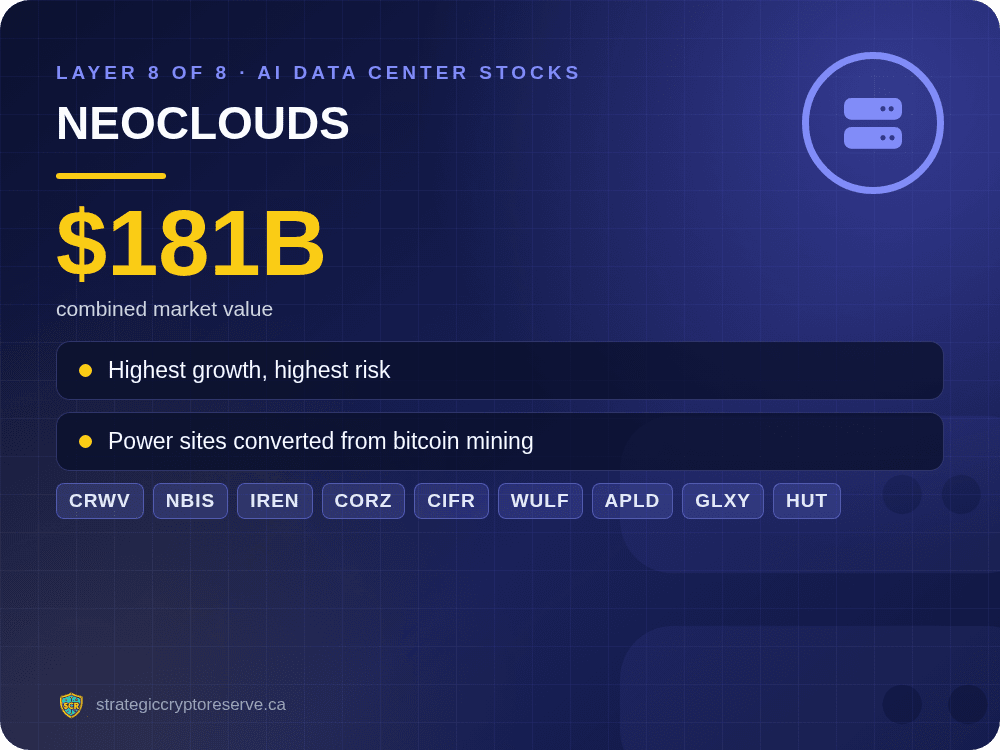
The purest AI data center stocks are the specialist GPU clouds (neoclouds) and the former bitcoin miners converting their power sites into AI campuses. They offer the highest growth and the highest risk: most carry heavy debt, depend on a few very large tenants, and move sharply on every financing headline. In September 2026 UBS started coverage of several converted miners with buy ratings while Rothschild rated CoreWeave and Nebius sells, a split that captures the debate.

CRWV
CoreWeave · ~$48.3B
NBIS
Nebius Group · ~$64.5B
IREN
IREN · ~$17.4B
CORZ
Core Scientific · ~$5.6B
CIFR
Cipher Digital · ~$7.4B
WULF
TeraWulf · ~$8.8B
APLD
Applied Digital · ~$7.7B
GLXY
Galaxy Digital · ~$9.5B
HUT
Hut 8 · ~$11.9B
AI data center stocks layer 8 of 8: Neoclouds, CRWV, NBIS, IREN, CORZ, CIFR, WULF, APLD, GLXY, HUT
CRWVNASDAQ
LIVE
  Loading live CRWV chart…
1-month chart · CRWV on TradingView

CoreWeave CRWVMkt cap ~$48.3B

CoreWeave is the largest independent AI cloud, renting Nvidia GPU capacity to OpenAI, Meta, Microsoft and others since its March 2025 IPO. It leases much of its power and buildings from converted miners on this list, including Core Scientific, Applied Digital and Galaxy, after Core Scientific shareholders rejected its 2025 takeover offer. SemiAnalysis gave CoreWeave its top Platinum rating for a third straight time in September 2026, but the stock carries the heaviest debt load in the sector, and Rothschild rated it a sell as credit markets grow wary of AI financing.

Nebius Group NBISMkt cap ~$64.5B

Nebius is an Amsterdam-headquartered neocloud that emerged from the former Yandex's international assets and now builds AI capacity in Europe and the United States, including a 1,200 MW project in Butler Township, Pennsylvania, detailed on our Pennsylvania tariff page. Its multi-billion-dollar capacity contracts with Microsoft and Meta transformed its revenue outlook, and in September 2026 Palantir announced a sovereign-focused AI infrastructure partnership with Nebius. Bank of America raised its revenue outlook the same week, while Rothschild rated it a sell, so expect wide swings.

NBISNASDAQ
LIVE
  Loading live NBIS chart…
1-month chart · NBIS on TradingView
IRENNASDAQ
LIVE
  Loading live IREN chart…
1-month chart · IREN on TradingView

IREN IRENMkt cap ~$17.4B

IREN, formerly Iris Energy, is a bitcoin miner that has pivoted to running its own AI cloud, anchored by a large multi-year GPU contract with Microsoft. It ended June 2026 with about $7.6 billion of cash, and management says cash, committed GPU financing and customer prepayments give it roughly $14 billion of funding. Its pipeline now exceeds 5 GW, centred on its Texas sites. Unlike most miners, which lease buildings to others, IREN owns the GPUs and sells the compute, which means higher potential margins but also more capital at risk.

Core Scientific CORZMkt cap ~$5.6B

Core Scientific was one of the largest US bitcoin miners and is now primarily an AI data center landlord, with CoreWeave leasing most of its converted capacity. Its shareholders voted down CoreWeave's all-stock takeover bid in 2025, keeping it independent. UBS initiated coverage with a buy rating in September 2026, but the company also faces a new risk: a Texas permitting freeze on data centers is testing its growth plans, although it already holds ERCOT-approved power at its existing sites. It is one of the cheaper ways to own converted capacity.

CORZNASDAQ
LIVE
  Loading live CORZ chart…
1-month chart · CORZ on TradingView
CIFRNASDAQ
LIVE
  Loading live CIFR chart…
1-month chart · CIFR on TradingView

Cipher Digital CIFRMkt cap ~$7.4B

Cipher Digital, formerly Cipher Mining, has turned its Texas power sites into AI campuses with two blue-chip tenants: Amazon Web Services, and Fluidstack at its Barber Lake campus, where Google provides a financial backstop. On September 25, 2026 it extended the Fluidstack lease to 20 years, lifting the total contract value to about $9 billion from $3.8 billion. Morgan Stanley set a $54 price target, and UBS started coverage with a buy rating. Cipher shows how a miner with good power can become a long-term infrastructure landlord.

TeraWulf WULFMkt cap ~$8.8B

TeraWulf converted its Lake Mariner site in New York into AI capacity leased to Fluidstack with a Google backstop, and it is building 336 MW there. In September 2026 it advanced a 20-year lease with Anthropic for 401 MW at its campus in Kentucky, after state regulators approved the electric service; our Kentucky tariff page covers the rules behind that. It reported $31.9 million of high-performance computing lease revenue in the second quarter. TeraWulf is a leveraged bet on a small number of very high-quality tenants.

WULFNASDAQ
LIVE
  Loading live WULF chart…
1-month chart · WULF on TradingView
APLDNASDAQ
LIVE
  Loading live APLD chart…
1-month chart · APLD on TradingView

Applied Digital APLDMkt cap ~$7.7B

Applied Digital builds purpose-designed AI campuses in North Dakota, where its Polaris Forge sites are leased to CoreWeave; the 530 MW Ellendale campus is covered on our North Dakota tariff page. The company reports about $36 billion of contracted backlog and very high margins on its data center leases, yet the stock turned negative for the year in September 2026 as investors priced in execution risk on power and supply chains. A pending 250 MW deal is widely seen as the next catalyst.

Galaxy Digital GLXYMkt cap ~$9.5B

Galaxy Digital, the crypto financial firm founded by Mike Novogratz, is building one of the largest AI campuses in Texas at its Helios site, leased to CoreWeave. In September 2026 ERCOT gave Galaxy conditional classifications for 4.23 GW of Texas data center projects, with Helios's approved capacity moving into the base-load category and 2.6 GW of expansion still under study. Galaxy began trading on Nasdaq in May 2025, alongside its Toronto listing. It combines crypto trading and asset management with data center development, so its stock also moves with bitcoin.

GLXYNASDAQ
LIVE
  Loading live GLXY chart…
1-month chart · GLXY on TradingView
HUTNASDAQ
LIVE
  Loading live HUT chart…
1-month chart · HUT on TradingView

Hut 8 HUTMkt cap ~$11.9B

Hut 8 is a bitcoin miner turned energy and data center developer that signed a major AI infrastructure agreement tied to Anthropic and Nvidia at its River Bend campus in Louisiana, a state whose large-load rules are covered on our Louisiana tariff page. In September 2026 UBS started coverage with a buy rating as part of its bet on miners' AI pivot. Hut 8 also holds a majority stake in American Bitcoin, so it keeps meaningful bitcoin exposure alongside the AI business.

Risks: What Moved These Stocks in September 2026

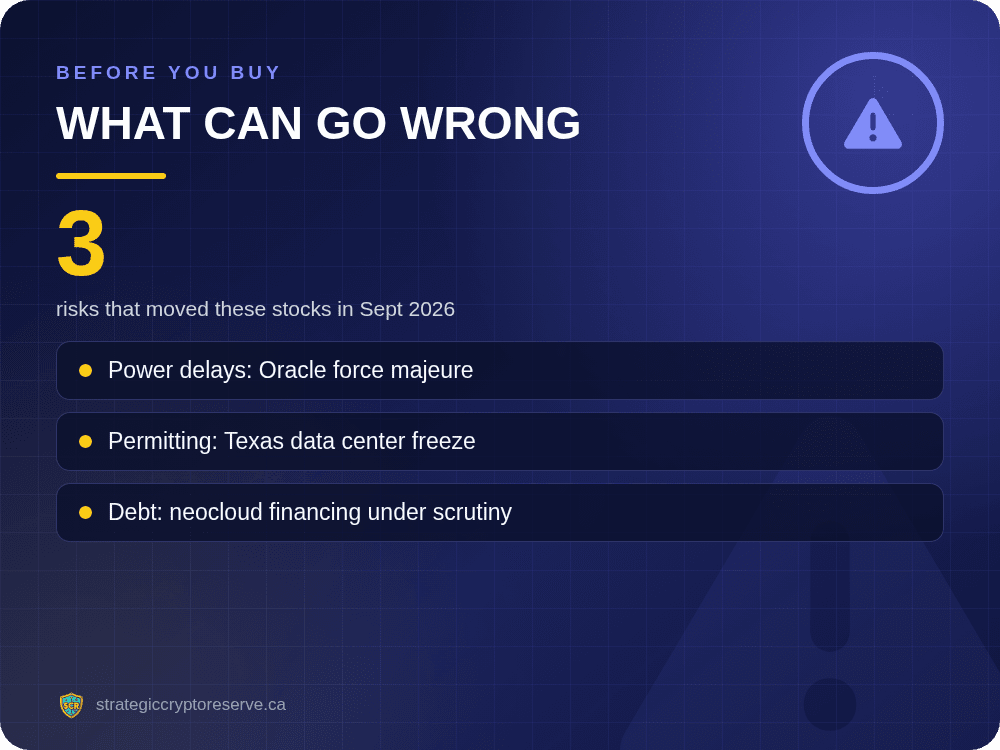
Risks for AI data center stocks: power delays, permitting freezes and neocloud debt

Power delays. Oracle's force majeure notice on Project Jupiter, caused by a delayed gas pipeline, hit Oracle and Bloom Energy in the same week. Power delivery, not chips, now sets most construction timelines.

Permitting. A Texas data center permitting freeze put the growth plans of converted miners such as Core Scientific under new scrutiny, and New Hampshire and Vermont are debating moratoriums outright (see our New Hampshire and Vermont pages).

Debt. Record AI bond issuance and 30-year yields above 5.5% have made credit markets the key signal for neoclouds. Rothschild rated CoreWeave and Nebius sells while UBS rated several converted miners buys in the same week.

None of these risks is spread evenly. Hyperscalers and the largest chip makers can absorb a delayed campus; a converted miner with one tenant and a large loan cannot. Before buying any stock on this list, check who its customers are, how its next projects will be powered and financed, and what the local utility's large-load tariff requires. Our Virginia, Texas, Georgia and Ohio pages cover the rules in the busiest markets.

Frequently Asked Questions

What are AI data center stocks?

AI data center stocks are publicly traded companies that make money from building, equipping, powering or renting the facilities that train and run AI models. They include hyperscalers (Microsoft, Amazon, Alphabet, Meta, Oracle), chip makers (Nvidia, AMD, Broadcom, TSMC, Micron), networking and optics suppliers, server makers, power and cooling equipment makers, power producers, data center REITs, and neoclouds such as CoreWeave and Nebius.

What is the biggest AI data center stock?

By market value, Nvidia is the largest, at about $5.4 trillion on September 27, 2026 according to Finnhub data, followed by Alphabet and Microsoft. Among pure-play data center operators, Nebius and CoreWeave are the largest neoclouds, and Equinix is the largest data center REIT.

Which AI data center stocks are pure plays?

The purest plays are the neoclouds (CoreWeave, Nebius, IREN) and the former bitcoin miners now leasing AI capacity (Core Scientific, Cipher Digital, TeraWulf, Applied Digital, Galaxy Digital, Hut 8), plus Vertiv on the equipment side and Equinix and Digital Realty among landlords. Pure plays carry the most upside and the most risk.

Are bitcoin miners AI data center stocks now?

Many are. Miners already own the scarcest input, large grid connections, so several have signed long-term AI leases with tenants such as CoreWeave, Fluidstack, Amazon Web Services, Anthropic and Microsoft. Cipher Digital, TeraWulf, Core Scientific, Applied Digital, IREN, Galaxy and Hut 8 are now valued mainly on their data center contracts rather than bitcoin production.

What are the biggest risks for AI data center stocks?

The main risks are a slowdown in hyperscaler capital spending, heavy debt at neoclouds and converted miners, dependence on a few large tenants, and power delays. Oracle's September 2026 force majeure notice on Project Jupiter, caused by a delayed gas pipeline, and Texas's data center permitting freeze both showed that power delivery can move timelines and share prices.

Are the charts on this page live?

Yes. Each chart box loads a live TradingView quote and one-month chart when you scroll to it. Prices during market hours may be delayed by the data provider. Market capitalisation figures on this page are a snapshot from Finnhub on September 27, 2026 and do not update.