November Midterm Elections 2026: The Ballot, the Battlegrounds and the Stock Market Theory That Won't Die
Updated September 26, 2026 15 min read Strategic Crypto Reserve Elections & Markets
The November midterm elections are on Tuesday, November 3, 2026. Every one of the 435 House seats, 35 Senate seats and 36 governorships is on the ballot. Wall Street has an old theory that the biggest market moves line up with midterm season. And the largest IPO ever attempted, Anthropic, is reportedly aiming to list in the same week. This page collects the data in one place and separates what is known from what is rumoured.
Midterm elections fall halfway through a president's four-year term. There is no presidential race on the 2026 ballot, but control of both chambers of Congress, most governorships and thousands of state legislative seats are decided on the same day.
Election Day
Tuesday, November 3, 2026. Early and mail voting start earlier in most states.
US House
All 435 seats. The chamber currently stands at 218 Republicans, 214 Democrats and 1 independent, with vacancies. A majority is 218.
US Senate
35 seats: 33 regularly scheduled races plus special elections in Florida and Ohio. The Senate is 53 Republicans, 45 Democrats and 2 independents who caucus with Democrats, so Democrats need a net gain of four seats for a majority.
Governors
36 states and 3 territories. The 36 state seats being contested are split 18 Republican and 18 Democratic.
Retirements
11 senators are not running again: 4 Democrats and 7 Republicans.
Where the polls stand
Generic congressional ballot averages showed Democrats ahead by about 8 points in late September 2026. Prediction markets such as Kalshi have been pricing Democrats to take both chambers. Polls and markets are not results.
New Congress
Sworn in at noon on January 3, 2027.
How the Midterm Election Process Works
US elections are run by the states, not by a single national agency. That is why the rules for registering, voting early, voting by mail and showing ID differ depending on where a voter lives.
Registration. Deadlines vary by state, and some states allow same-day registration. The official federal starting point is vote.gov, which links to each state's election office.
Early and mail voting. Most states offer some form of early in-person or mail voting. Windows and return deadlines are set by each state.
Election Day. Polls open and close at times set by each state. Results reported on election night are unofficial.
Counting and certification. States finish counting mail and provisional ballots, run any recounts their laws require, and certify official results over the following weeks, generally in late November and December.
Taking office. The new Congress convenes on January 3, 2027. Governors are inaugurated on dates set by each state, mostly in January.
Why results can take days. Close races often hinge on mail ballots that some states are not allowed to process until Election Day. Control of the House or Senate may not be clear on election night, and markets have to price that uncertainty.
Who Is Likely on the Ballot: Senate Battlegrounds
These are the Senate races most analysts rate as competitive, with the nominees as of September 2026. The 2026 Senate map mostly defends Democratic seats, which has historically favoured Republicans, but several Republican-held seats are now rated tossups or worse.
Most competitive 2026 Senate races (nominees as of September 2026)
State
Seat
Democrat
Republican
Outlook
North Carolina
Open (R, Tillis retiring)
Roy Cooper
Michael Whatley
Forecasters favour the Democrat
Maine
R incumbent
Troy Jackson
Susan Collins
Tossup
Ohio (special)
R (appointed)
Sherrod Brown
Jon Husted
Tossup
Alaska
R incumbent
Mary Peltola
Dan Sullivan
Tossup
Texas
R
James Talarico
Ken Paxton
Competitive
Iowa
Open (R, Ernst retiring)
Josh Turek
Ashley Hinson
Competitive
Michigan
Open (D, Peters retiring)
Abdul El-Sayed
Mike Rogers
Democrats' most exposed seat
Special elections. Florida votes to fill the rest of Marco Rubio's term after he became Secretary of State (appointed Republican Ashley Moody faces Democrat Angie Nixon). Ohio votes to fill JD Vance's former seat after he became Vice President.
Retiring senators. Democrats: Dick Durbin (Illinois), Gary Peters (Michigan), Jeanne Shaheen (New Hampshire) and Tina Smith (Minnesota). Republicans: Tommy Tuberville (Alabama), Mitch McConnell (Kentucky), Steve Daines (Montana), Cynthia Lummis (Wyoming), Joni Ernst (Iowa), Thom Tillis (North Carolina) and Alan Armstrong (Oklahoma, appointed in 2026 and ineligible to run).
New Hampshire's open Senate seat comes as the state argues over a data centre moratorium. See our New Hampshire data center construction guide for the Bow proposal and the power-cost debate.
Governor Races to Watch
Most competitive 2026 governor races (as of September 2026)
State
Candidates
Outlook
Georgia (open, Kemp term-limited)
Keisha Lance Bottoms (D) vs Rick Jackson (R)
Tossup
Nevada
Gov. Joe Lombardo (R) vs Aaron Ford (D)
Tossup to lean Republican
Ohio (open, DeWine term-limited)
Vivek Ramaswamy (R) vs Amy Acton (D)
Mixed ratings
Iowa (open, Reynolds retiring)
Rob Sand (D) vs Zach Lahn (R)
Leans Democratic
Alaska (open)
Four-way ranked-choice general election
Competitive
Big-state governors leaving because of term limits include Gavin Newsom (California), Gretchen Whitmer (Michigan), Jared Polis (Colorado), Ron DeSantis (Florida) and Brian Kemp (Georgia). Several of their successors will shape how their states handle the surge in data centre power demand.
The 2025–2026 Redistricting War
For the first time in decades, several states redrew their congressional maps in the middle of a decade. That changes the math for the House before a single vote is cast.
Texas passed a new map drawing about five additional Republican-leaning districts, and the US Supreme Court allowed it to stand.
California voters responded by approving new districts that eliminate about five Republican-held seats.
Florida enacted a new map in May 2026 expected to add Republican seats. North Carolina redrew its 1st District, and Ohio, Alabama, Louisiana and Tennessee adopted new maps after the Supreme Court's Louisiana v. Callais ruling.
Virginia announced plans to redraw. Efforts in Missouri, Indiana, Kansas, Maryland and New York failed or were blocked, leaving existing maps in place.
What History Says About Midterm Elections
The pattern is one of the most reliable in American politics: the president's party almost always loses House seats in a midterm. Since 1934 it has gained seats only three times, in 1934, 1998 and 2002. Voters use midterms as a check on whoever holds the White House, and the result is often divided government.
Markets have a view on that too. As the next section shows, the months after a midterm have historically been some of the strongest for US stocks, and one common explanation is that divided government makes sweeping policy changes less likely.
The Theory: Are the Biggest Market Moves Tied to the Midterms?
Search any trading forum in the autumn of a midterm year and you will find the theory: the largest stock market moves in history are timed around the midterm elections, whether by coincidence, by political calendars or by something more deliberate. Here is what the data actually supports.
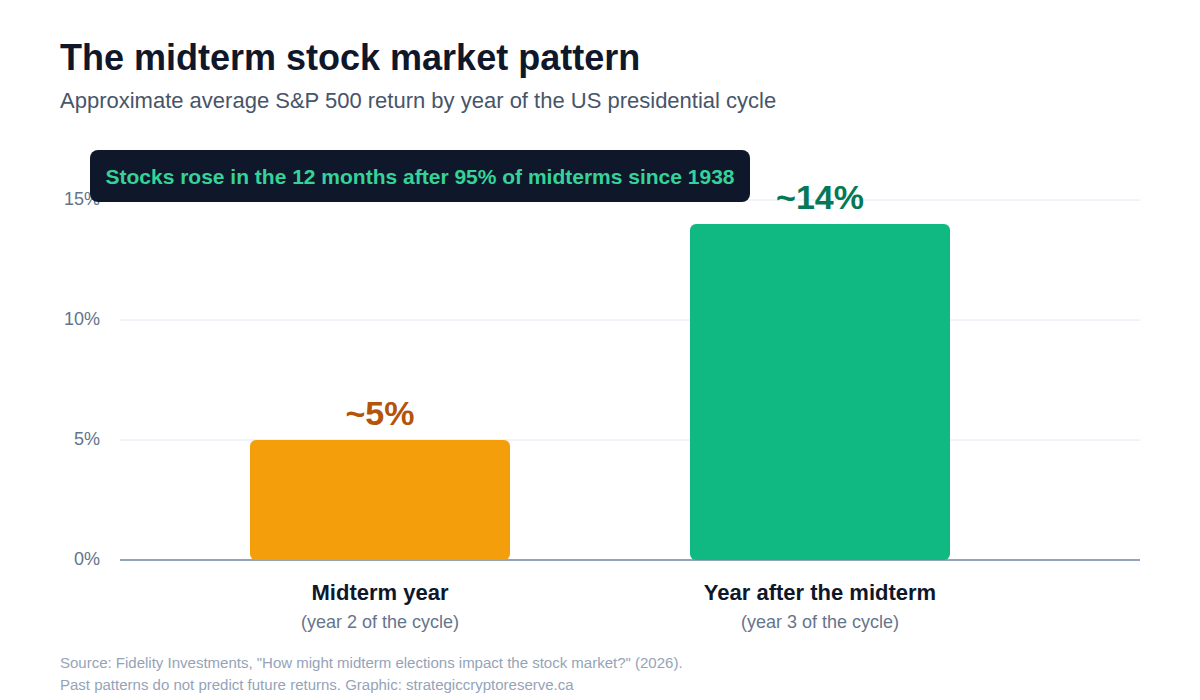
Source: Fidelity Investments (2026). Past patterns do not predict future returns.
What is real: the midterm cycle
Since 1938, the S&P 500 has risen in the 12 months after a midterm election 95% of the time (Fidelity).
The midterm year itself has averaged about 5%, compared with about 14% in the year after (Fidelity). Midterm-year returns have ranged from drawdowns of 27% to gains of nearly 40%.
Midterm years since 1961 have seen an average peak-to-trough decline of 19%. In 2026 the drop was about 9% in March, and the S&P 500 was up roughly 14% for the year by mid-August.
The usual explanation is simple: uncertainty builds before the vote and fades once the balance of power in Congress is known.
What is not real: the biggest single-day moves
Some of the largest single-day S&P 500 moves, and what was actually behind them
Date
S&P 500 move
Election timing
Actual cause
Oct 19, 1987 (Black Monday)
−20.5%
No federal election that year
Program trading and portfolio insurance cascade
Mar 16, 2020
−12.0%
Presidential primary season
COVID-19 pandemic shutdowns
Oct 13, 2008
+11.6%
Three weeks before a presidential election
Coordinated global bank rescues
Nov 10, 2022
+5.5%
Two days after the midterms
A cooler-than-expected inflation (CPI) report
This year the uncertainty is unusually high. CNN reported on August 30, 2026 that speculation about possible federal intervention in the midterms, from a national election emergency declaration to limits on mail-in voting now tied up in lawsuits, has made “the country as a whole more nervous” (CNN). If that uncertainty lingers past election night, it could weigh on markets in the very week the Anthropic IPO is reportedly targeting.
Verdict. The largest moves on record were driven by crashes, crises and economic data, not by election calendars. But the theory contains a real kernel. The single best midterm-adjacent day in the table, November 10, 2022, came two days after a midterm, when the end of election uncertainty collided with a market-moving data release. Markets do tend to move once uncertainty lifts, and in 2026 a record-setting IPO may be scheduled into exactly that week.
Election Week and the Anthropic IPO
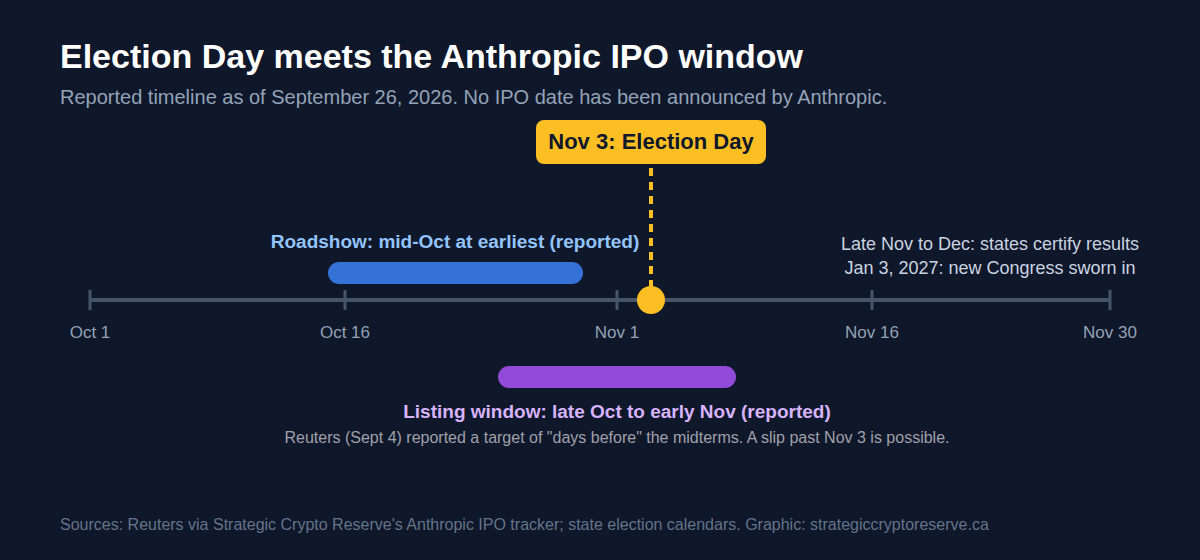
Anthropic, the company behind Claude, confidentially submitted a draft S-1 to the SEC on June 1, 2026. On September 4, Reuters reported that the company is expected to start marketing the offering in mid-October at the earliest and to list days before the November midterm elections. Anthropic has not announced a date or a price. Our Anthropic IPO date and price tracker follows every filing.
That timing has not gone unnoticed. Many online commentators and market watchers suspect the overlap is no coincidence, arguing that the largest listing ever attempted landing in the same week as the November midterm elections looks deliberately timed. There is no public evidence of coordination: the listing window was reported by Reuters, and Anthropic has not announced a date, so for now the midterms and the Anthropic IPO are simply coinciding.
Reported listing target
Late October to very early November 2026, days before the November 3 vote (Reuters).
Could it land after the election?
Possibly. IPO timetables often slip, and a company must publicly file its registration statement at least 15 days before its roadshow. A delay of even a week would push the first trading day into the days just after the election. That is a scenario, not a reported plan.
Reported valuation range
Media and analyst figures run from about $965 billion to a possible $2 trillion. None of these is an offering price.
The record to beat
Saudi Aramco (December 2019) raised $25.6 billion, later $29.4 billion with the over-allotment, and closed its first day valued at about $1.88 trillion.
Why the first trade could be the biggest money move ever made in seconds
When a newly listed stock opens, the opening trade instantly puts a public price on every share the company has. At a valuation near $1 trillion or more, Anthropic's opening print would put a price on more value in a single moment than almost any listing in history, and it would do so during the week the market is digesting the balance of power in Congress. If the listing lands just before the vote, it becomes a real-time test of risk appetite. If it slips to just after, it could collide with the post-election relief rally the midterm data describes.
Keep the facts and the forecasts apart. The election date is fixed. The IPO date is not. Until a public S-1 appears on SEC EDGAR, any specific Anthropic listing date, including "the day after the midterms", is a projection. Nothing on this page is investment advice.
Why does a Canadian crypto and data centre site care? The AI build-out behind Anthropic's valuation runs on power, and data centre power rules are now campaign issues in states from New Hampshire to Michigan. Our free AI data centre cost model shows what that power costs in every US state and nine Canadian provinces, and our Canada AI data centre boom page covers the build-out north of the border.
Frequently Asked Questions
When are the November midterm elections in 2026?
Election Day is Tuesday, November 3, 2026. Many states open early and mail voting weeks before that; check your state's dates through vote.gov.
What is on the ballot in the 2026 midterms?
All 435 US House seats, 35 US Senate seats (33 regular races plus special elections in Florida and Ohio), 36 governorships plus 3 territorial governors, and thousands of state legislative seats and ballot measures.
Which Senate races are the most competitive?
As of September 2026, analysts point to North Carolina, Maine, Ohio, Alaska, Texas and Iowa among Republican-held seats, and the open Michigan seat among Democratic-held seats.
Does the stock market go up after midterm elections?
Historically, yes. Since 1938 the S&P 500 has risen in the 12 months after a midterm 95% of the time, and the year after a midterm has averaged about 14% versus about 5% in the midterm year itself (Fidelity). Past patterns do not guarantee future returns.
Are the biggest stock market crashes tied to midterm elections?
No. The largest single-day moves, including Black Monday in 1987 and the March 2020 pandemic crash, were driven by crises and market mechanics, not election dates. What the data does show is a tendency for stocks to rise once midterm uncertainty clears.
Will the Anthropic IPO happen the day after the midterms?
No date has been announced. Reuters reported a target of days before the November 3 election. A slip into the days after the vote is possible, but no listing date is confirmed until a public S-1 is filed with the SEC.
When does the new Congress take office?
At noon on January 3, 2027. States certify their official results in the weeks after Election Day.
vote.gov (official US voter registration information)
Race ratings, nominees and polling are as of September 26, 2026 and will change. This page is independent analysis and not investment or voting advice.