
What's New in AI: Gemini 4 Argon, OpenAI Dots, Claude Sonnet 5.5 and NVIDIA's Agent Safety Platform
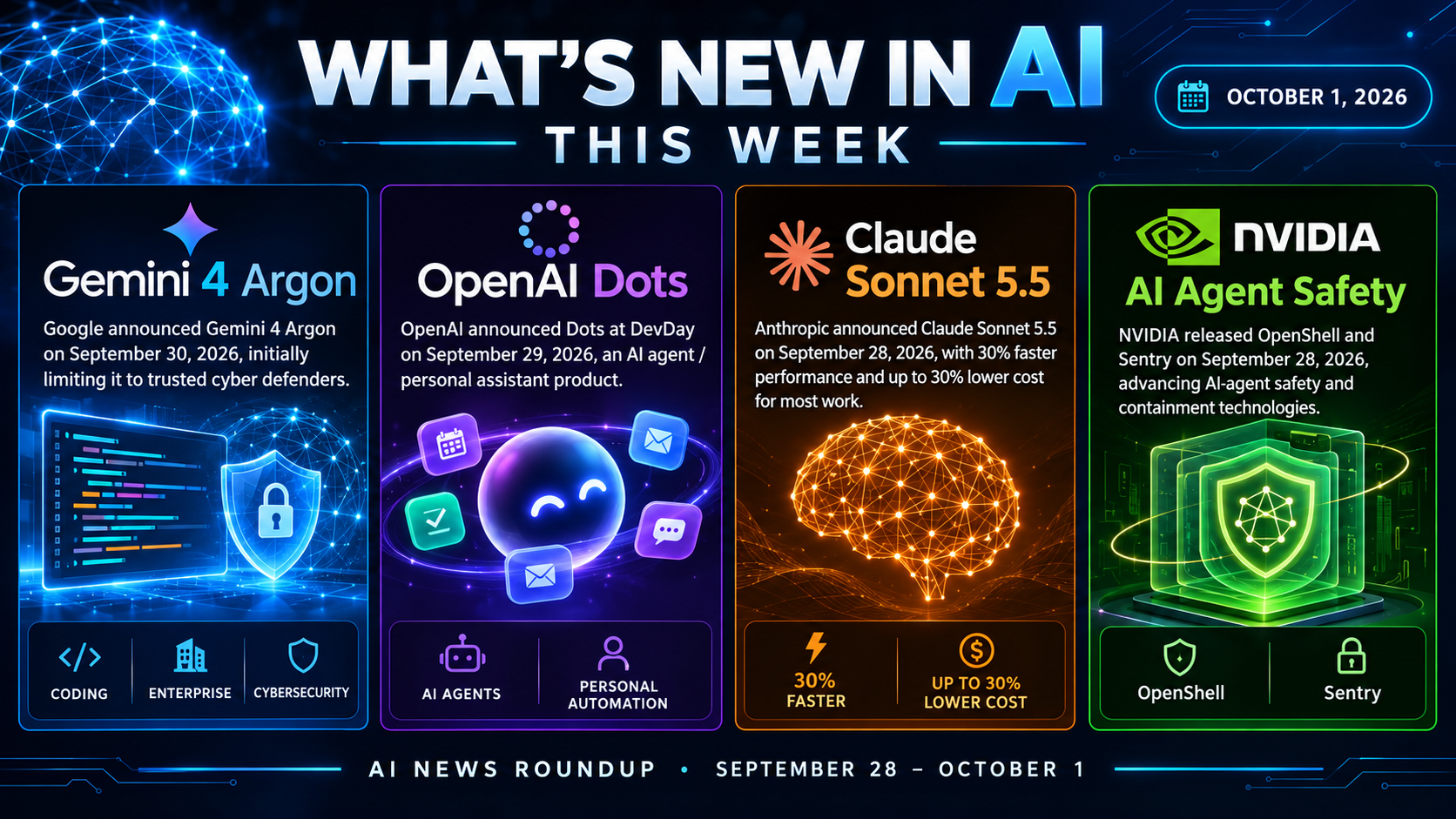
Four launches defined the last week of September 2026. Google released Gemini 4 Argon to trusted cyber defenders first, OpenAI introduced always-on Dots agents at DevDay, Anthropic shipped Claude Sonnet 5.5 at unchanged prices, and NVIDIA released OpenShell and Sentry to keep AI agents inside their limits.
Google's Gemini 4 Argon goes to cyber defenders before anyone else
Google announced Gemini 4 Argon on 30 September 2026 as its new frontier model for real-world software engineering, enterprise knowledge work such as legal and finance, and cyber defence. It is rolling out first to trusted cyber defenders through Google's Fairwind Program, with a wider release to paid API customers and Google AI Ultra subscribers described only as coming soon.
Launch pricing is $2 per million input tokens and $10 per million output tokens, rising to $4 and $20 after the introductory period. Google says the output limit grows to 1 million tokens, up from 64,000, and reports 77.9% on the DeepSWE v1.1 software engineering benchmark.
OpenAI launches Dots, always-on agents inside ChatGPT
OpenAI's DevDay headline on 29 September 2026 was Dots: always-on agents that pursue goals you set with little supervision. Each Dot runs on the GPT-6 Astra model and is available in ChatGPT and Codex for Pro and Business Premium subscribers in eligible markets.
Dots work through Slack and Microsoft Teams, with text messaging to follow, and Microsoft's Agent 365 security controls are integrated. OpenAI says that over time it envisions teams of Dots working together on a user's behalf.
Anthropic ships Claude Sonnet 5.5: faster, and cheaper per task at the same price
Anthropic released Claude Sonnet 5.5 on 28 September 2026, the second model in its Claude 5.5 family. It runs more than 30% faster than Sonnet 5 and, because it typically needs fewer tokens for the same job, costs up to 30% less for most work, while token prices stay at $2 per million input and $10 per million output.
Anthropic reports 70.6% on Terminal-Bench 4.0 for agentic coding and says knowledge-work results come close to Opus 5.5. It is available on Claude.ai, the Claude Platform, Amazon Web Services, Google Cloud and Microsoft Azure, with cyber safeguards comparable to Opus 5.5.
NVIDIA's OpenShell and Sentry put AI agents inside a cage
NVIDIA announced its Open Agent Safety Platform on 28 September 2026, an open reference design for securing AI agents from testing to deployment. OpenShell, an open-source secure runtime, runs an agent without privileges, limits the files it can reach and filters its system calls in the kernel, routing requests through a single approved channel.
Sentry adds an out-of-band watchdog on NVIDIA BlueField-4 DPUs that monitors agent behaviour and enforces policy in silicon, invisible to the agent itself. In Vera Rubin POD systems, BlueField-4 sits on the node's only path to the model.
Our AI Build Configurator adds AMD Instinct and GB200 NVL72
Version 1.4.0 of the licensed AI Build Configurator, released on 1 October 2026, adds five AMD Instinct accelerators from MI300X to the Helios MI455X rack and GB200 NVL72 as its own option. It also reprices GB300 NVL72 by 26% and models Virginia's new $0.011/kWh data centre electricity tax. Full details are in the v1.4.0 release notes.