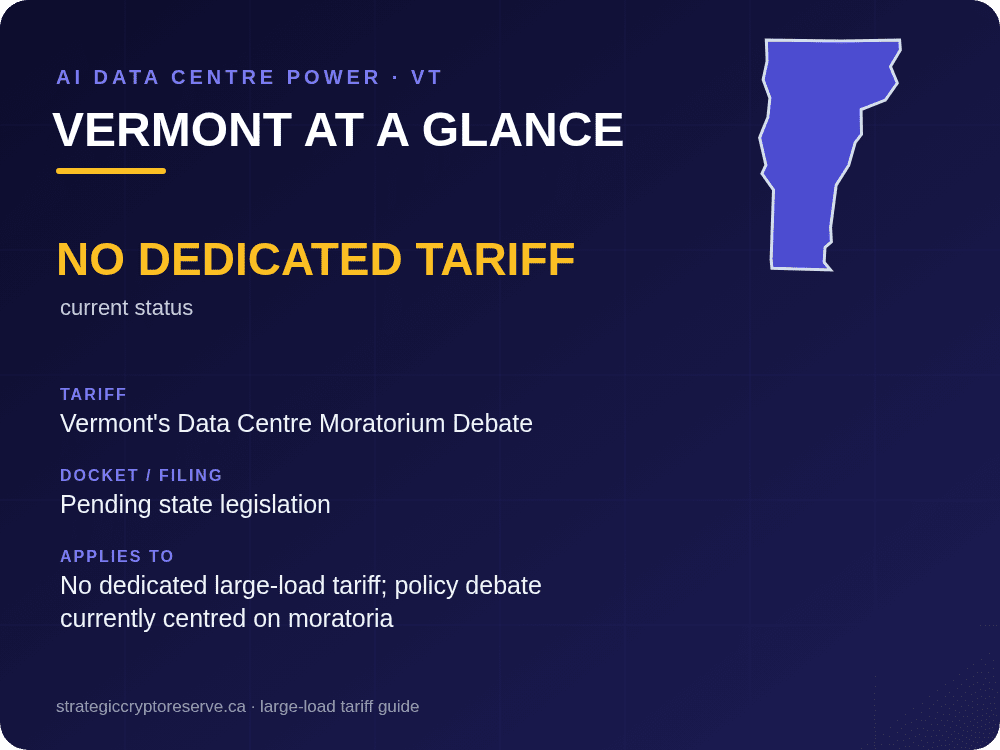
Vermont has not adopted a large-load tariff. In 2026 the legislature passed H.727, a data center law covering facilities of 20 MW or more, but Governor Phil Scott vetoed it on May 28 and the House override failed 83-52 the next day, so no moratorium or data center rules are in force.
Also active in Vermont: Vermont's current data center electricity consumption is among the lowest of any US state, and its small, hydro-and-renewables-heavy grid makes the cost-shifting risk from a single very large load proportionally larger than in bigger states — a likely driver of the moratorium conversation.
Policy Update, 1 October 2026
Vermont's legislature passed H.727, an act relating to sustainable data center deployment, by 26-3 in the Senate and a near-unanimous House voice vote. Governor Phil Scott vetoed it on 28 May 2026, and the House override attempt on 29 May fell short at 83-52, with 90 votes needed. A separate moratorium bill, S.205, did not pass. Vermont therefore still has no data center-specific rules or large-load tariff.
Figures compiled from the Edison Electric Institute's "Large Load Projects and Tariffs" (September 2026) member-company summary and public regulatory filings. Confirm current tariff terms directly with Green Mountain Power and the relevant state public utility commission before relying on any figure for a capital decision.
Weighing Vermont against another state or a Canadian province with a different rate and interconnection picture entirely? Run both sides of the comparison through our licensed AI data center cost configurator — it applies each jurisdiction's actual power rate, tax treatment and large-load tariff rules to the same seven build configurations.
Vermont’s moratorium debate mirrors discussions happening in several states right now; our crypto data center in BC offers a real example of an operating facility for that conversation.