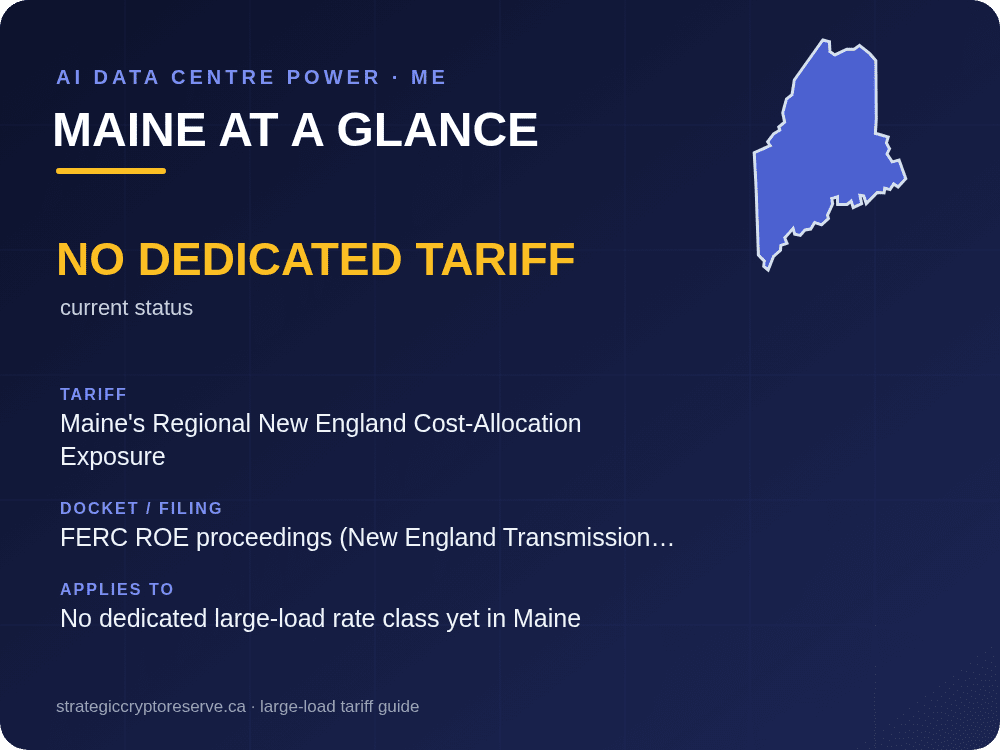
Maine has no state-specific large-load tariff at this time. Like Connecticut, Maine sits inside the same New England Transmission Owners FERC rate case governing how much data center-driven transmission investment gets recovered from the regional rate base, rather than through its own dedicated data center tariff.
Also active in Maine: Maine's low current data center electricity consumption (among the lowest of any US state) means large-load-specific regulation has not yet been a legislative priority, but the regional FERC transmission cost debate affects Maine ratepayers regardless of whether a local data center ever locates there.
Policy Update, 1 October 2026
LD 713, signed on 23 April 2026, excludes data centres that begin operating on or after 1 August 2026, including expansions, from the Business Equipment Tax Exemption and the Dirigo program, so new projects carry full equipment property tax. A state study is due on 4 November 2026. An 18-month moratorium on sites above 20 MW passed the legislature but was vetoed, and the veto stood. At the federal level, FERC issued show-cause orders on large-load interconnection to all six RTOs and ISOs on 18 June 2026, and PJM filed a framework on 13 August 2026 under which new loads of 50 MW or more that do not bring their own capacity face curtailment ahead of other demand response from 1 June 2027.
Figures compiled from the Edison Electric Institute's "Large Load Projects and Tariffs" (September 2026) member-company summary and public regulatory filings. Confirm current tariff terms directly with Central Maine Power / Versant Power and the relevant state public utility commission before relying on any figure for a capital decision.
Weighing Maine against another state or a Canadian province with a different rate and interconnection picture entirely? Run both sides of the comparison through our licensed AI data center cost configurator — it applies each jurisdiction's actual power rate, tax treatment and large-load tariff rules to the same seven build configurations.