AI Infrastructure · Updated November 5, 2026

DataOne Vineland AI Data Center Emissions: Generators, Fine and Fuel Cells

DataOne's AI data center in Vineland, New Jersey has become the East Coast's test case for AI data center emissions. The 300 MW campus, built for Nebius to serve a multibillion-dollar Microsoft contract, ran dozens of natural gas generators without air permits, drew the state's largest-ever data center fine and now faces a federal Clean Air Act lawsuit threat. Here is what happened, what the emissions are, and what it means for anyone building AI capacity.


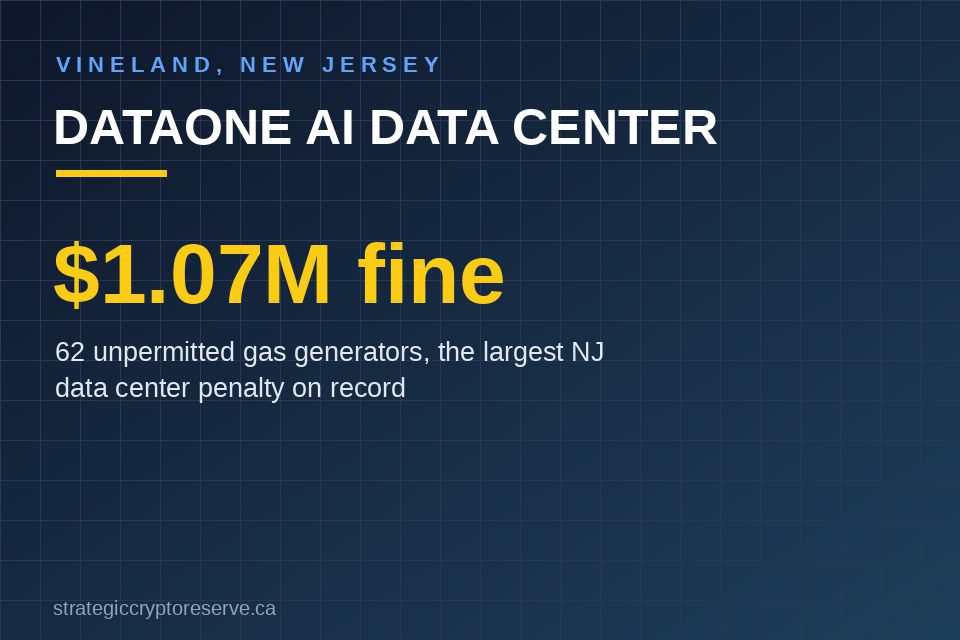
DataOne Vineland AI data center emissions: $1.07 million NJDEP fine for 62 unpermitted gas generators

NJDEP fine, Sept 22, 2026

$1.07M · record

Sources: NJDEP enforcement reporting via WHYY, Floodlight and local press, November 2026. Not legal advice.

$SCRPolygon $— Connecting to Polygon…

Quick answers (updated November 5, 2026)

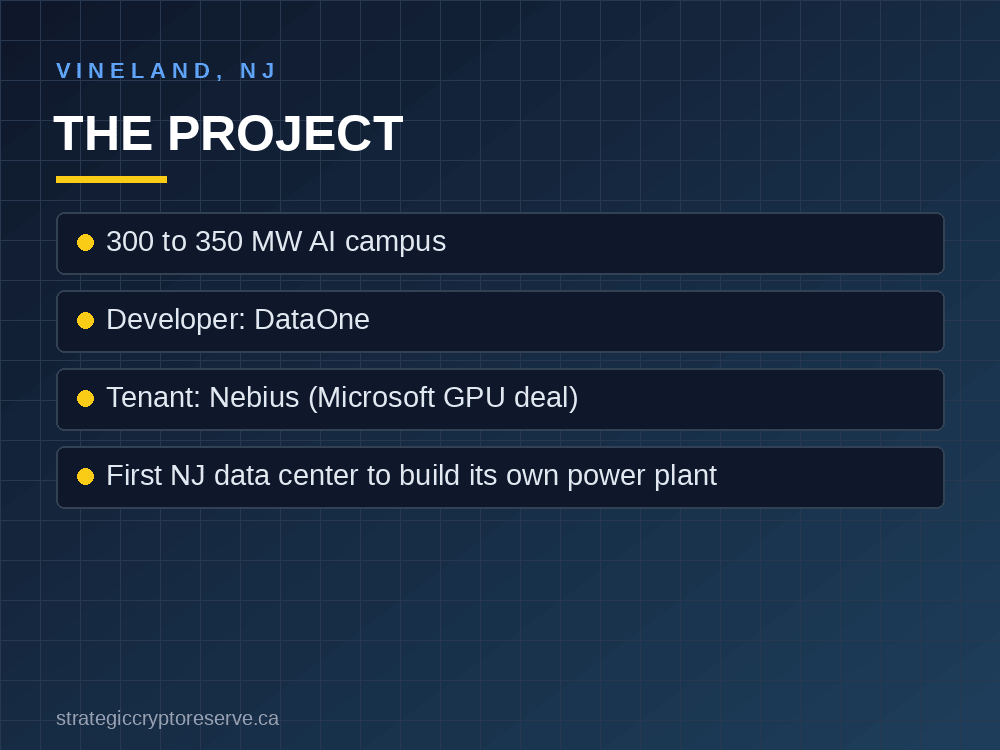
What is it? A 300 to 350 MW AI data center campus in Vineland, NJ, developed by DataOne for the AI cloud company Nebius, which uses it to serve its Microsoft GPU contract.

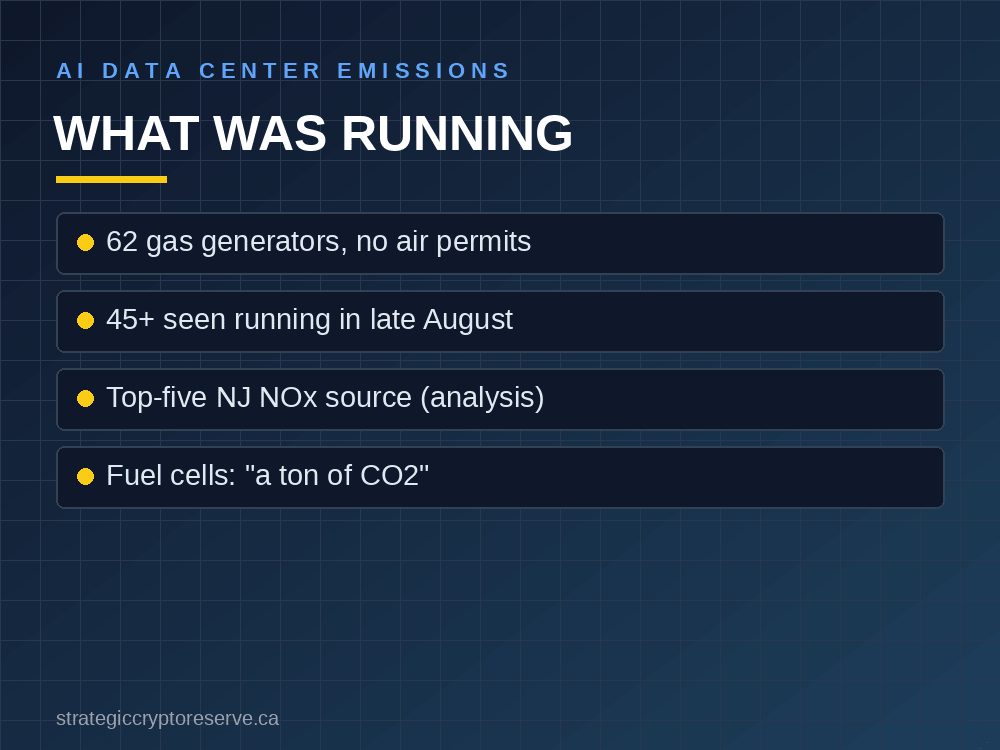
The emissions problem: the site powered itself with 62 natural gas generators that had no state air permits. Drone footage showed at least 45 running in late August 2026.

The fine: New Jersey DEP fined DataOne $1.07 million on September 22, 2026, its largest penalty ever against a data center. DataOne disputes it.

Legal risk: on October 21, 2026 the group Sustain SJ, represented by Earthjustice, sent a notice of intent to sue under the federal Clean Air Act.

What next: DataOne says it is moving to Bloom Energy fuel cells (up to 328 MW). Those still emit CO2 and still need state permits.

What Is the DataOne Vineland AI Data Center?

The Vineland campus sits in Cumberland County in southern New Jersey. DataOne is developing it for Nebius, the Amsterdam-based AI cloud provider, which signed a GPU capacity agreement with Microsoft worth up to about $17.4 billion. Vineland is one of the main sites behind that contract, with planned capacity of roughly 300 MW and reports of up to 350 MW.

What makes it unusual is power. Instead of waiting years for a grid connection big enough for an AI campus, the project generated its own electricity on site. Reporting describes it as the first data center in New Jersey to seek its own power plant. That speed-to-power strategy is exactly what put it in front of regulators.

If you want to see why developers go behind the meter, compare the months to energisation for each state in our data center cost per MW by state table: grid queues are often the longest line item in an AI build.
DataOne Vineland AI data center project facts: 300 to 350 MW, built for Nebius

DataOne Vineland Emissions: Gas Generators, NOx and CO2

The core of the emissions story is 62 natural gas generators installed to power GPUs before any permanent supply was approved. New Jersey's Department of Environmental Protection says it had issued no permits for power generation at the site. Thermal drone footage published by Floodlight showed at least 45 of them operating in late August 2026.

Gas engines emit nitrogen oxides (NOx), which form smog, plus carbon monoxide and CO2. An analysis cited by Floodlight estimated that, running at that level, the site would rank among New Jersey's five largest NOx emitters of 2025 based on EPA data. That is an outside estimate; DataOne did not respond to it.

DataOne's position is different. It says the facility is classified as a minor emissions source, uses controls that cut emissions by about 95% and targets net zero. Its CEO, Charles-Antoine Beyney, told a January town hall the site would be "polluting less than a farm", while also acknowledging that "we're gonna have a ton of CO2 emitted by these fuel cells."

Residents have also raised noise from the generators and the site's water use. Water is the other big environmental question for AI campuses; see our guide to AI data center water usage.

DataOne Vineland AI data center emissions: 62 unpermitted gas generators and NOx estimates

The $1.07 Million NJDEP Fine and the Clean Air Act Notice

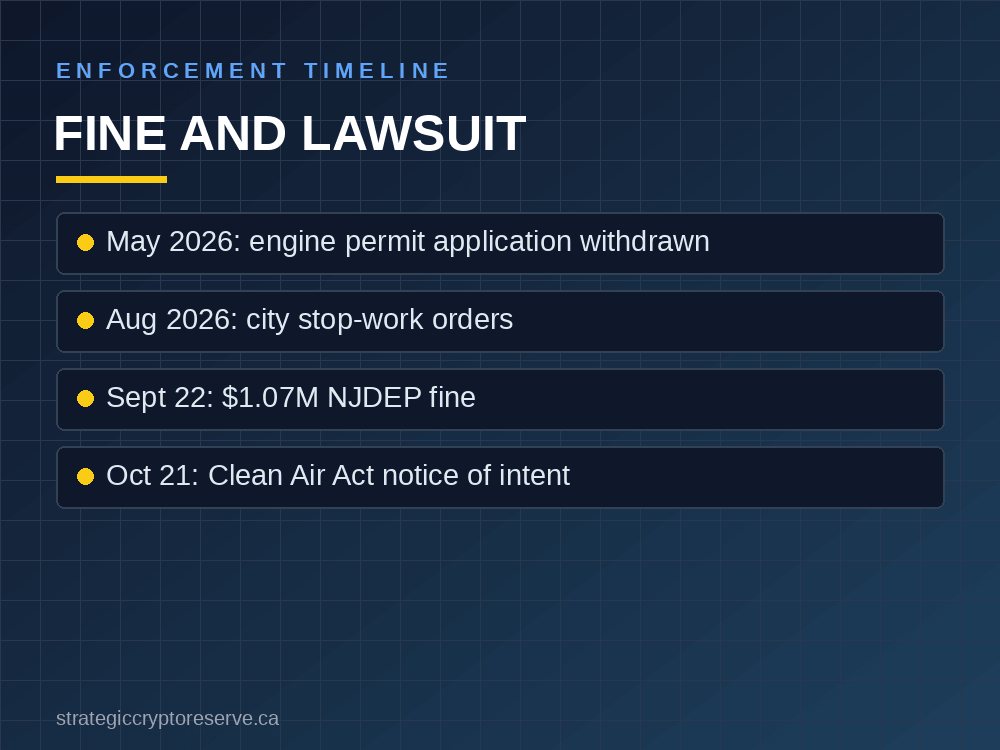
The timeline, from state and local reporting:

  • Early 2026: DataOne applied for permits for more than 30 gas-burning engines, then withdrew the application in May 2026 after the DEP found deficiencies.
  • August 2026: the City of Vineland issued stop-construction orders, one for a liquefied natural gas tank and one for fuel-cell installation work that had started without approvals.
  • September 22, 2026: the DEP fined DataOne $1.07 million for operating the generators without permits, the largest enforcement action it has ever taken against a data center. DataOne disputes the fine.
  • October 9, 2026: DataOne reportedly asked the DEP for a hearing and a stay of a requirement to have permits by November 6.
  • October 21, 2026: Sustain SJ, represented by Earthjustice, sent DataOne, Nebius and the neighbouring Northeast Precast a notice of intent to sue under the federal Clean Air Act. A notice usually starts a 60-day clock before a suit can be filed.

As of November 5, 2026 we found no public confirmation of whether the November 6 permit deadline was stayed. Nebius did not comment to reporters and Microsoft declined to comment.

Vineland data center enforcement timeline: NJDEP fine and Clean Air Act notice of intent

From Gas Engines to Bloom Energy Fuel Cells

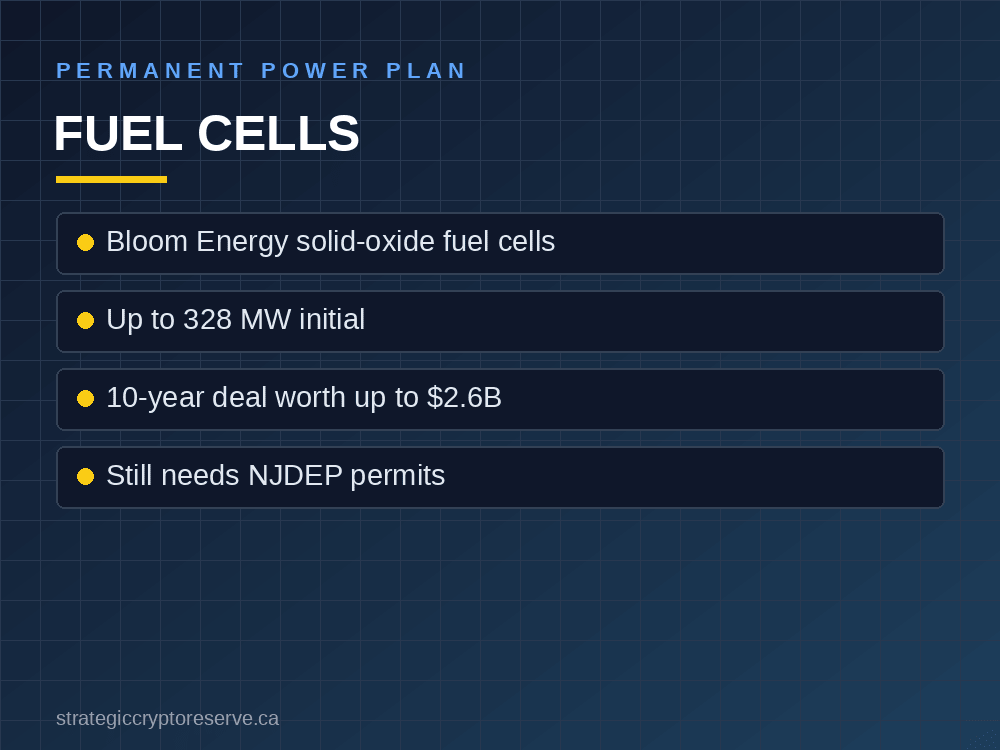
DataOne's long-term answer is fuel cells. Nebius announced a ten-year master agreement with Bloom Energy worth up to $2.6 billion, covering an initial 328 MW of solid-oxide fuel cells. Fuel cells convert natural gas to electricity electrochemically rather than by burning it, so they emit far less NOx and are much quieter than reciprocating engines.

They are not zero emission. Running on pipeline gas, they still release CO2, which is what the company's CEO acknowledged. They also still need state air permits, and AI Grid Watch reported that NJDEP approval was outstanding. DataOne says it is transitioning to the fuel cells as the site's permanent power and that it has the approvals it needs.

Nebius Bloom Energy fuel cell plan for the Vineland AI data center: 328 MW

What the Vineland Emissions Case Means for AI Data Center Builders

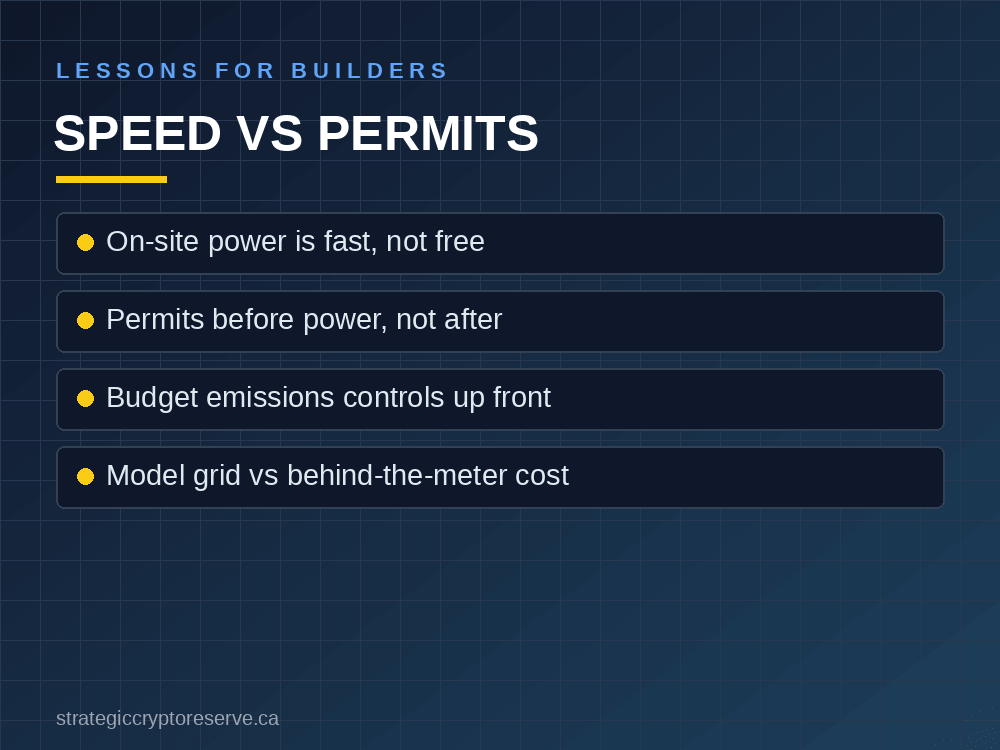
Vineland shows the trade-off every AI developer faces in 2026: the grid is slow, on-site gas is fast, and regulators are paying attention. A few practical lessons:

  • Permit before you energise. A record fine and a federal lawsuit threat cost more time than the generators saved.
  • Price emissions controls into the budget. Selective catalytic reduction, fuel cells or a cleaner tariff all change the cost per megawatt.
  • Compare power paths honestly. A grid tariff with a long queue can still beat on-site generation once permits, fuel and community risk are counted.

Our AI Build Configurator lets you compare those paths: pick a state or province, see the large-load tariff, the months to energisation and the full capital cost by line item. New Jersey is in the tariff library alongside 49 other states and every Canadian province.

Lessons from the DataOne Vineland AI data center emissions case for builders

Price an AI Data Center With Real Power Costs

Vineland went behind the meter to move fast. Before you choose your own power path, compare grid tariffs, build costs and payback for any US state or Canadian province.

Price your own AI build in seconds. The AI Build Configurator shows capital cost by line item, power cost and payback for every Canadian province and US state, by GPU class and cooling type. Try the free demo, or put it on your own site: Standard licence C$4,000 a year, Pro C$10,000, site screening reports from C$950 (see licensing).

AI Build Configurator

Live AI and HPC build-cost model: CapEx, energy cost and payback by province or state. Free demo, licensed for your own site.

Try the free demo →

AI Data Center Water Usage

How much water AI data centers use, and how cooling choice changes it.

Read it →

Nebius vs CoreWeave vs IREN

NBIS stock, Vineland and how the neoclouds compare.

Read it →

Data Center Cost per MW by State

Build cost and power for every US state.

Read it →

Frequently Asked Questions: DataOne Vineland AI Data Center Emissions

1. What is the DataOne data center in Vineland, NJ?

It is a 300 to 350 MW AI data center campus in Vineland, New Jersey, developed by DataOne for Nebius, which uses it to provide GPU capacity to Microsoft under a contract worth up to about $17.4 billion.

2. What emissions come from the Vineland AI data center?

The site ran 62 natural gas generators without state air permits, which emit nitrogen oxides (NOx), carbon monoxide and CO2. One analysis estimated it would rank among New Jersey's five largest NOx sources of 2025. DataOne says the facility is a minor source with controls that cut emissions by about 95%.

3. How much was DataOne fined?

The New Jersey Department of Environmental Protection fined DataOne $1.07 million on September 22, 2026 for operating the generators without permits. It is the largest enforcement action the department has taken against a data center. DataOne disputes the fine.

4. Is DataOne being sued?

On October 21, 2026 the community group Sustain SJ, represented by Earthjustice, sent DataOne, Nebius and Northeast Precast a notice of intent to sue under the federal Clean Air Act. As of November 5, 2026 no lawsuit had been reported as filed.

5. Will fuel cells fix the Vineland emissions problem?

Bloom Energy solid-oxide fuel cells, up to 328 MW under a deal worth up to $2.6 billion, emit far less NOx and noise than gas engines, but they run on natural gas and still emit CO2. They also still need New Jersey air permits.

6. How can I estimate the cost of powering an AI data center?

Use the free demo of the Strategic Crypto Reserve AI Build Configurator. It shows large-load power tariffs, months to energisation, capital cost and payback for every US state and Canadian province.