Mining Economics · Comox Valley, BC · Published July 2026

Bitcoin Mining Heat Reuse: Turning ASIC Waste Heat into Home Heating in BC

An ASIC miner is, thermodynamically, a space heater that happens to compute SHA-256 hashes. Essentially every watt of electricity it draws leaves the machine as heat — which means in a heating climate like coastal British Columbia, "waste heat" isn't waste at all. This guide covers the real numbers behind Bitcoin mining heat reuse: how many BTU each common ASIC produces, what that heat costs on BC Hydro's residential tiers, how a heat-mining setup compares honestly against baseboards and heat pumps, and the practical noise, wiring, and moisture realities of running one in a home. Written from a real, small-scale operation in the Comox Valley on Vancouver Island.


Every ASIC Is a Space Heater: The Physics of Mining Heat

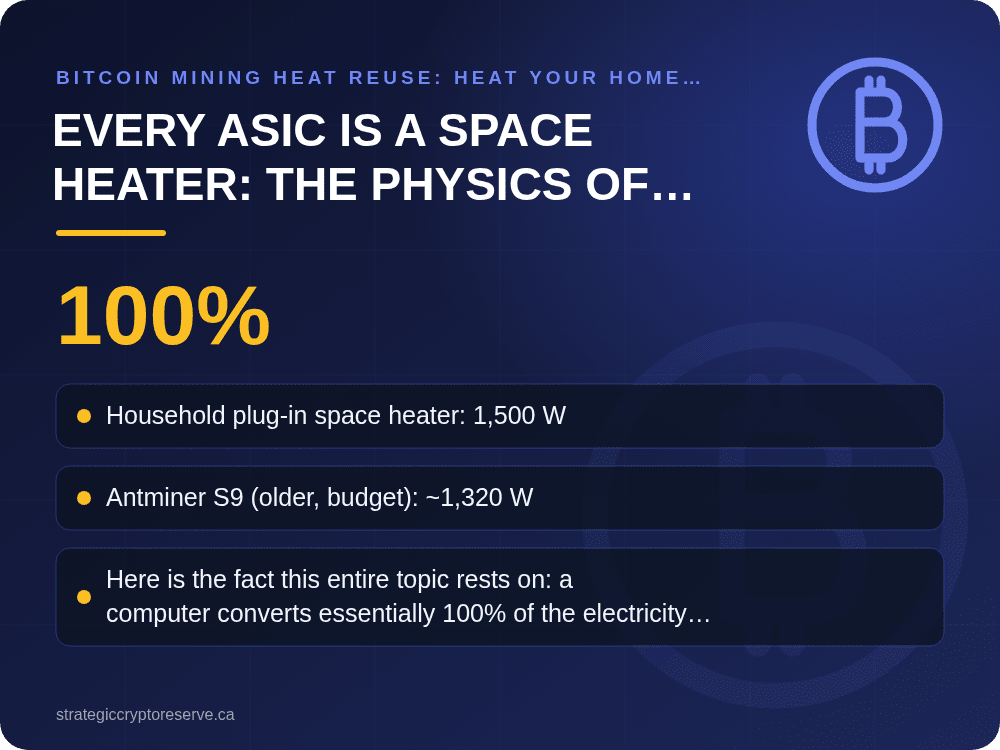
Here is the fact this entire topic rests on: a computer converts essentially 100% of the electricity it consumes into heat. The hashes an ASIC produces carry no meaningful energy out of the machine — a trivial amount leaves as fan noise and indicator-light photons, but from your room's perspective, a 3,500-watt miner and a 3,500-watt electric resistance heater warm the space identically. This is the same principle behind electric baseboard heating, which is rated 100% efficient at the point of use.

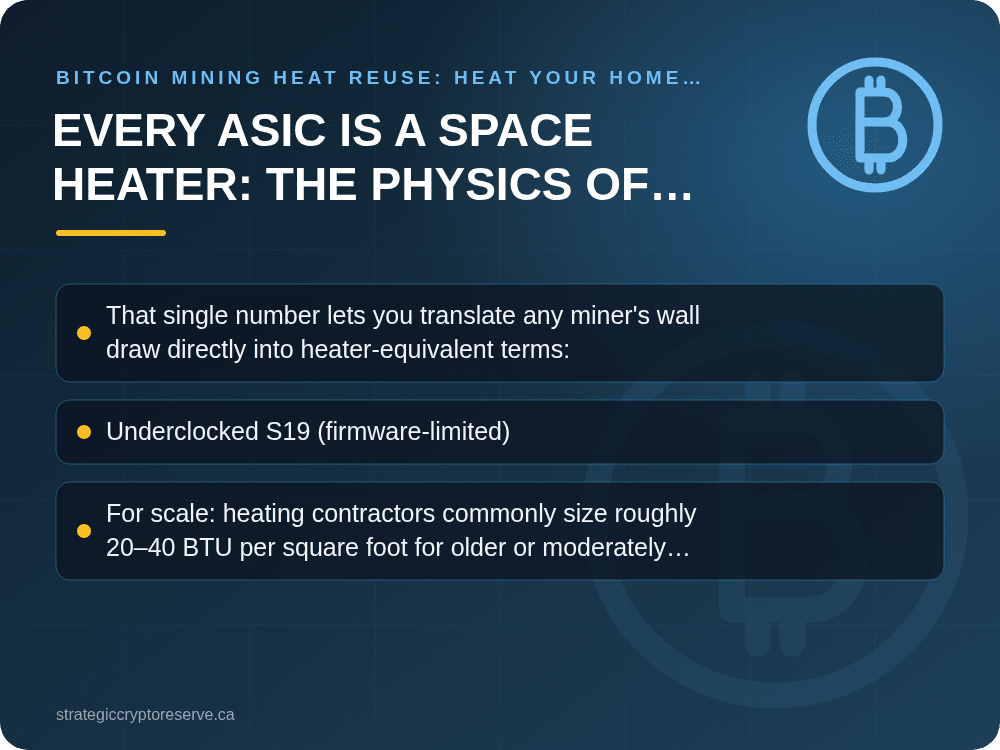
The conversion between electrical power and heating output is fixed physics: 1 watt = 3.412 BTU per hour. That single number lets you translate any miner's wall draw directly into heater-equivalent terms:

HardwareWall Draw (approx.)Heat OutputHeater Equivalent
Household plug-in space heater1,500 W~5,100 BTU/hrBaseline reference
Antminer S9 (older, budget)~1,320 W~4,500 BTU/hr≈ 0.9 space heaters
Antminer S19j Pro~3,050 W~10,400 BTU/hr≈ 2 space heaters
Antminer S21~3,500 W~11,900 BTU/hr≈ 12,000 BTU garage heater
Underclocked S19 (firmware-limited)~1,800 W~6,100 BTU/hr≈ 1.2 space heaters

For scale: heating contractors commonly size roughly 20–40 BTU per square foot for older or moderately insulated homes in mild climates. A single S21's ~11,900 BTU per hour is therefore in the range of what a well-insulated 300–500 square foot zone needs on a cold Vancouver Island day — a large living area, a suite, a workshop, or a garage. It is genuinely useful heat. It is not, on its own, a furnace for a 2,400 square foot house in January.

The core reframe: people usually ask "how do I get rid of mining heat?" In a heating climate, the better question is "what heating bill can this displace?" Every BTU your miner delivers into space you were going to heat anyway is a BTU your baseboards, furnace, or heat pump doesn't have to produce.

What Mining Heat Costs on BC Hydro's Residential Tiers

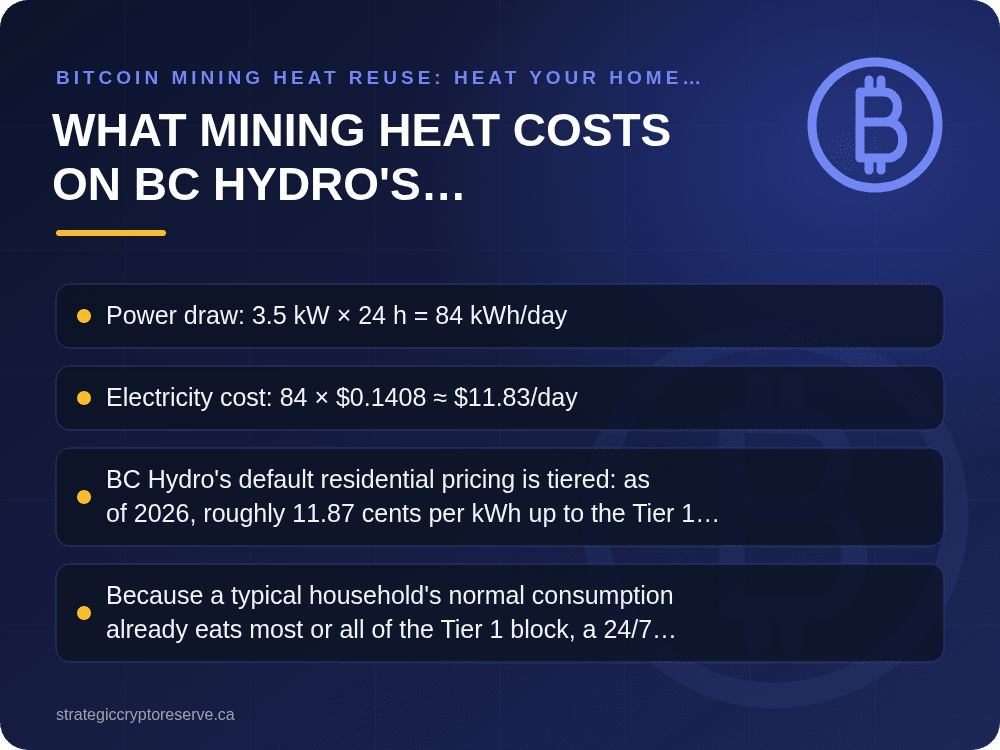
BC Hydro's default residential pricing is tiered: as of 2026, roughly 11.87 cents per kWh up to the Tier 1 threshold (about 1,350 kWh per two-month bill) and 14.08 cents per kWh above it. Because a typical household's normal consumption already eats most or all of the Tier 1 block, a 24/7 mining load lands almost entirely on the Tier 2 rate — the "marginal rate trap" we walk through in detail in our BC Hydro electricity rates guide. For heat-reuse planning, 14.08 cents per kWh is the honest number to use.

Run the daily math on a single Antminer S21 during heating season:

Line ItemValueNotes
Power draw3.5 kW × 24 h = 84 kWh/dayContinuous operation
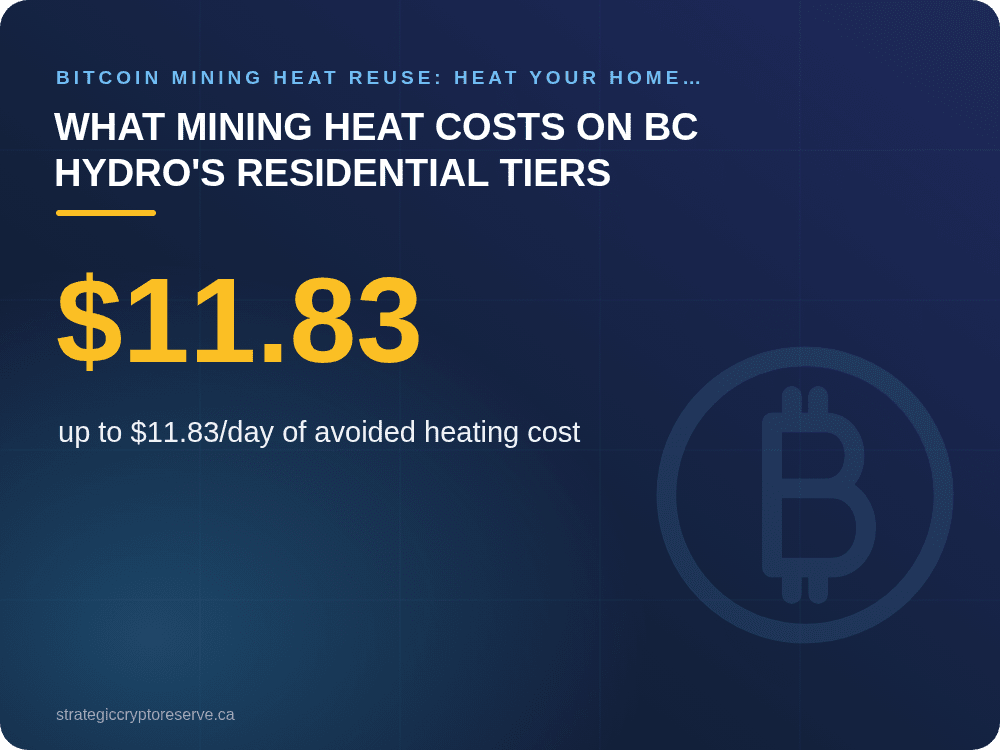
Electricity cost84 × $0.1408 ≈ $11.83/dayTier 2 marginal rate
Heat delivered84 kWh of heat (~286,000 BTU/day)Identical to 84 kWh of baseboard heat
Baseboard heat displacedup to $11.83/day of avoided heating costIf it replaces resistance heat you'd otherwise run
Net cost of the heatElectricity cost − Bitcoin earnedEvery satoshi mined is a discount on heat you needed anyway

That last row is the whole business case. If the miner earned nothing, you'd simply have an expensive, loud baseboard heater — break-even with resistance heat, minus your hardware cost. Everything the miner actually earns in Bitcoin is a rebate on a heating bill you were going to pay regardless. Whether that rebate covers 20% or 80% of the power bill depends on hash price, network difficulty, and BTC price at the time — variables that move constantly, which is why we don't print a revenue projection here. Model your own scenario with live inputs using our crypto data center calculator, and treat any specific figure as an illustration, not a forecast.

One more BC-specific wrinkle: BC Hydro's optional time-of-day overlay discounts overnight consumption and surcharges the evening peak. A heat-reuse miner is a steady 24/7 load, so the overnight credit and evening surcharge partially offset — our rates guide works through when the overlay helps a continuous load and when it doesn't. For most heat-miners the flat-vs-tiered rate decision matters more than the time-of-day overlay.

Miner vs. Baseboard vs. Heat Pump: The Honest Comparison

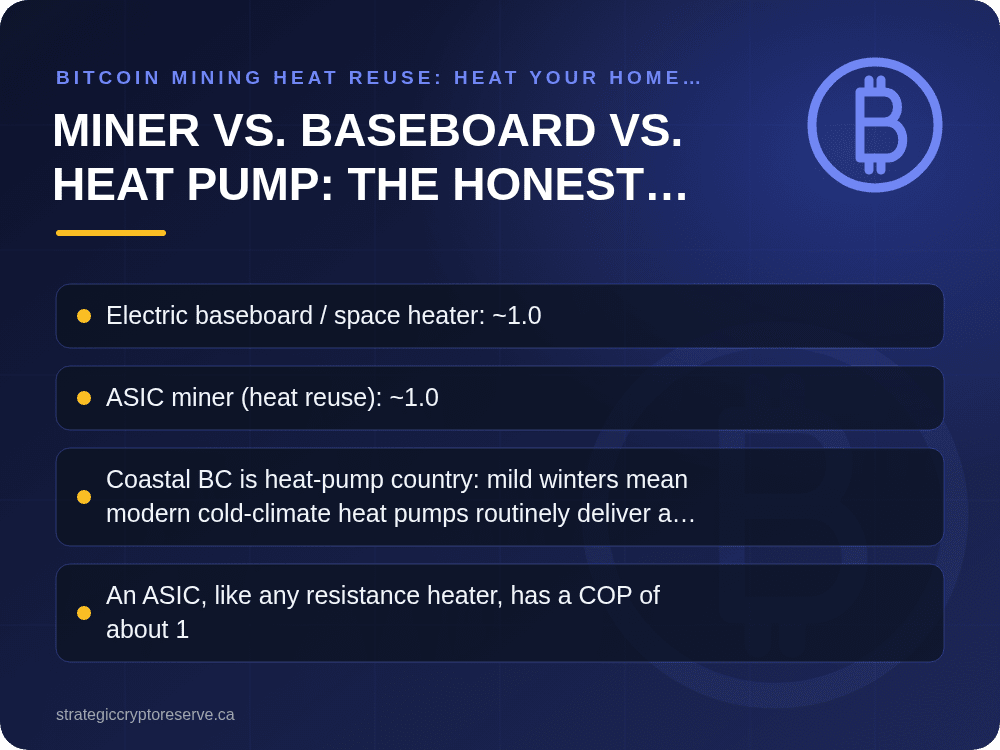
Most heat-reuse articles dodge this comparison, so let's not. Coastal BC is heat-pump country: mild winters mean modern cold-climate heat pumps routinely deliver a seasonal coefficient of performance (COP) around 3 here — three units of heat per unit of electricity. An ASIC, like any resistance heater, has a COP of about 1. On raw cost-per-BTU, a heat pump beats a Bitcoin miner three-to-one before the miner earns a single satoshi.

Heat SourceEffective COPCost per 84 kWh of heat (at 14.08¢)Offsetting Revenue
Electric baseboard / space heater~1.0≈ $11.83None
ASIC miner (heat reuse)~1.0≈ $11.83Bitcoin mined while heating
Cold-climate heat pump (coastal BC)~3.0≈ $3.94None

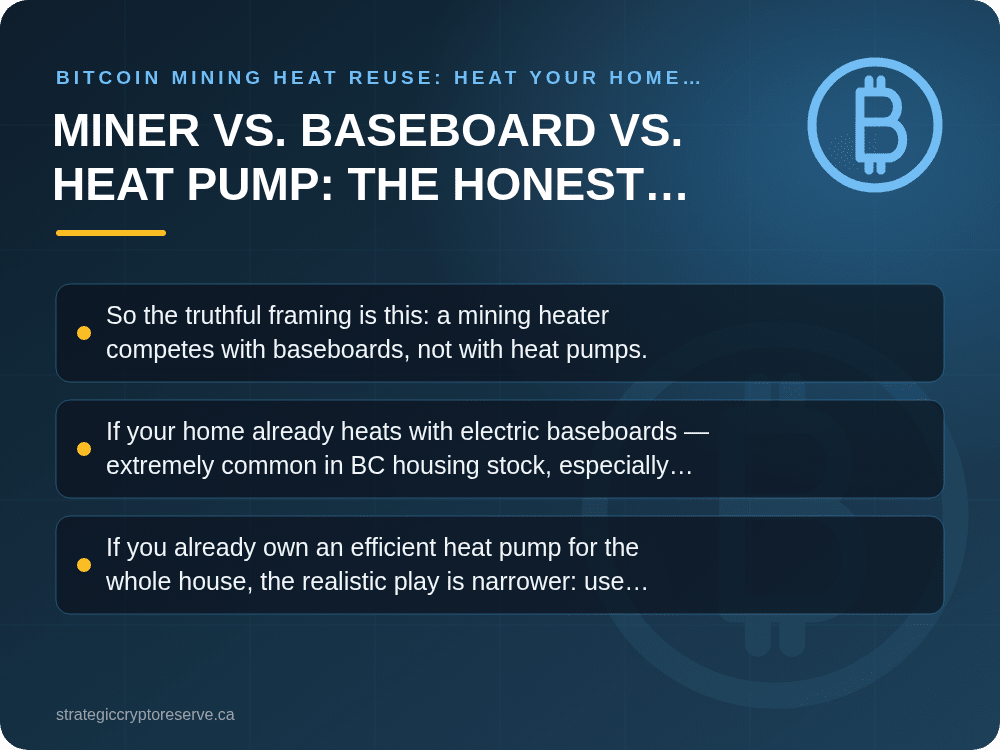
So the truthful framing is this: a mining heater competes with baseboards, not with heat pumps. If your home already heats with electric baseboards — extremely common in BC housing stock, especially suites, condos, older homes, garages, and workshops — then swapping some of that resistance load for an ASIC is close to a free lunch: same heat, same power bill, plus whatever the miner earns. If you already own an efficient heat pump for the whole house, the realistic play is narrower: use mining heat in the zones the heat pump serves poorly (garage, shop, crawlspace, detached studio) rather than displacing the heat pump itself.

Decision rule of thumb: the miner needs its Bitcoin earnings to cover roughly two-thirds of its power bill before it beats a COP-3 heat pump on net heating cost. Against baseboards, it wins the moment it earns anything at all. Know which fight you're actually in before buying hardware.

Practical Heat-Reuse Setups (and the Noise Problem)

The physics is friendly; the acoustics are not. A stock air-cooled ASIC runs its fans hard and measures roughly 75–80 decibels up close — vacuum-cleaner loud, continuously. Nobody lives with that in a bedroom. Every workable home setup is really a noise-management strategy with a heat-delivery path attached. The four patterns that actually get built:

Ducted Remote Placement

The miner lives in a garage, crawlspace, or utility room. Insulated flexible duct (6–8 inch) and an inline booster fan carry the hot exhaust into living space. The mass of the house swallows the noise. This is the most common DIY pattern and the one used at our Comox Valley setup.

Most popular

Sound Enclosure

An insulated box with baffled intake and exhaust paths knocks 15–25 dB off the machine. Airflow design is critical — ASICs move a lot of air, and a starved miner throttles or overheats. Budget real intake area, not just foam.

Compact spaces

Firmware Underclocking

Custom firmware can drop an S19-class unit from ~3,000 W to ~1,500–1,800 W. Hashrate falls, but efficiency per terahash often improves and fan speed drops dramatically — turning a screaming appliance into a loud-ish one that matches a single room's heat demand.

Quietest air-cooled

Hydro & Immersion Cooling

Hydro-cooled ASICs and immersion tanks move heat into water or dielectric fluid instead of air — near-silent, and the heat can feed hydronic loops, radiant floors, or hot-water preheat. Highest complexity and cost; the ceiling for serious heat reuse.

Advanced

Three non-negotiables regardless of pattern. Wiring: a 3,000–3,500 W machine does not belong on a shared 15-amp household circuit; it wants a dedicated circuit — typically 240 V — installed and permitted by a licensed electrician. Clearance and dust: treat the unit like the industrial appliance it is — hard surfaces, clear intake/exhaust, no lint-heavy laundry rooms. Moisture: coastal BC air is damp for much of the year; pulling raw outside air through electronics in a Vancouver Island crawlspace invites condensation and corrosion, so recirculate conditioned air where possible and keep the machine above dew-point conditions.

If you're scaling past one or two units, the constraints shift from acoustics to electrical service and ventilation engineering — that's the territory of our guide on how to build a small-scale crypto data center and the power grid strategies writeup.

Why Coastal BC Is Quietly Ideal for Heat-Reuse Mining

Heat-reuse mining has a geography problem in most places: either winters are too short to matter, or electricity is fossil-generated and expensive. Coastal British Columbia sits in an unusual sweet spot on both axes.

Long, mild heating season. The Comox Valley and most of Vancouver Island run a heating season from roughly October through April — long by global standards — but with mild coastal lows rather than prairie-grade cold. That profile is exactly what low-grade ASIC heat serves best: months and months of "take the chill off" demand that a 10,000–12,000 BTU source can genuinely carry, instead of brutal peaks that dwarf it.

Clean electricity in, clean heat out. BC Hydro's grid is overwhelmingly hydroelectric. A Bitcoin miner heating a Comox Valley room is converting hydro power into warmth at 100% — the same site-efficiency as the baseboards it displaces — while producing hashrate that would otherwise be generated somewhere on the global grid at a materially worse carbon intensity. It's one of the few contexts where home mining and clean-energy arguments point the same direction, which is exactly why our own small operation runs here; the background is on our Bitcoin mining Vancouver Island page.

Housing stock that still burns resistance heat. A large share of Island homes, suites, and outbuildings heat with electric baseboards — the one heat source an ASIC matches watt-for-watt. Every baseboard kilowatt-hour displaced by a mining kilowatt-hour is cost-neutral heat plus mining revenue, no COP penalty involved.

Rules, Tariffs, and Gotchas Before You Plug In

BC Hydro's mining restrictions target big loads, not your garage. The connection moratorium British Columbia imposed on cryptocurrency mining applies to new large-load service requests — the megawatt-scale interconnections — not to a homeowner running one or two machines on existing residential service. A small setup on a standard panel is ordinary household consumption, billed on the normal residential tiers. The full policy timeline, and what it means at different scales, is covered in our BC Hydro rates and crypto mining guide.

The marginal-rate trap still applies. Your miner's kilowatt-hours stack on top of household consumption, which means they're billed almost entirely at the Tier 2 rate of ~14.08 cents — not the blended average on your bill. Plan the economics at the marginal rate or the math will flatter you.

Strata, rentals, and insurance. Condo strata bylaws frequently restrict heat-producing appliances, continuous noise, and electrical modifications; tenants need landlord consent for dedicated circuits; and home insurers can treat undisclosed mining hardware as a material change in risk. None of these are usually deal-breakers for a single quiet, properly wired unit — but all three are cheaper to ask about before installation than after a claim or complaint.

Permits for wiring. In BC, adding a dedicated 240 V circuit is permitted electrical work. Use a licensed electrician and pull the permit — it protects your insurance coverage and your resale, and a 3.5 kW continuous load is precisely the kind of thing inspectors exist for.

The Summer Problem: What Happens May Through September

Heat reuse's honest weakness is that the heat is only valuable part of the year. From May to September on Vancouver Island, an ASIC's output shifts from asset back to liability, and you have three realistic responses.

Curtail. Shut the machine down for the summer. Simple, silent, zero cost — but your hardware now earns only ~7 months a year, which stretches payback timelines. Many home heat-miners accept this deliberately: the machine is a heating appliance first, a miner second.

Underclock to a whisper. Drop the unit to a few hundred watts of summer output — negligible heat, minimal noise, small but nonzero revenue, and the machine stays exercised and online.

Move the heat to a year-round load. Domestic hot water preheating and greenhouse heating want BTUs in July too. Hydronic-capable setups (hydro/immersion cooling) can shift their output to these loads seasonally — more plumbing, more capex, but it converts a 7-month asset into a 12-month one.

Whichever you choose, bake it into the purchase math up front: a miner bought for heat reuse should be evaluated on heating-season economics, with summer revenue treated as a bonus rather than a pillar.

Bitcoin Mining Heat Reuse — FAQ

Can a Bitcoin miner really heat a house?

Partially, yes — and the physics is simple. Nearly 100% of the electricity an ASIC consumes leaves the machine as heat, so a 3,500-watt Antminer S21 puts out roughly 11,900 BTU per hour, comparable to two large plug-in space heaters running flat out. That is enough to carry a well-insulated room or open-plan zone through most of a Vancouver Island winter, but it is supplemental zone heating, not a whole-home furnace replacement for a large or poorly insulated house.

Is heating with a Bitcoin miner cheaper than a heat pump in BC?

On pure efficiency, no. A modern cold-climate heat pump in coastal BC delivers roughly three units of heat per unit of electricity, while an ASIC — like any resistance heater — delivers about one. The miner's advantage is that it earns Bitcoin while it heats, which offsets part of the power bill. Whether that offset closes the gap depends on hash price, difficulty, and your BC Hydro marginal rate, which is why the honest comparison is miner versus baseboard heat, where the miner wins whenever it earns anything at all.

How much heat does an Antminer S21 actually produce?

An Antminer S21 draws about 3,500 watts at the wall, and one watt of electrical input equals 3.412 BTU per hour of heat output, so an S21 emits roughly 11,900 BTU per hour — in the same class as a 12,000 BTU garage heater. A 1,500-watt household space heater, for comparison, produces about 5,100 BTU per hour.

How loud is an ASIC miner inside a home?

Stock air-cooled ASICs measure roughly 75 to 80 decibels at close range — about the level of a vacuum cleaner that never shuts off — which is far too loud for living space. Workable options include placing the unit in a garage, crawlspace, or utility room and ducting the warm air in, building an insulated sound enclosure with baffled airflow, underclocking the machine with custom firmware to cut fan speed, or using hydro or immersion-cooled hardware that moves heat into water instead of air.

Does BC Hydro allow small-scale mining in a home?

BC Hydro's crypto-mining connection restrictions target new large-load service requests, not ordinary homes running a machine or two on existing residential service. A small setup on a standard panel is treated as regular household consumption and billed at the normal residential tiers. That said, check your tariff terms, keep loads within what your electrical circuits are rated for, use a licensed electrician for any dedicated 240-volt circuit, and read our BC Hydro rates guide for how a 24/7 load lands almost entirely on the higher Tier 2 rate.

What do you do with the miner in summer?

The three common answers are curtail, underclock, or relocate the heat. Many home heat-miners simply shut down from May to September, accepting that the hardware earns only during the heating season. Others underclock to a few hundred watts of quiet background output, and some move heat into year-round loads like domestic hot water preheating or a greenhouse. Seasonal operation changes the payback math, so model it before you buy hardware.