
AI and Gaming · Updated November 12, 2026

Big Walk AI Usage: What House House Actually Used Generative AI For

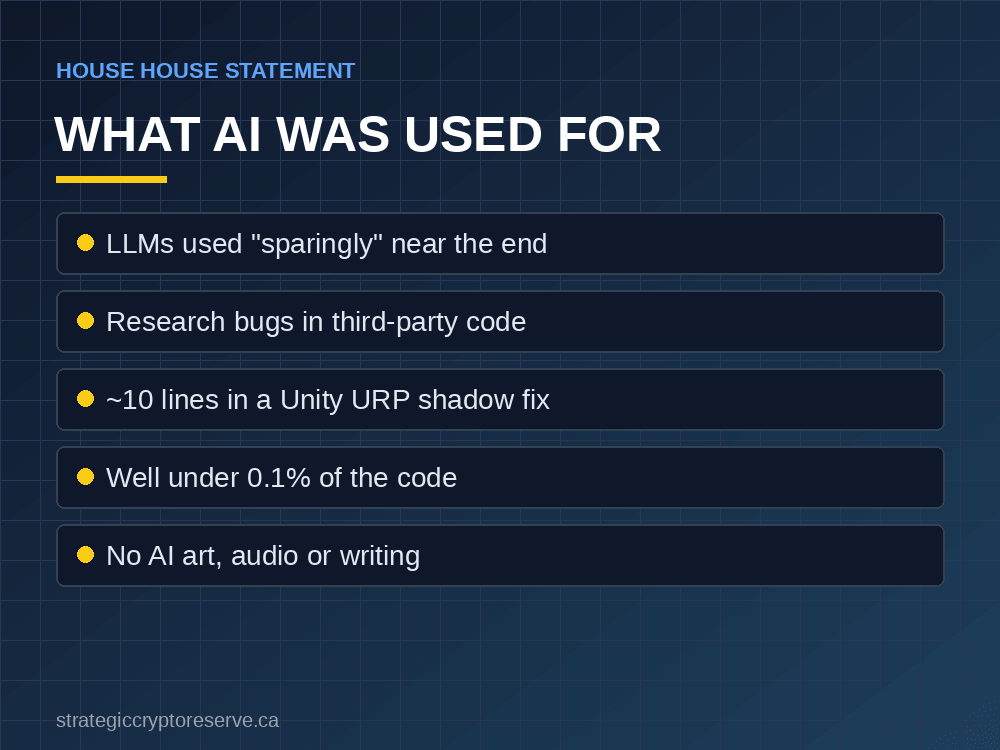
Big Walk’s AI usage was limited to code. House House says it used large language models (LLMs) sparingly in the final stretch of development to research bugs in third-party code, and that well under 0.1% of Big Walk’s code had anything to do with it. No generative AI was used for the game’s art, audio or writing.

The disclosure landed the same week 19 Independent Games Festival jurors said they would not vote for any game that uses generative AI “in any capacity”, and Big Walk’s recent Steam reviews turned sharply negative. Here is exactly what was used, what the rules require and why it became a debate.

Quick answers (updated November 12, 2026)

Did Big Walk use AI? Yes, but only chatbot help with code bugs: well under 0.1% of the code.

AI art, voices or writing? No, House House says.

Disqualified from the IGF? No. 19 jurors said they won’t vote for games that use generative AI; Big Walk was not named.

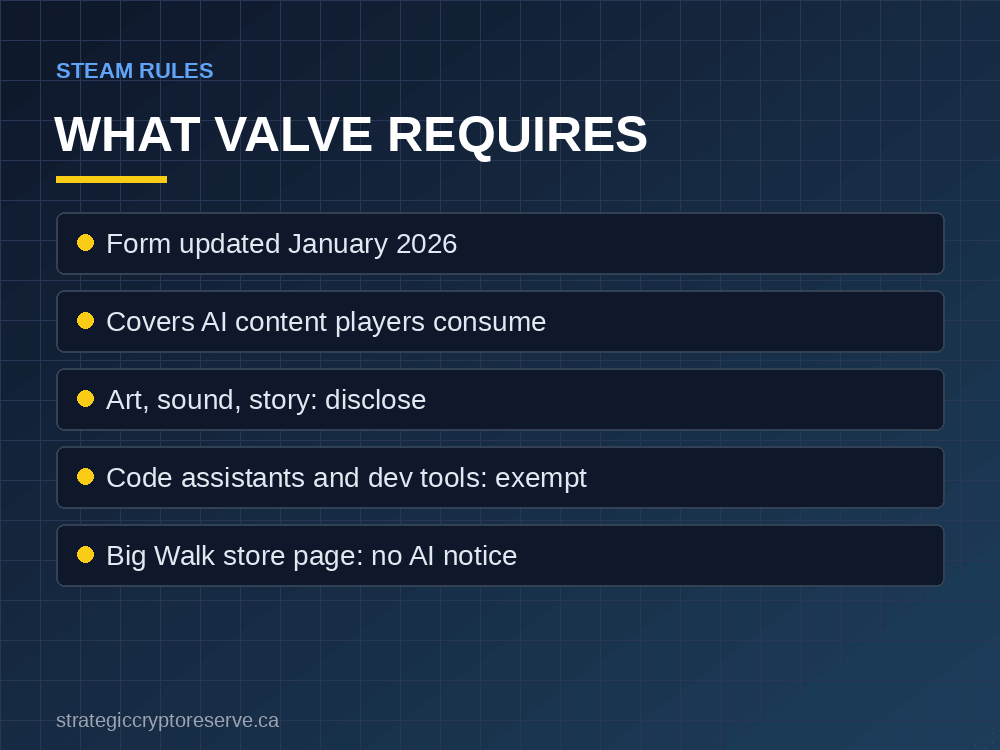
Steam disclosure? Not required: Steam’s form covers player-facing AI content, not coding tools.

Big Walk AI usage graphic: under 0.1% of code, LLM bug fixes only

AI share of Big Walk code

< 0.1%

Sources: House House statement via Aftermath, PC Gamer, Game Informer and MMOs.com, Nov 10–12, 2026.

$SCRPolygon $— Connecting to Polygon…
Big Walk AI usage at a glance (House House statement, November 2026)
AreaGenerative AI used?Details
Game codeYes, minimalLLM chatbot answers used as a starting point for fixes; well under 0.1% of the code
Art and visualsNo“Not used in any other context”
Audio and musicNo“Not used in any other context”
Writing and dialogueNo“Not used in any other context”
Steam AI disclosureNot shownSteam’s form does not ask about code or chatbot use
Internal AI policyNone at the timeHouse House calls the lack of a policy “a failure”

What Big Walk’s AI Usage Actually Was

House House published an AI section in the Big Walk FAQ (archived copies suggest it was added some time after October 23, 2026) and sent the same statement to the press. The key lines:

“In the final stretch of Big Walk’s development, LLMs were used sparingly by House House to help work through difficult technical challenges and bugs.”
“In some cases, snippets from LLM responses were copied as a starting point to be modified into game code—we’d estimate that well under 0.1% of Big Walk’s code had anything to do with this usage, and generative AI was not used in any other context when making the game.”

The studio says the main use was research: asking chatbots about problems in third-party code. Its example was a Unity Universal Render Pipeline (URP) bug where shadow casters behind the player were treated as infinitely far away, making the game run about 50% slower for roughly 20 seconds at sunrise and sunset. A chatbot suggested a fix, which the team heavily modified. The final change was about ten lines of code inside URP.

That kind of chatbot help runs on the same large language models covered in our guide to Anthropic’s Claude models and other AI labs.
What Big Walk AI usage covered: LLM help with third-party code bugs

The IGF Juror Statement on Generative AI

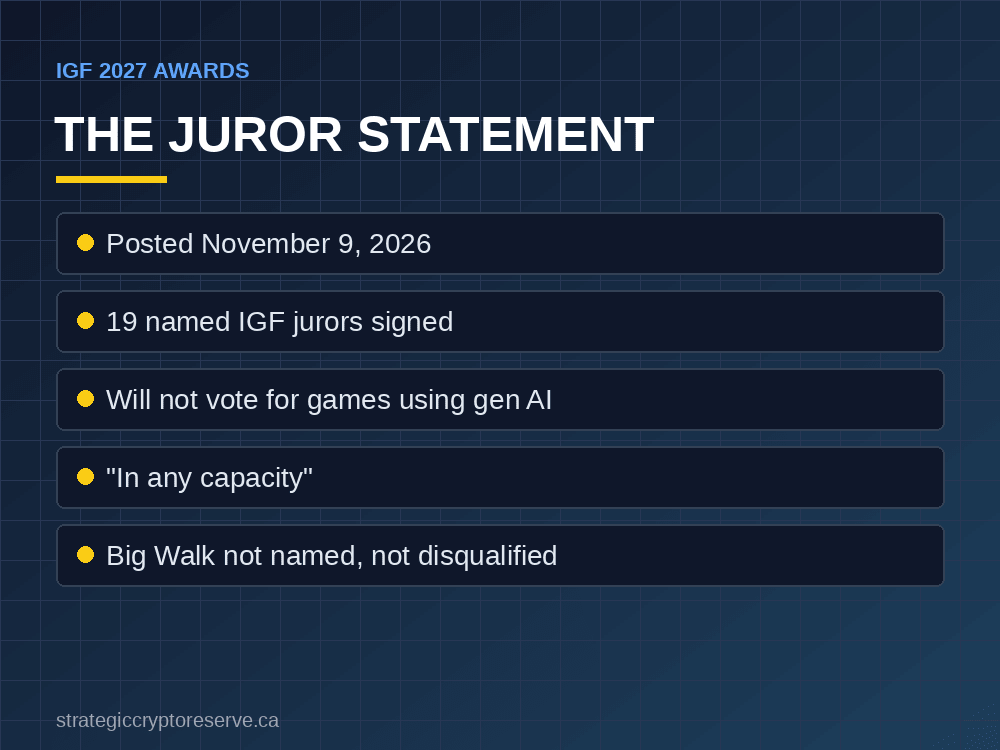
On November 9, 2026, a group of 19 named jurors for the Independent Games Festival (IGF) 2027 awards said they would decline to vote for “any game that uses generative AI in any capacity”. The statement noted that other jurors had different views and significant reservations. The IGF awards are scheduled for March 3, 2027.

The juror statement did not name Big Walk. House House says its AI statement was originally written for its IGF submission, which is how judges learned about the LLM usage. The studio wrote that it apologises “that Big Walk’s LLM usage may not meet their standards” and that it supports “the work of those who are trying to limit the harm generative AI is doing to videogames and our world.”

Was Big Walk disqualified? No. A social media post claimed it was, but no festival document says so. The question for those 19 jurors is whether ten lines of chatbot-assisted code counts as using generative AI “in any capacity”. Strictly read, it does.

IGF 2027 juror statement on generative AI explained

Steam’s AI Disclosure Rules: Why Big Walk Had No Notice

House House says it made no disclosure on Steam because “the platform does not request disclosure of code or chatbot usage.” That matches Valve’s rules.

In January 2026, Valve rewrote its AI disclosure form to focus on AI-generated content that players consume: art, sound, story and other content shipped in the game, plus live-generated content. Efficiency tools used behind the scenes, such as code assistants, do not need to be disclosed.

So Big Walk followed Steam’s rules, but some players and jurors want a stricter standard than Valve sets. The same tension showed up in the Arc Raiders AI voice controversy, where the AI was player-facing.

Steam AI disclosure rules and why Big Walk had no notice

The Steam Review Backlash and the Bigger Debate

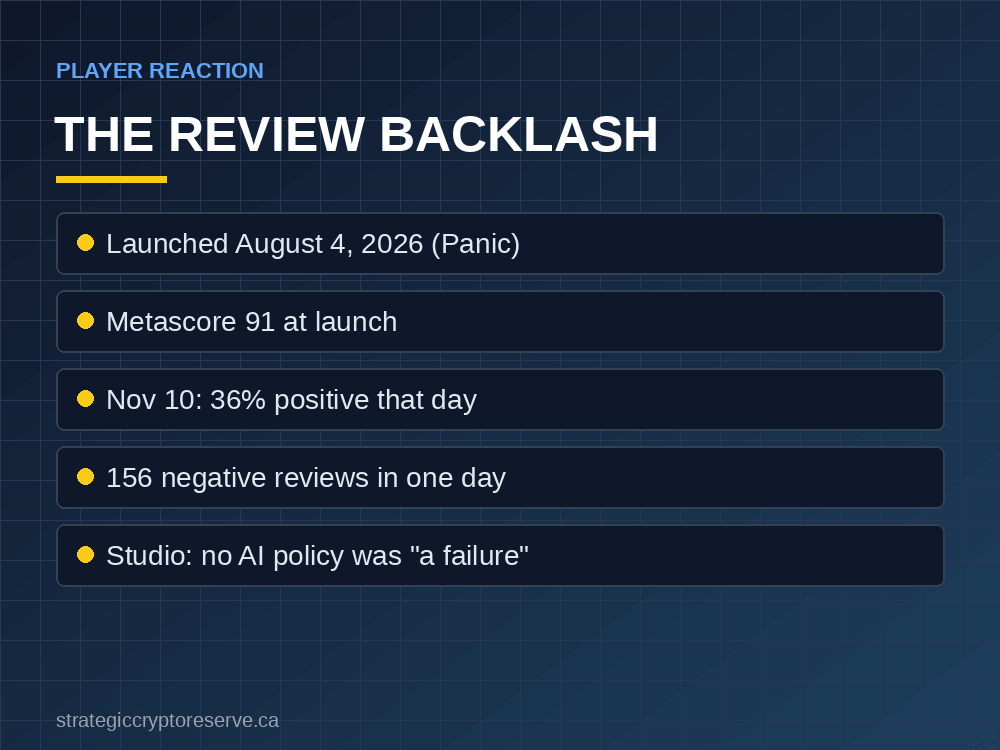
Big Walk launched on August 4, 2026 for Windows and Mac, published by Panic, to a Metascore of 91. After the disclosure spread, recent Steam reviews turned sharply negative: on November 10, 2026, reviews posted that day were 36% positive, with 156 negative reviews in a single day (up from a handful a day before). That is a one-day count, not the game’s overall rating.

The debate splits two ways:

  • “It’s nothing.” Asking a chatbot about an engine bug is like searching a forum, and ten lines out of a whole game is a rounding error.
  • “Disclose from day one.” Critics say the studio should have been open before the awards row, and object to AI on environmental and labour grounds (see how much water AI data centers use).

House House itself landed in the middle: “This is not an endorsement of, or argument for, the use of AI tools, however minimal,” and Big Walk “was developed without an internal AI usage policy in place, and we consider that lack of policy a failure.” It says it will write a fuller policy going forward.

Big Walk Steam review backlash after the AI disclosure

Big Walk AI Controversy Timeline

Key dates, all 2026 unless noted
DateWhat happened
January 2026Valve narrows Steam’s AI disclosure form to content players consume
August 4Big Walk launches on Windows and Mac (Panic), Metascore 91
After October 23AI section appears in the Big Walk FAQ
November 919 IGF 2027 jurors say they will not vote for any game using generative AI
November 10Big Walk AI usage goes viral; reviews posted that day are 36% positive
November 10–12House House statement is widely reported: “well under 0.1%” of code
March 3, 2027IGF awards ceremony

Other AI-in-games stories this month: whether generative AI could port GTA 6 to PC, and the rest of the week in artificial intelligence news.

What Powers the Chatbot Behind a Ten-Line Fix

Even a single chatbot answer about a Unity shadow bug runs on a GPU cluster inside an AI data center. Those clusters cost billions to build and draw tens to hundreds of megawatts. See what an AI data center costs to build, or price one yourself.

Price your own AI build in seconds. The AI Build Configurator shows capital cost by line item, power cost and payback for every Canadian province and US state, by GPU class and cooling type. Try the free demo, or put it on your own site: Standard licence C$4,000 a year, Pro C$10,000, site screening reports from C$950 (see licensing).

AI Build Configurator

Model the GPU clusters that run AI chatbots. Free demo, licensed for your own site.

Try the free demo →

Arc Raiders AI Voice

The player-facing AI controversy Big Walk is being compared to.

Read it →

GTA 6 and Generative AI

Take-Two’s “zero part” AI pledge and the AI porting warning.

Read it →

AI Water Usage

The environmental cost critics cite against generative AI.

Read it →

Frequently Asked Questions: Big Walk AI Usage

1. What was Big Walk's AI usage?

House House says it used large language models sparingly in the final stretch of development to research bugs in third-party code. Some snippets from chatbot answers were modified into game code, which it estimates is well under 0.1% of Big Walk's code. No generative AI was used for anything else.

2. Did Big Walk use AI art, voices or writing?

No. House House says generative AI was not used in any other context when making the game. The only use was chatbot help with code problems.

3. How much of Big Walk's code was made with AI?

House House estimates well under 0.1% of Big Walk's code had anything to do with its LLM usage. Its main example was a fix of about ten lines inside Unity's Universal Render Pipeline for a shadow bug.

4. Was Big Walk disqualified from the IGF?

No public festival document says Big Walk was disqualified. On November 9, 2026, 19 named IGF jurors said they would decline to vote for any game that uses generative AI in any capacity for the 2027 awards. Their statement did not name Big Walk.

5. Why didn't Big Walk disclose AI on Steam?

House House says Steam does not ask developers to disclose code or chatbot usage. Since January 2026, Valve's disclosure form covers AI content that players consume, such as art, sound and story, not development tools like code assistants.

6. Why are Big Walk's Steam reviews negative?

Players posted negative reviews after the AI disclosure spread. On November 10, 2026, reviews posted that day were 36% positive, with 156 negative reviews in one day. That is a single-day count, not the game's overall score.

7. Who makes Big Walk?

Big Walk is made by House House, the Australian studio behind Untitled Goose Game, and published by Panic. It launched on August 4, 2026 for Windows and Mac.

8. What hardware runs the AI chatbots developers use?

Large GPU clusters in AI data centers. The free demo of the Strategic Crypto Reserve AI Build Configurator shows what those clusters cost to build and power.