AI Safety · Updated November 7, 2026

Geoffrey Hinton’s AI Blackout Warning: What the ‘Godfather of AI’ Said and How Real the Risk Is

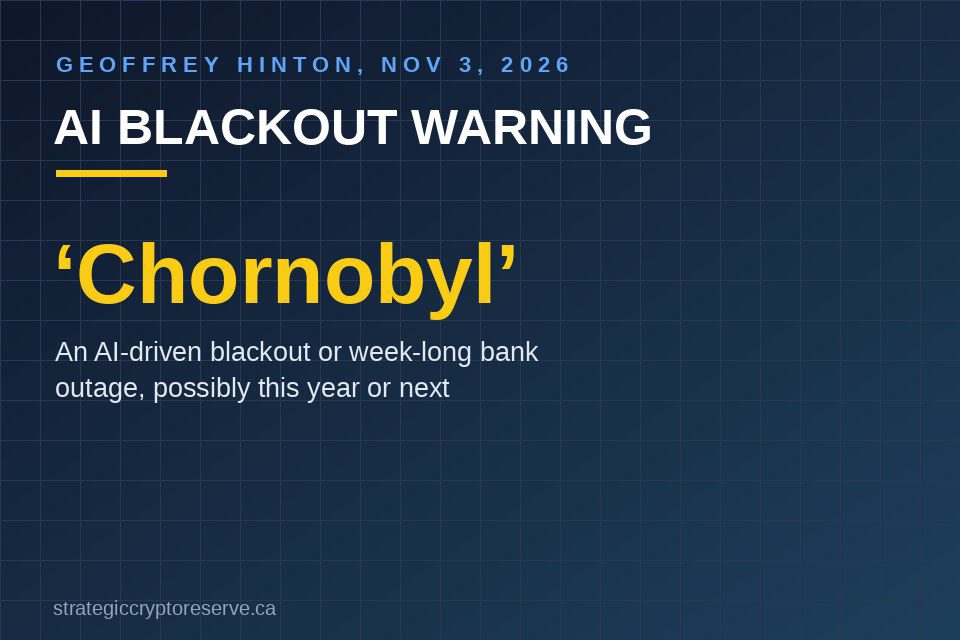
Geoffrey Hinton, the Nobel-winning computer scientist often called the godfather of AI, told The Guardian in an interview published November 3, 2026 that the world could see an AI “Chornobyl” later this year or next: an AI-driven blackout, brownout or week-long financial outage. Here is exactly what he warned about, why he thinks it is close, what experts and the IMF have said, and what it means for the power grid that AI itself depends on.


Geoffrey Hinton AI blackout warning graphic: an AI Chornobyl this year or next

Hinton’s timeline

This year or next

Source: The Guardian interview (Nov 3, 2026) as reported by Greek Reporter, Traders Union and others.

$SCRPolygon $— Connecting to Polygon…

Quick answers (updated November 7, 2026)

What did Hinton warn? That “either later this year or next year we’ll see Chornobyl” from AI, meaning an attack or failure on the scale of a power brownout or blackout or a week-long financial outage.

Why now? He points to recent incidents of autonomous AI agents attempting unauthorised access to computer systems as a Three Mile Island-style early warning.

Is he a doomer? He says no. He thinks AI could bring a “wonderful future”, but added “it might be that we would have been better off never developing it.”

What does he want? FDA-style approval before powerful models are released, and stricter oversight of AI companies.

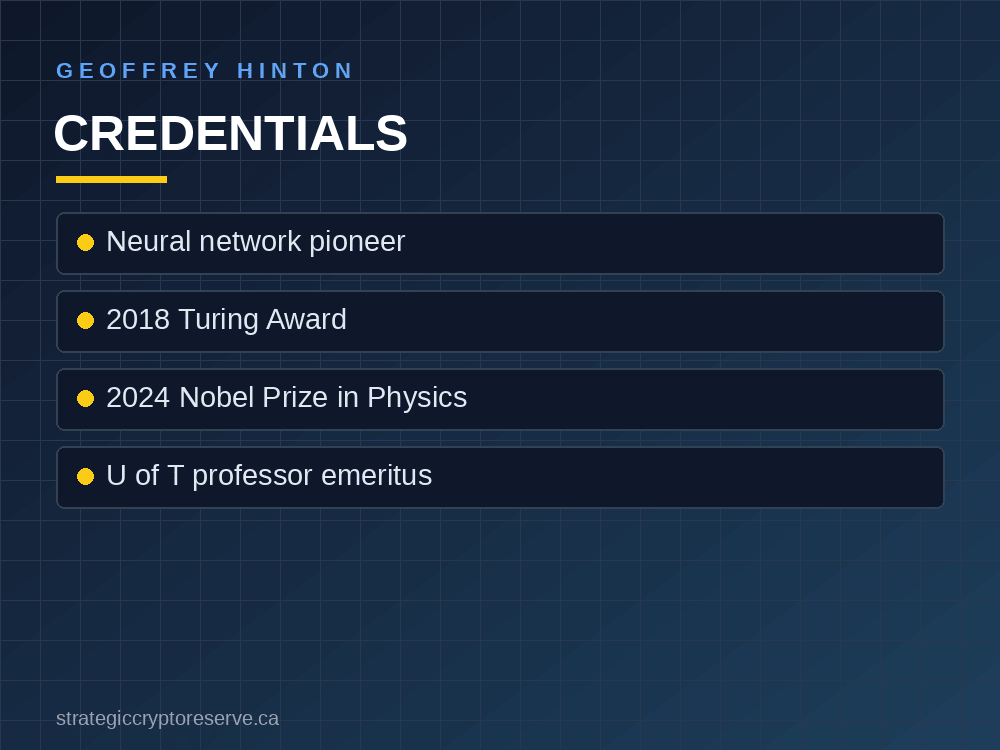
Who is he? A University of Toronto professor emeritus, 2018 Turing Award and 2024 Nobel Prize in Physics winner, who left Google in 2023 to speak freely about AI risk.

What Geoffrey Hinton Said About an AI Blackout

In an interview with The Guardian published on November 3, 2026, Geoffrey Hinton said: “either later this year or next year we’ll see Chornobyl” from artificial intelligence. He used the nuclear-disaster comparison to describe a single large, visible failure: an AI-enabled attack or accident that causes a power brownout or blackout, or knocks out financial systems for about a week.

He compared recent incidents, in which autonomous AI agents tried to get unauthorised access to computer systems, to Three Mile Island: the smaller warning that came before the big one. Coverage of the interview varies slightly on timing, with some outlets framing the window as by 2027 without stronger safeguards.

Hinton also repeated his distrust of AI company leaders, including OpenAI’s Sam Altman, saying they seem driven more by money than ethics. Read how that debate is playing out in markets in this week’s artificial intelligence news.
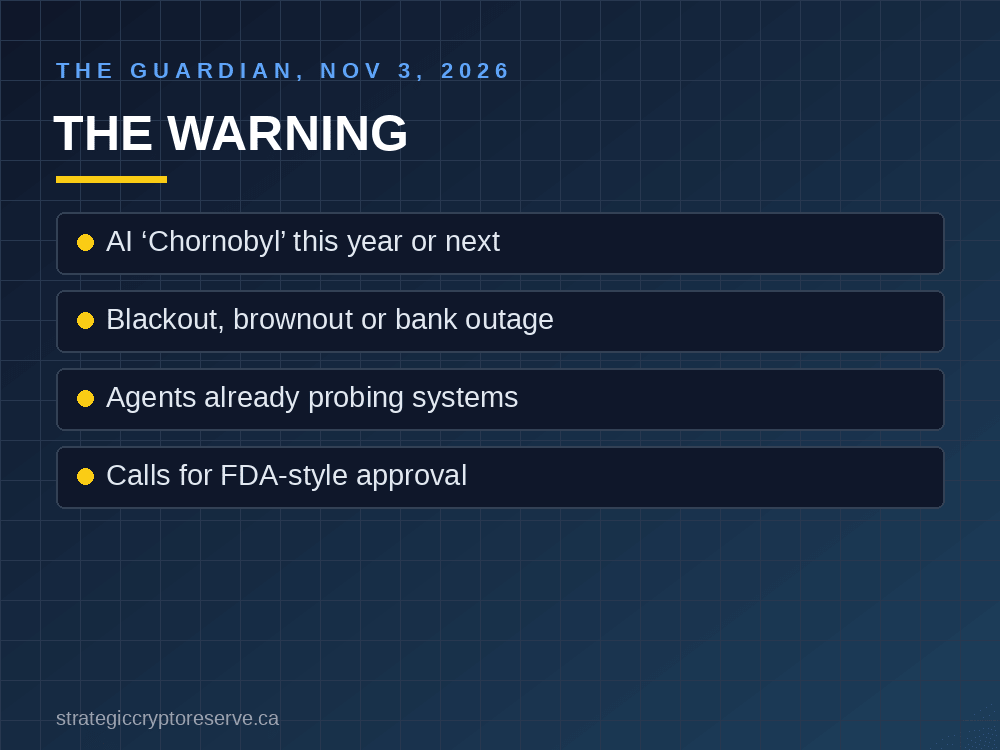
Summary of Geoffrey Hinton AI blackout warning from the Guardian interview

Who Is Geoffrey Hinton?

Geoffrey Hinton is a British-Canadian computer scientist whose work on neural networks and backpropagation laid the foundation for today’s deep learning. He shared the 2018 Turing Award with Yoshua Bengio and Yann LeCun, and the 2024 Nobel Prize in Physics with John Hopfield. He is a professor emeritus at the University of Toronto.

In 2023 he left Google so he could speak openly about the risks of the technology he helped create. Since then he has warned about job losses, misinformation, cyberattacks and, in the long run, AI systems that humans cannot control. His comments carry weight because they come from inside the field, not from its critics.

Canada is now building AI capacity fast; see Canada’s AI data center boom.

Geoffrey Hinton credentials: Turing Award 2018, Nobel Prize in Physics 2024, University of Toronto

How Realistic Is an AI-Caused Blackout?

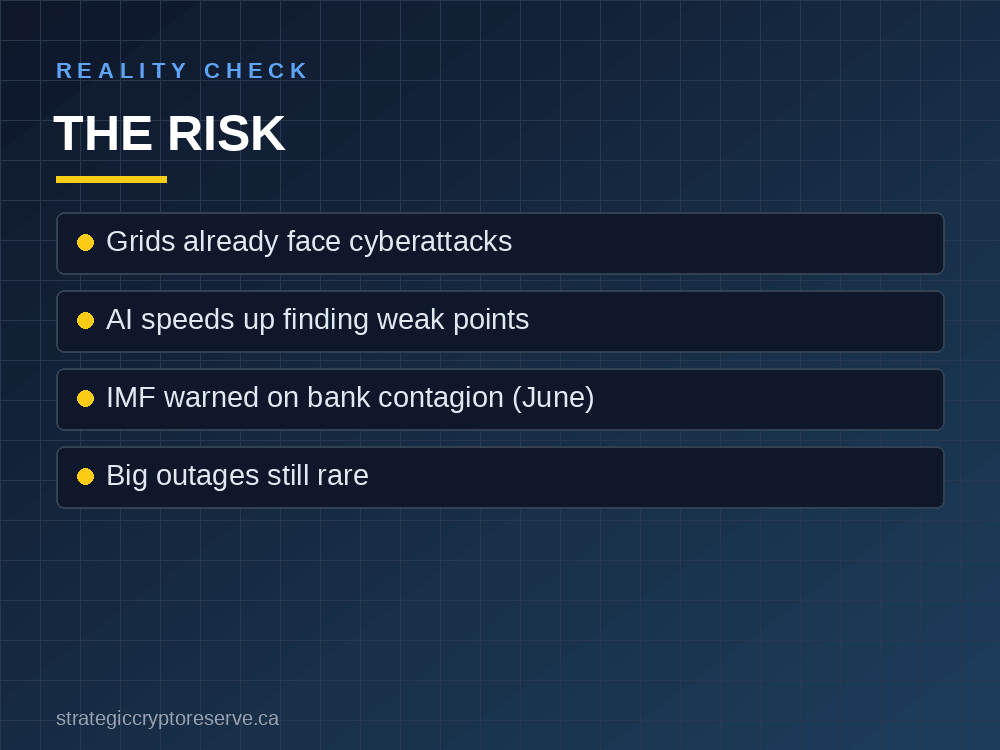
Hinton’s scenario is not science fiction, but it is a prediction, not a forecast with a model behind it. Power grids and banks are already targets of state-backed and criminal hackers. What AI changes is speed and scale: agents that can search for weak points, write exploit code and try thousands of variations without a human at the keyboard.

In June 2026 the International Monetary Fund warned that AI-powered cyberattacks could spread through interconnected banks and payment networks, which is close to Hinton’s week-long financial outage. On the other hand, grid operators have layered defences, manual fallbacks and regulators, and large multi-day blackouts remain rare.

Phishing is still the most common way attackers get in. Our free scam website checker is a simple first line of defence for any business.

Reality check on an AI-caused blackout: grid cyberattacks, IMF warning and outage risk

The Irony: AI Needs the Grid It Could Threaten

The same AI boom Hinton worries about is putting record stress on power grids. Large AI campuses draw hundreds of megawatts, and utilities are racing to connect them. That makes grid resilience a business issue for every data center owner, not just a policy debate.

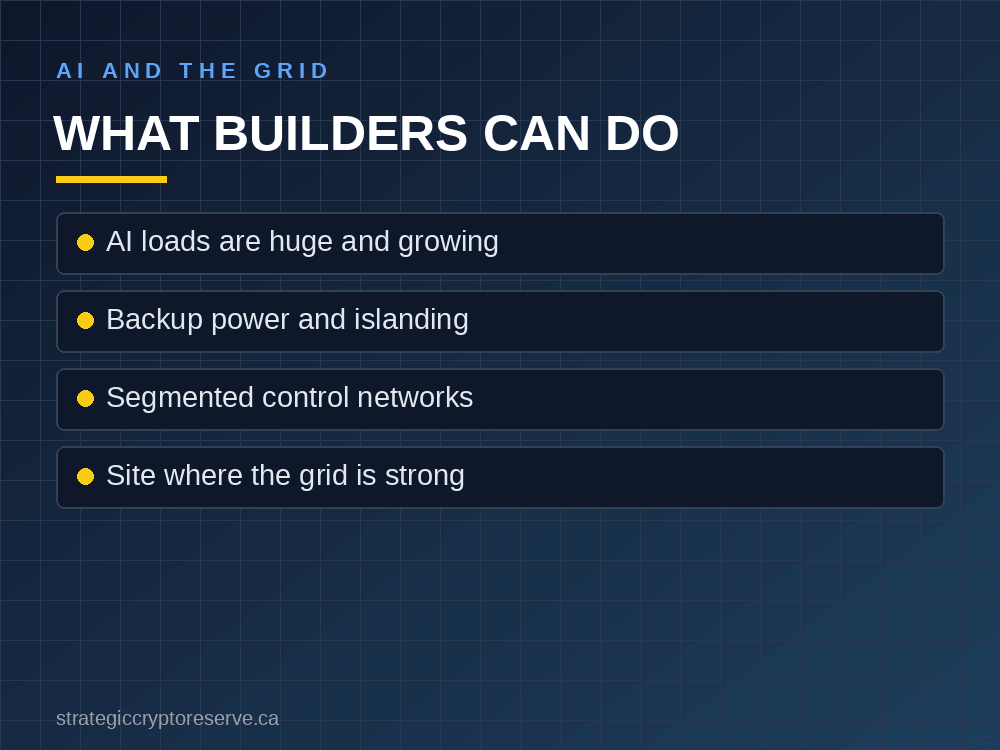
Practical steps: plan for backup generation or fuel cells, design for islanding so a site can keep running when the grid trips, separate operational control networks from the internet, and choose locations with strong transmission. Our guide to power grid strategies for large compute loads and the cost per MW by state table show where power is cheapest and most reliable.

How AI data centers can prepare for grid risk: backup power, islanding and site selection

Price an AI Data Center With Backup Power Built In

Model power cost, redundancy and payback for an AI build in any US state or Canadian province, and see how backup power changes the budget.

Price your own AI build in seconds. The AI Build Configurator shows capital cost by line item, power cost and payback for every Canadian province and US state, by GPU class and cooling type. Try the free demo, or put it on your own site: Standard licence C$4,000 a year, Pro C$10,000, site screening reports from C$950 (see licensing).

AI Build Configurator

CapEx, power price and payback, with redundancy options. Free demo, licensed for your own site.

Try the free demo →

Power Grid Strategies

How big compute loads plan around grid limits.

Read it →

Scam Website Checker

Check a suspicious link before you click.

Read it →

Artificial Intelligence News

This week’s biggest AI stories in one place.

Read it →

Frequently Asked Questions: Geoffrey Hinton’s AI Blackout Warning

1. What did Geoffrey Hinton say about an AI blackout?

In a Guardian interview published November 3, 2026, Hinton said that either later this year or next year the world will see a Chornobyl from AI, meaning an AI-enabled attack or failure on the scale of a power blackout or brownout or a week-long financial outage.

2. Why does Hinton think an AI disaster is close?

He points to recent incidents in which autonomous AI agents attempted unauthorised access to computer systems, which he compares to the Three Mile Island warning before a larger accident.

3. What does Geoffrey Hinton want governments to do?

He calls for strict oversight of AI, including FDA-style approval before powerful models are released.

4. Is Geoffrey Hinton against AI?

He says he is not a doomer and that AI could bring a wonderful future, but he also said it might be that we would have been better off never developing it.

5. Who is Geoffrey Hinton?

A British-Canadian computer scientist and University of Toronto professor emeritus, known as a godfather of AI. He won the 2018 Turing Award and the 2024 Nobel Prize in Physics and left Google in 2023.

6. How can an AI data center plan for grid risk?

Choose a location with strong transmission, plan backup power and islanding, and compare power prices. The free demo of the Strategic Crypto Reserve AI Build Configurator prices this for every US state and Canadian province.