AI Markets · Updated November 4, 2026

S&P 500 and the AI Trade Rebound on Election Day 2026

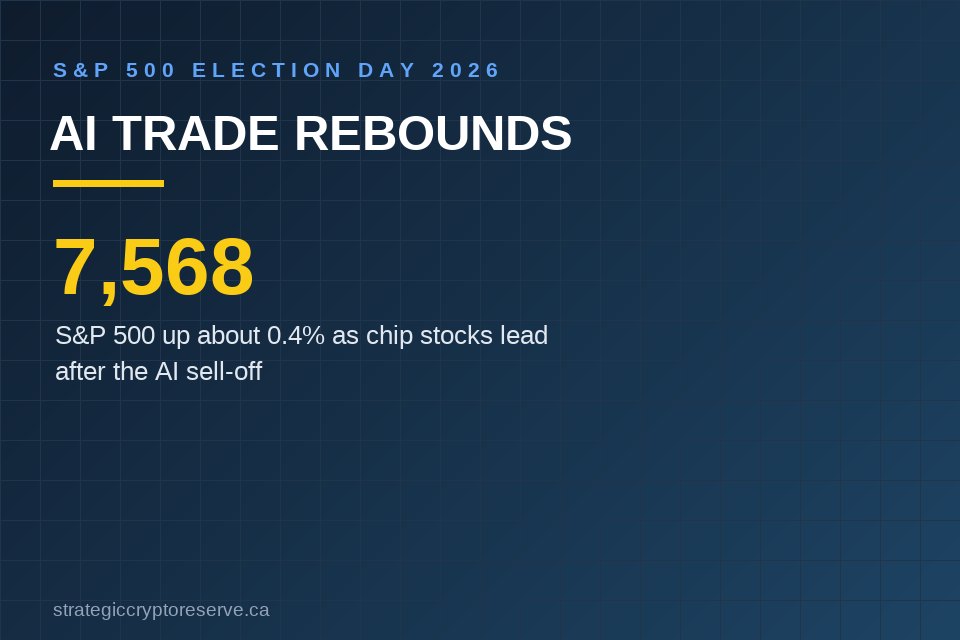
The S&P 500 rose about 0.4% to 7,568 on Tuesday, November 3, 2026, US election day, as chip stocks led a rebound in the AI trade after days of selling over AI spending. Searches for “S&P 500”, “SPX”, “SPY” and “VOO” trended in the US and Canada. Here is what moved, how narrow the rally was, and what it says about AI infrastructure.


S&P 500 and the AI trade rebound on election day 2026

S&P 500 close, Nov 3, 2026

7,568 · up about 0.4%

Closing figures as reported by Kiplinger, Investing.com and Bloomberg. Not investment advice.

$SCRPolygon $— Connecting to Polygon…

Quick answers (updated November 4, 2026)

S&P 500: closed up about 0.4% at 7,568 on November 3, 2026 (Kiplinger; Investing.com put the gain at 0.36%).

Chips led: the Philadelphia Semiconductor Index rose about 3%, its first gain in five sessions.

Nvidia: up about 2.3%, taking its market value back above $5 trillion. CoreWeave, Nebius and Applied Digital each gained more than 7%.

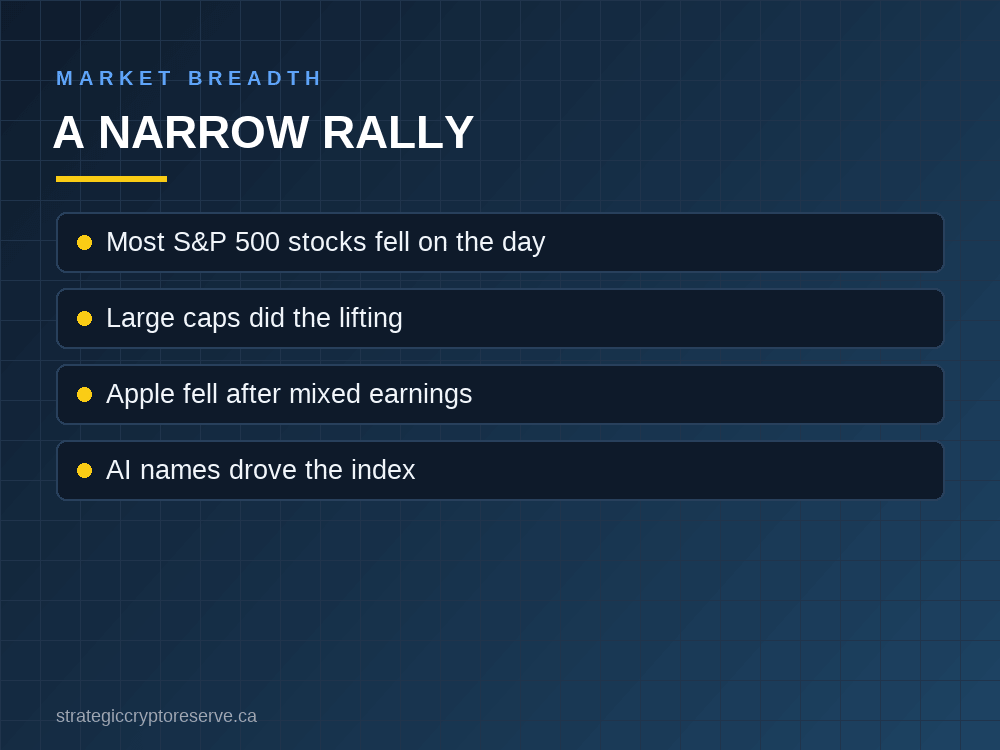
Narrow rally: Bloomberg noted that most S&P 500 stocks fell even as the index rose.

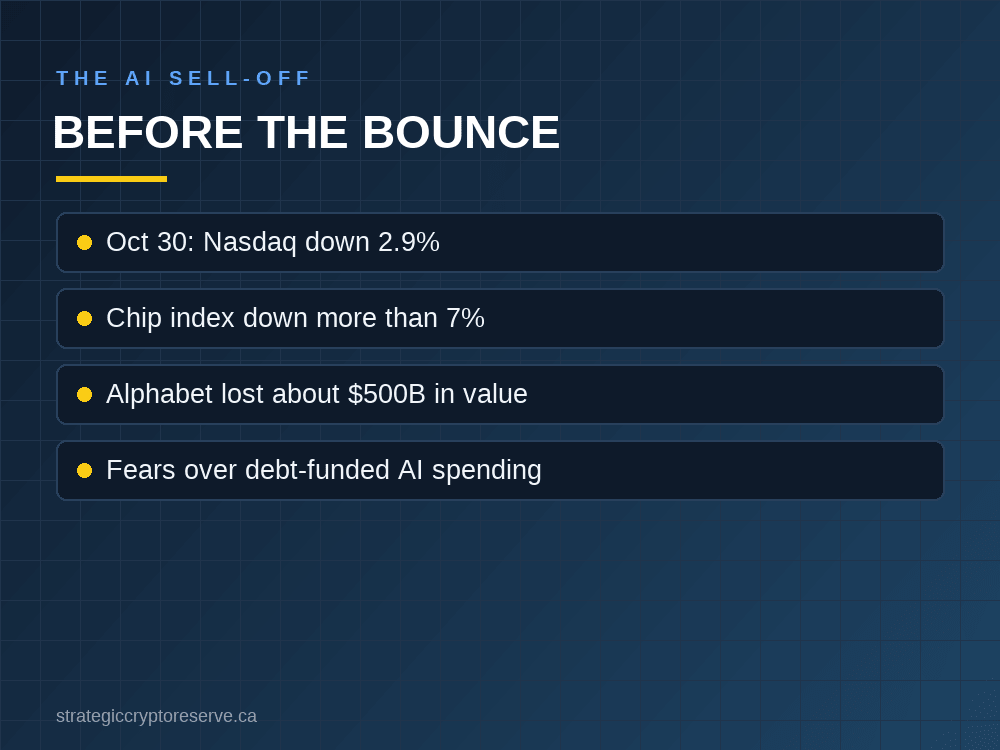
Why: a bounce after the October 30 sell-off over debt-funded AI spending. AMD and Super Micro then beat estimates after the close.

What Moved the S&P 500 on November 3, 2026

On US midterm election day, the S&P 500 closed about 0.4% higher at 7,568, according to Kiplinger. Investing.com reported a 0.36% gain, and the Nasdaq also finished higher. It snapped a three-day losing streak for the index.

Market moves on November 3, 2026 (as reported)
MarketMove
S&P 500Up about 0.4%, to 7,568
Philadelphia Semiconductor IndexUp about 3% (2.6% per BlockBeats)
NvidiaUp about 2.3%; market value back above $5 trillion
CoreWeave, Nebius, Applied DigitalEach up more than 7%
US Treasury yieldsHigher
US dollarFirmer

Popular index funds tracked the move, which is why searches for SPY and VOO trended alongside the index itself.
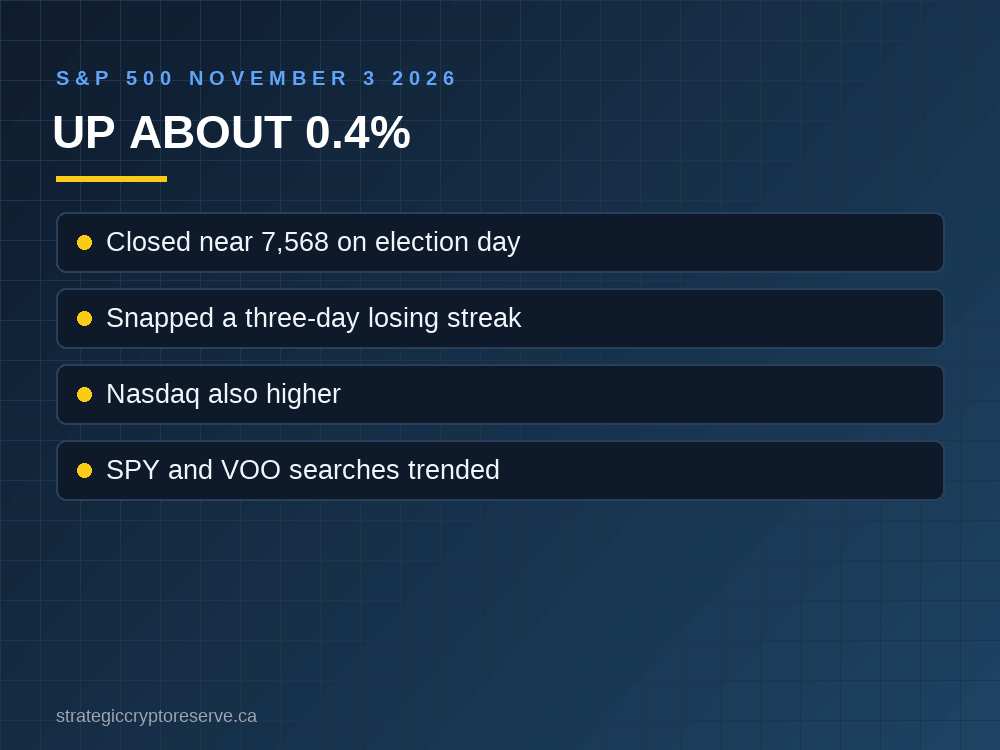
S&P 500 on November 3 2026: up about 0.4 percent to 7,568

The AI Sell-Off That Came Before

The AI stock sell-off before the November 2026 rebound

The rebound only makes sense against the week before it. On Friday, October 30, the Nasdaq fell 2.9% and the semiconductor index dropped more than 7%, InvestorPlace reported. Alphabet lost close to $500 billion of market value after its earnings.

The worry was money. Big tech companies are spending record sums on AI data centers, and more of it is now borrowed. Meta, Microsoft and Oracle have all raised new equity or debt to fund AI. At the same time, the Fed held rates at its October 28 meeting with two officials voting for a hike, and Chair Kevin Warsh was reported to have said that higher rates do reach AI investment.

Read more in Kevin Warsh’s AI stock market comments, explained.

A Narrow Rally: Most S&P 500 Stocks Fell

The headline gain hid a split market. Bloomberg reported that most S&P 500 companies fell on November 3 even as the index rose. Goldman Sachs’ trading desk described the move as driven mainly by large caps.

That happens because the S&P 500 is weighted by market value. When Nvidia, Microsoft, Broadcom and a few other giants rise together, they can lift the index while hundreds of smaller companies slip. Apple fell on the day after mixed earnings, which shows the AI trade, not big tech as a whole, did the lifting.

For index investors, narrow rallies are a reminder of how concentrated the S&P 500 has become in AI-linked names. It is not a reason to buy or sell on its own.

Narrow S&P 500 rally: most stocks fell as AI names rose

After the Close: AMD and Super Micro Beat

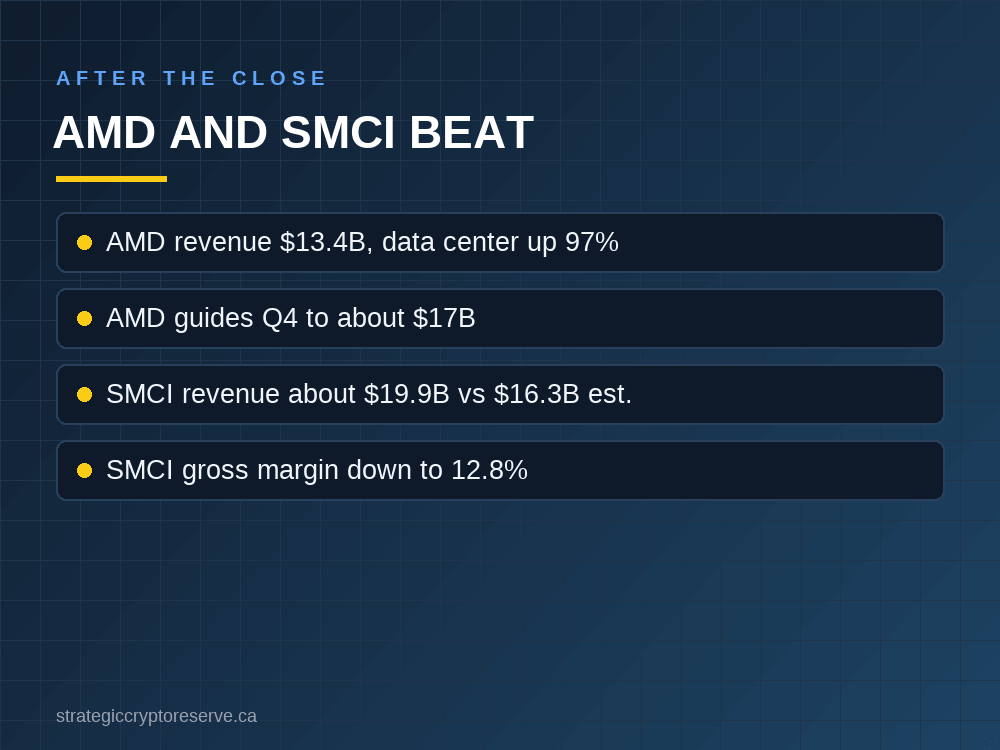
AMD and Super Micro earnings after the close on November 3 2026

Two AI hardware companies reported after the bell and kept the theme going:

  • AMD posted record revenue of $13.4 billion, with data center sales up 97% to $8.5 billion, and guided the fourth quarter to about $17 billion. See AMD Q3 2026 earnings.
  • Super Micro reported about $19.9 billion of revenue against about $16.3 billion expected, and guided higher, though its gross margin fell to 12.8%. See SMCI stock after earnings.

Both shares rose in after-hours trading, then gave back some gains as election results arrived. Results like these feed directly into the debate about whether AI spending is a bubble or a buildout: they show the spending is real, and that it is turning into revenue for the suppliers.

What the AI Trade Means for Data Center Builders

Behind every move in the AI trade is physical construction: power lines, substations, cooling plants and buildings full of racks. CoreWeave, Nebius and Applied Digital, three of the day’s biggest gainers, all build or run AI data centers.

Stock prices swing on sentiment, but the facilities have to be planned on fundamentals: electricity cost, cooling, construction cost and payback. Those vary hugely by location. Power in Quebec, Manitoba or Washington costs a fraction of what it does in parts of California or the Northeast.

Our AI Build Configurator turns those fundamentals into numbers for every Canadian province and US state. It is free to try and available to license for your own site.

What the AI trade means for AI data center builders

Plan on Fundamentals, Not Headlines

Markets swing between AI boom and AI bubble every week. Power prices, cooling and construction costs move much more slowly, and they decide whether a facility pays back.

Price your own AI build in seconds. The AI Build Configurator shows capital cost by line item, power cost and payback for every Canadian province and US state, by GPU class and cooling type. Try the free demo, or put it on your own site: Standard licence C$4,000 a year, Pro C$10,000, site screening reports from C$950 (see licensing).

AI Build Configurator

Live AI and HPC build-cost model: CapEx, energy cost and payback by province or state. Free demo, licensed for your own site.

Try the free demo →

AMD Stock Q3 2026 Earnings

Record $13.4B quarter, data center up 97% and a $17B Q4 outlook.

Read it →

Kevin Warsh on AI and Stocks

What the Fed chair said, what is confirmed, and why AI stocks care about rates.

Read it →

SMCI Stock After Earnings

Super Micro beat on revenue and earnings, but margins fell to 12.8%.

Read it →

Frequently Asked Questions: S&P 500 and the AI Trade

1. How did the S&P 500 do on November 3, 2026?

The S&P 500 closed about 0.4% higher at roughly 7,568 on November 3, 2026, according to Kiplinger, snapping a three-day losing streak. Investing.com reported the gain as 0.36%.

2. Why did stocks rise on election day 2026?

Chip and AI stocks rebounded after a sharp sell-off the previous week. The Philadelphia Semiconductor Index rose about 3% and Nvidia gained about 2.3%, taking its market value back above $5 trillion.

3. Why did AI stocks sell off before November 3?

Investors worried about record and increasingly debt-funded AI spending by big tech, and about a less friendly Federal Reserve. On October 30 the Nasdaq fell 2.9% and the semiconductor index dropped more than 7%.

4. Did most S&P 500 stocks go up on November 3?

No. Bloomberg reported that most S&P 500 companies fell even though the index rose, because a handful of large AI-linked stocks drove the gain.

5. What is the difference between SPX, SPY and VOO?

SPX is the S&P 500 index itself. SPY (SPDR S&P 500 ETF) and VOO (Vanguard S&P 500 ETF) are exchange-traded funds that track the index, so they move almost exactly with it before fees.

6. What does the AI trade mean for data center costs?

The AI trade reflects heavy spending on data centers whose costs depend on power price, cooling and construction by location. The Strategic Crypto Reserve AI Build Configurator estimates those costs and the payback for any Canadian province or US state.