AI Markets · Updated November 4, 2026

Kevin Warsh’s AI Stock Market Comments, Explained

Searches for “Kevin Warsh AI stock market comments” jumped on November 3 as AI stocks swung. The Fed chair has been widely quoted as saying higher interest rates do reach AI investment. Here is what is confirmed, what is still unverified, and why rates matter to anyone financing an AI buildout.


Kevin Warsh AI stock market comments and the October 2026 Fed decision

Fed funds target range

3.75% to 4% · held Oct 28

Rate decision from the FOMC statement of October 28, 2026. Not investment advice.

$SCRPolygon $— Connecting to Polygon…

Quick answers (updated November 4, 2026)

Who: Kevin Warsh, Chair of the US Federal Reserve.

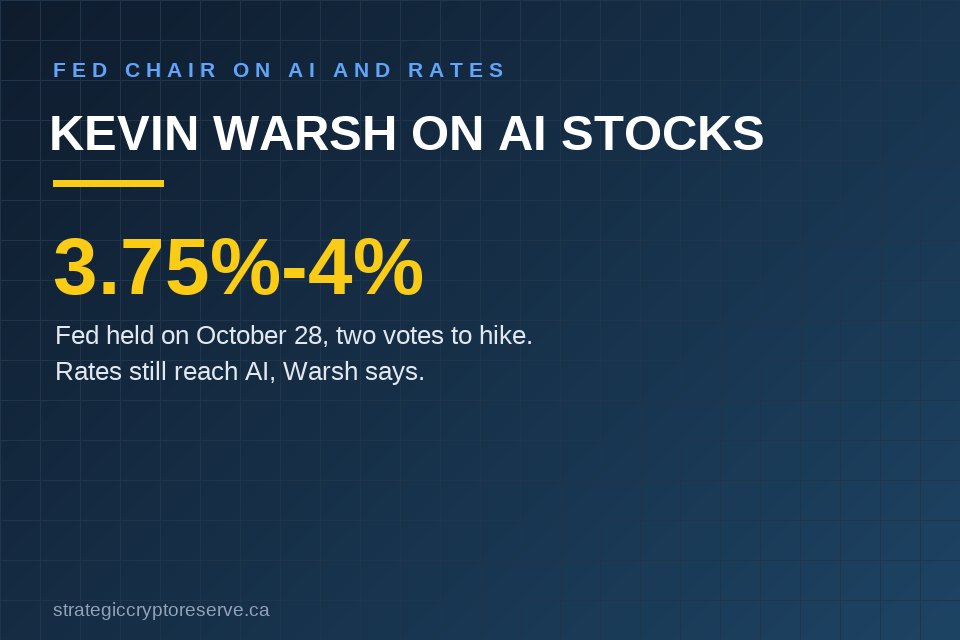
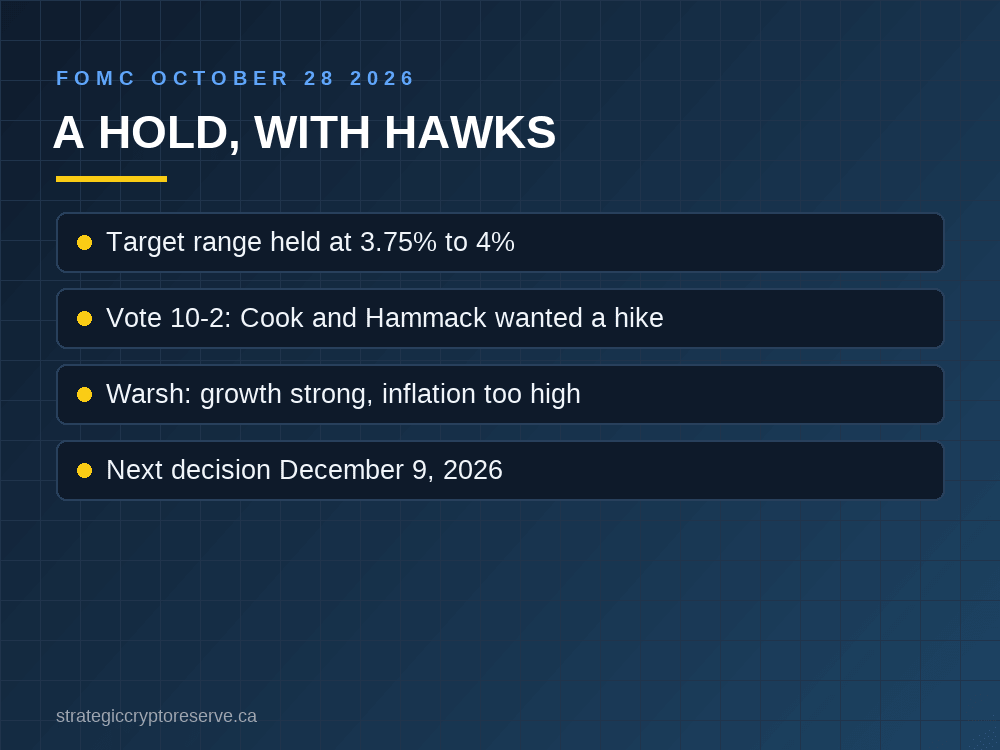
The decision: on October 28, 2026 the Fed held its target range at 3.75% to 4% in a 10–2 vote. Governor Lisa Cook and Cleveland Fed President Beth Hammack wanted a quarter-point hike.

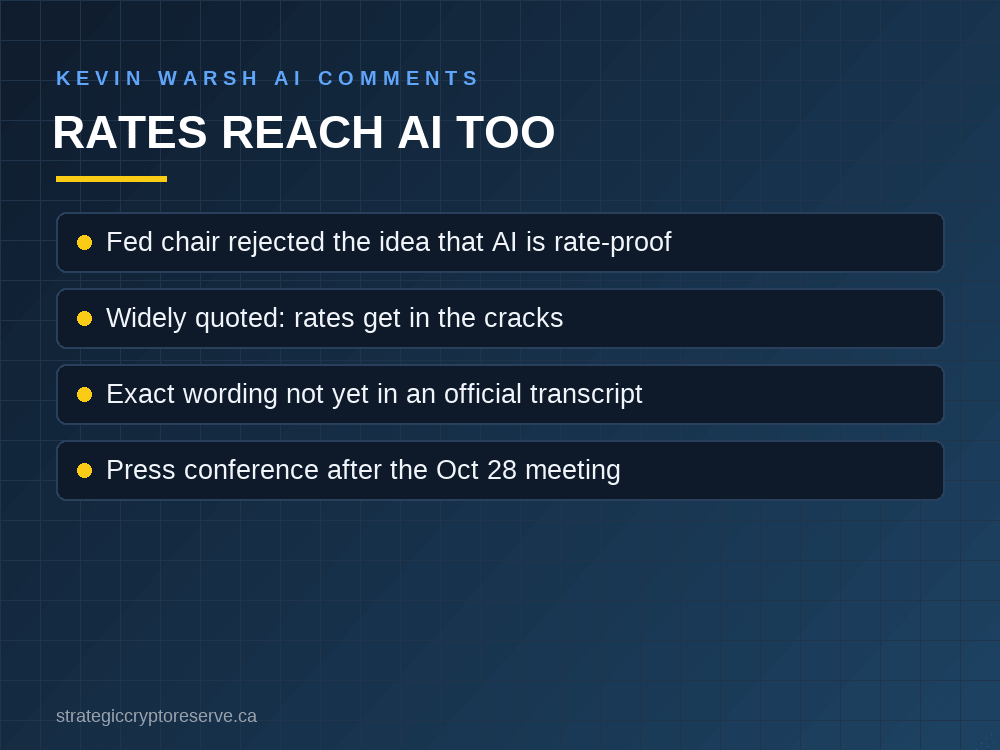
The AI comments: commentators report Warsh rejected the idea that AI investment is immune to interest rates. A widely quoted line is “interest rates get in the cracks.” We could not yet confirm the exact wording in an official transcript.

Why stocks cared: much of the AI buildout is now funded with debt, so higher rates raise its cost. AI stocks sold off hard on October 30 before rebounding on November 3.

Next date: the next Fed decision is December 9, 2026, with new projections.

What Kevin Warsh Said About AI and the Stock Market

The comments people are searching for came from the press conference after the Federal Open Market Committee meeting that ended on October 28, 2026. According to reporting by The Motley Fool and other market commentators, Warsh pushed back on a popular argument on Wall Street: that the AI boom is so large and so well funded that interest rates barely affect it.

The line most often quoted is that “interest rates get in the cracks”, meaning higher borrowing costs eventually reach every part of the economy, AI included. Some coverage framed this as a warning to the AI-driven rally; other analysts read it as a general statement about how monetary policy works.

What is verified and what is not. The rate decision, the vote and the dissents are in the official FOMC statement. The exact AI wording comes from press and commentary. At the time of writing, we could not match it to a published transcript. The Federal Reserve posts press conference transcripts on federalreserve.gov, and we will update this page if the wording differs.
Kevin Warsh AI stock market comments explained

The October 28 Fed Decision: A Hold With Two Votes to Hike

Fed decision October 28 2026: rates held at 3.75 to 4 percent

The backdrop explains why markets listened closely. The Fed kept the federal funds target range at 3.75% to 4%, but the vote was 10–2. Governor Lisa Cook and Cleveland Fed President Beth Hammack dissented because they wanted a quarter-point rate increase.

Target range
3.75% to 4%, unchanged
Vote
10–2; Cook and Hammack favoured a 0.25-point hike
Chair’s message
Growth is strong and inflation is too high
Next decision
December 9, 2026, with new economic projections

When two voters want to raise rates and the chair says inflation is too high, investors start pricing a chance of a hike rather than a cut. That shift matters most for companies whose valuations depend on profits far in the future, a description that fits much of the AI trade.

Why Interest Rates Matter for AI Stocks

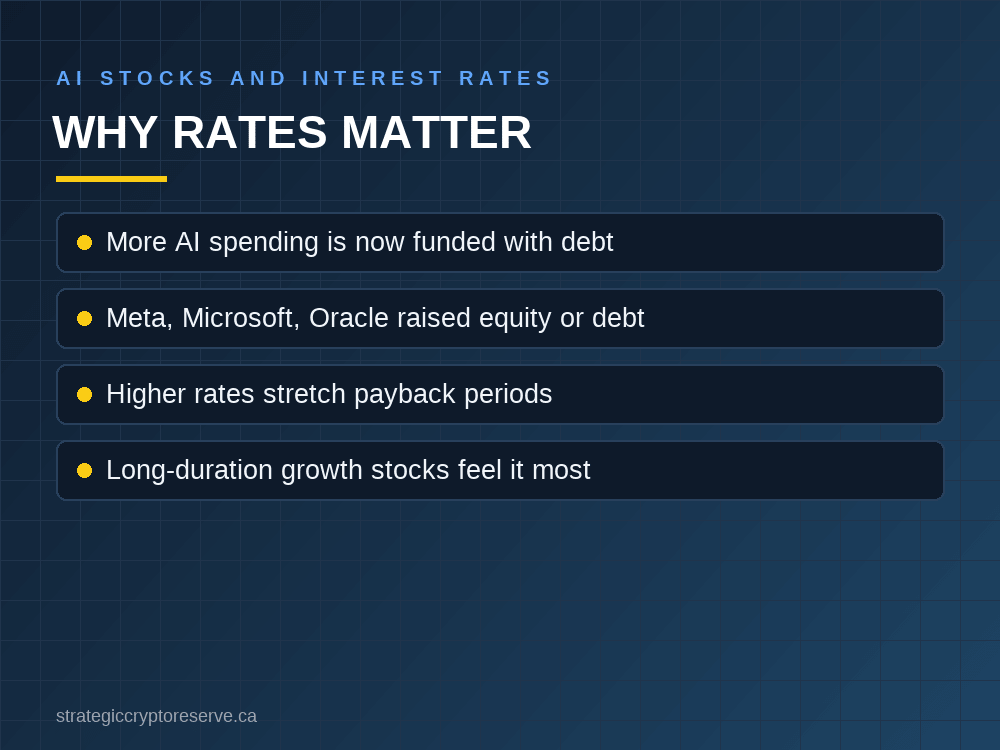
For most of 2025 the AI buildout was paid for largely with cash from the biggest tech companies. In 2026 that changed. Meta, Microsoft and Oracle have all raised new equity or debt to fund AI spending, and a growing share of GPU purchases and data center construction is financed with loans, bonds and leases.

That is the link Warsh’s comments point to. When rates rise:

  • Financing costs rise for data centers, GPU fleets and the power deals behind them.
  • Payback periods stretch, because each year’s cash flow is worth less in today’s money.
  • Valuations of long-duration growth stocks tend to fall, since more of their value sits in future years.

Not everyone agrees on the size of the effect. Moody’s chief economist Mark Zandi has said there is some merit to the view that AI demand is not very rate-sensitive, while still warning that higher rates weigh on stocks and raise the cost of capital.

Why interest rates matter for AI stocks and AI data center financing

How the Market Reacted: Sell-Off, Then a Rebound

AI stock sell-off and rebound after the October 2026 Fed meeting

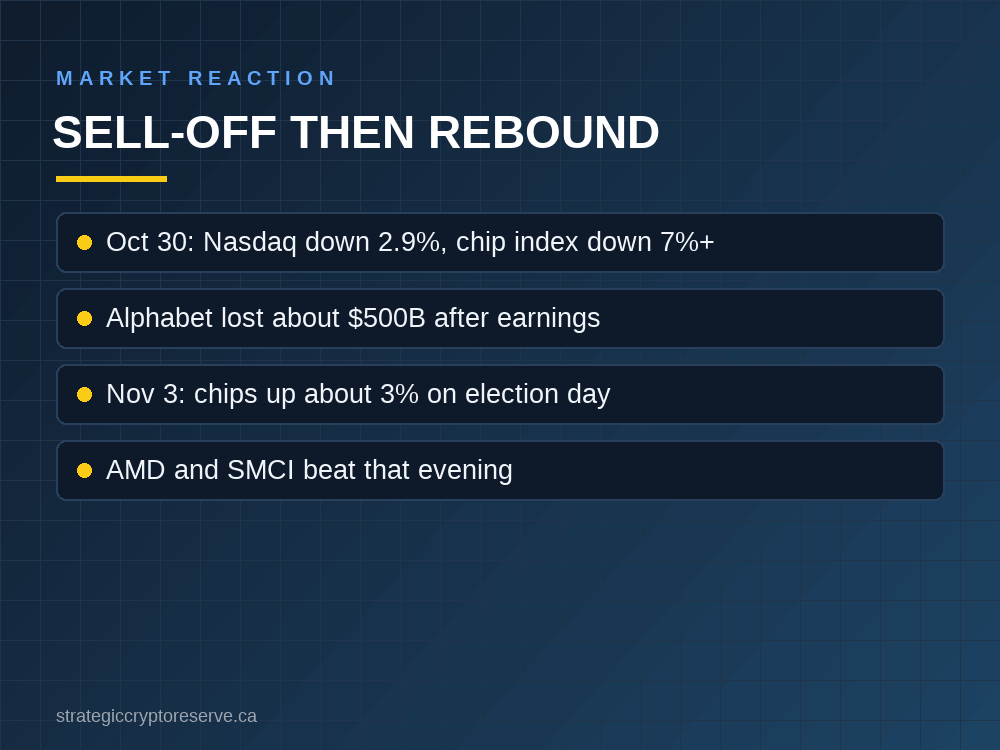
The week after the Fed meeting was rough for AI shares. On Friday, October 30, the Nasdaq fell 2.9% and the Philadelphia Semiconductor Index dropped more than 7%, and Alphabet lost close to $500 billion of market value after its earnings, InvestorPlace reported. Worries about debt-funded AI spending and a less friendly Fed fed into the same move.

On Tuesday, November 3, US election day, the trade bounced. The semiconductor index rose about 3% and Nvidia’s market value went back above $5 trillion. That evening AMD and Super Micro both beat expectations. Searches for Warsh’s comments peaked the same day, as investors tried to work out whether the sell-off or the rebound was the better guide.

We cover the rebound in S&P 500 and the AI trade rebound, and the two earnings reports in AMD Q3 2026 earnings and SMCI stock after earnings.

What Higher Rates Mean for an AI Data Center Budget

For a company building AI capacity, interest rates are not an abstract market story. A data center is a large up-front cost paid back over years, so the cost of money changes whether a project works.

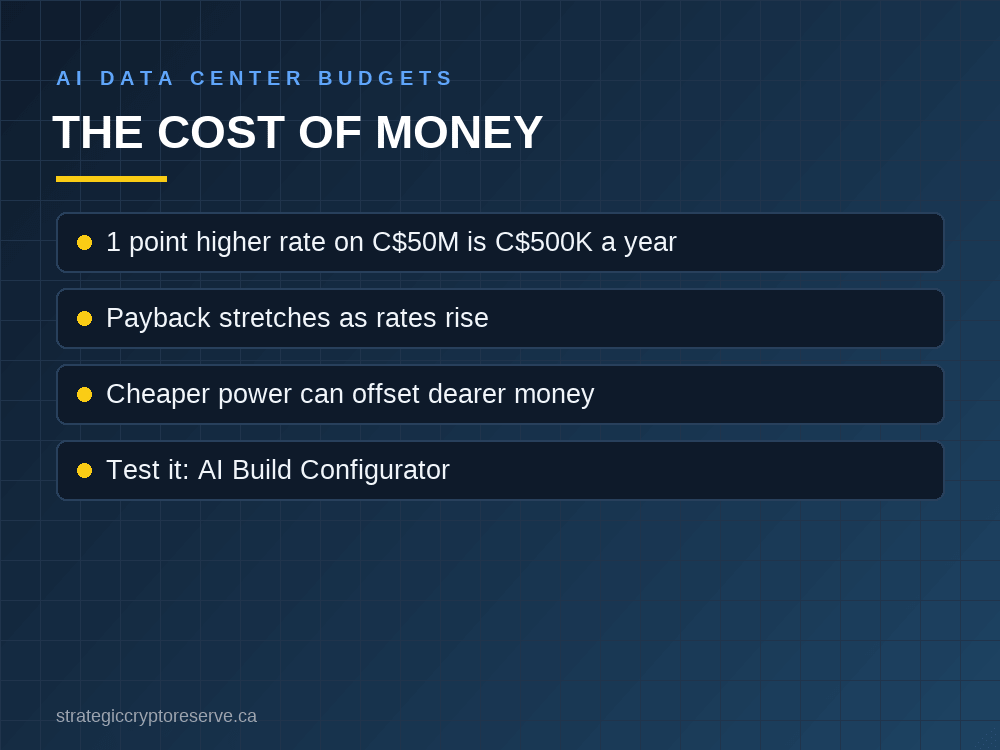
Take a simple example: a facility that costs C$50 million and earns steady cash each year. If the financing rate rises by one percentage point, the yearly interest bill rises by about C$500,000 on the full amount borrowed. That can add months to the payback and change which province or state makes sense, because cheaper power can offset dearer money.

That trade-off is what our AI Build Configurator is built for. It shows capital cost by line item, power cost and payback for every Canadian province and US state, so you can test a project before rates move again.

What higher interest rates mean for an AI data center budget

Stress-Test Your AI Build Before Rates Move

If the Fed’s next move is up rather than down, projects with thin margins feel it first. See how location, power price and cooling choices change the numbers for your build.

Price your own AI build in seconds. The AI Build Configurator shows capital cost by line item, power cost and payback for every Canadian province and US state, by GPU class and cooling type. Try the free demo, or put it on your own site: Standard licence C$4,000 a year, Pro C$10,000, site screening reports from C$950 (see licensing).

AI Build Configurator

Live AI and HPC build-cost model: CapEx, energy cost and payback by province or state. Free demo, licensed for your own site.

Try the free demo →

AMD Stock Q3 2026 Earnings

Record $13.4B quarter, data center up 97% and a $17B Q4 outlook.

Read it →

SMCI Stock After Earnings

Super Micro beat on revenue and earnings, but margins fell to 12.8%.

Read it →

Arc Raiders AI Voice Explained

Why Embark still uses AI voices for pings, and what changed.

Read it →

Frequently Asked Questions: Kevin Warsh, AI and Interest Rates

1. What did Kevin Warsh say about AI and the stock market?

At the press conference after the October 28, 2026 Fed meeting, Chair Kevin Warsh was reported to have rejected the idea that AI investment is insensitive to interest rates. The line most quoted in the press is that interest rates get in the cracks. The exact wording has not yet been confirmed against an official transcript.

2. Did the Fed raise rates in October 2026?

No. On October 28, 2026 the Federal Reserve held the federal funds target range at 3.75% to 4% in a 10-2 vote. Governor Lisa Cook and Cleveland Fed President Beth Hammack dissented because they wanted a quarter-point increase.

3. When is the next Fed meeting?

The next Federal Reserve rate decision is scheduled for December 9, 2026, and it comes with new economic projections.

4. Why do interest rates affect AI stocks?

A growing share of AI data center and chip spending is financed with debt, so higher rates raise its cost. Higher rates also lower the present value of profits expected years from now, which weighs most on fast-growing technology stocks.

5. Is the AI boom sensitive to interest rates?

Economists disagree on how much. Warsh has argued that rates reach every part of the economy. Others, including Moody's chief economist Mark Zandi, see some merit in the view that AI demand is not very rate-sensitive, while still warning that higher rates weigh on stocks and the cost of capital.

6. How do higher rates change an AI data center budget?

They raise financing costs and lengthen payback. As a rough guide, each percentage point on C$50 million of debt adds about C$500,000 a year in interest. The Strategic Crypto Reserve AI Build Configurator shows capital cost, power cost and payback by province or state so you can test the effect.