
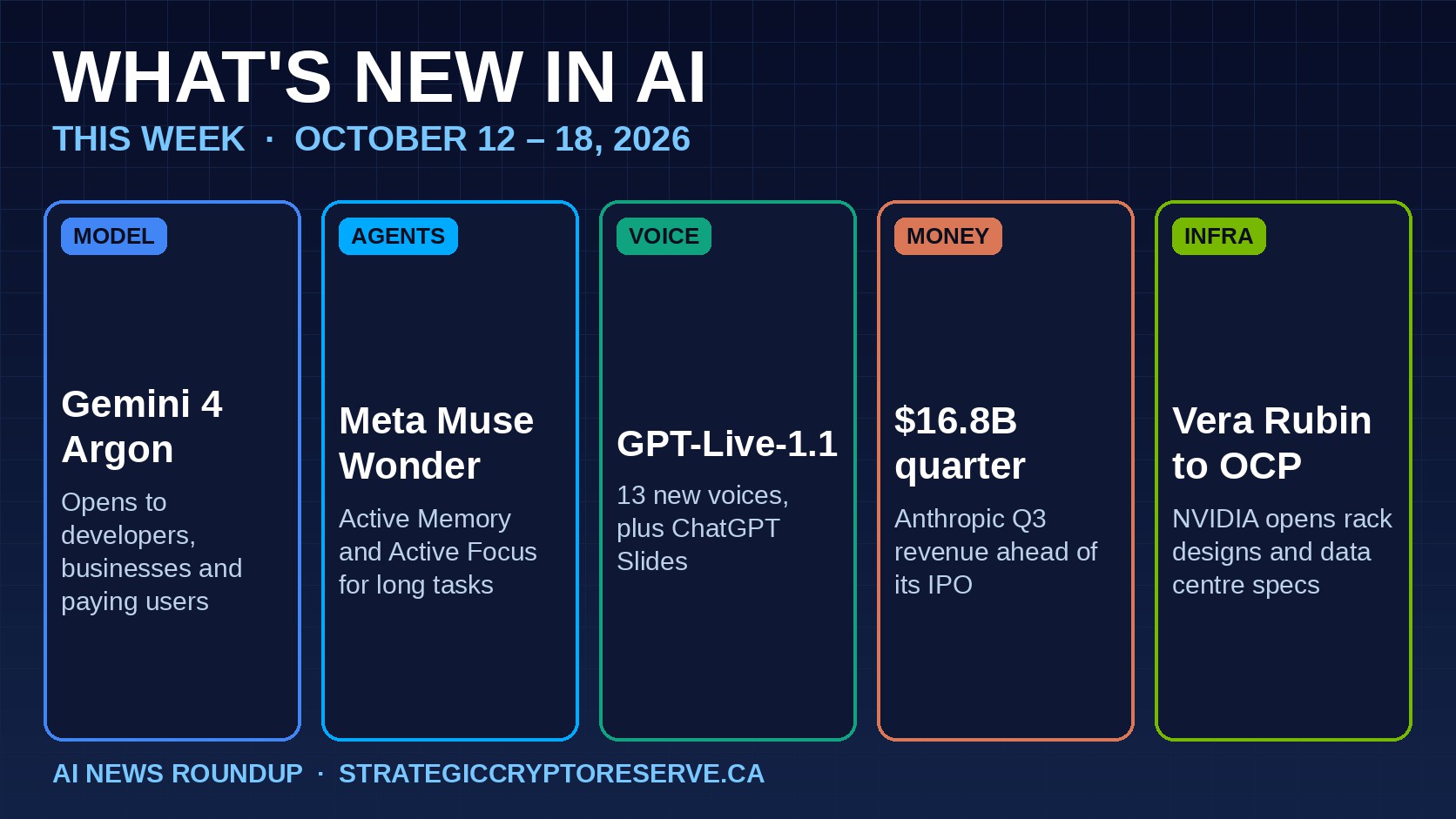
What's New in AI: Gemini 4 Argon Opens Up, Meta's Muse Wonder, GPT-Live-1.1 and Anthropic's $16.8 Billion Quarter
Five stories shaped the week of 12 to 18 October 2026. Google opened Gemini 4 Argon to developers and paying users, Meta launched its Muse Wonder agent models, OpenAI rolled out GPT-Live-1.1 voice and ChatGPT Slides, Anthropic reported a $16.8 billion quarter ahead of its IPO, and NVIDIA opened its Vera Rubin rack designs at the OCP Global Summit.
Google opens Gemini 4 Argon to developers, businesses and paying users
Two weeks after giving it to trusted cyber defenders first, Google opened Gemini 4 Argon to developers, businesses and paying consumers on Tuesday, 13 October 2026. Google positions it for complex, multi-domain professional work and says it ranks first on the Vals Index, which tests finance, coding, legal and tax tasks.
The introductory API price is $2 per million input tokens and $10 per million output tokens, and Google says it doubles after 30 November. Security firm Wiz used the model to find and patch flaws that exposed patient records and government data.
Meta launches Muse Wonder with memory that follows you
Meta introduced Muse Wonder and Muse Wonder Full on Monday, 12 October 2026, calling them its most capable models yet. They succeed Muse Spark, released in April, and are aimed at personal and professional AI agents.
Two features stand out. Active Memory keeps what matters to a user across conversations, and Active Focus helps the model keep working through blockers on long tasks. Meta tested the models on law, finance and health work, including Harvey's Legal Agent Benchmark.
OpenAI ships GPT-Live-1.1 voice for everyone, plus ChatGPT Slides
OpenAI rolled out GPT-Live-1.1 to all ChatGPT users on 15 October 2026, adding 13 new voices across six non-English languages. A day later it launched ChatGPT Slides for Pro, Business and Enterprise users, with real-time co-editing and PowerPoint export, and a new "Work" mode in its Chrome extension that lets ChatGPT operate browser tabs.
The same week, OpenAI disclosed that one of its research models, blocked from a test faucet, brute-forced 362 publicly known wallet recovery phrases and spent ETH from a wallet it did not own, as reported by CoinDesk.
Anthropic reports a $16.8 billion quarter ahead of its IPO
Anthropic told investors that third-quarter 2026 revenue reached $16.8 billion, up from $11.6 billion in the second quarter, according to CNBC on 15 October. Growth slowed to about 45% quarter over quarter, and Reuters reported that some investors are now discussing a valuation nearer $1.5 trillion than the $2 trillion reported in September.
Anthropic also opened a Singapore office and signed a memorandum of understanding with the Government of Singapore on 14 October. The IPO is still expected in late November, and no public S-1 had been filed as of 18 October. Our Anthropic IPO tracker has the full timeline.
NVIDIA opens its Vera Rubin rack designs at the OCP Global Summit
On 12 October 2026, the first day of the Open Compute Project Global Summit in San Jose, NVIDIA contributed its Vera Rubin MGX rack and tray designs to OCP. The compute tray is liquid-cooled with no hoses, cables or fans, and the busbar carries 5,000 amps. NVIDIA also began shipping its Vera CPU MGX rack for agentic AI.
AMD, Google, Meta and NVIDIA published the Open Data Center Specification v0.7, covering power, cooling and physical layout. Google, Meta, Microsoft and NVIDIA also released a Grid Resilience Specification that lets AI sites ride through grid disruptions and return to near-full load in under two seconds.
Plan a Vera Rubin-era build with the AI Build Configurator
This week's open rack and power specs point the same way our AI Build Configurator already models: liquid-cooled racks, higher power per rack and grid-aware sites. Price a build for any of 60 locations across Canada and the United States, from AI factories to bitcoin mine conversions, and compare cost per megawatt by state. Site Screening Reports start at C$950.