Infrastructure Guide · Updated September 27, 2026

Converting a Bitcoin Mine to an AI Data Center: Cost, Timeline and What Changes (2026)

A bitcoin mine already has the scarcest thing in AI infrastructure: energised power. That is why the biggest public miners have signed multi-billion-dollar AI leases. But power is the head start, not the finish line. This guide sets out what a conversion really involves, what it costs per megawatt, how long it takes, and how to tell whether your site is a good candidate.


Bitcoin Mine to AI Data Center: Cost, timeline and what has to change

Why Bitcoin Miners Are Converting to AI

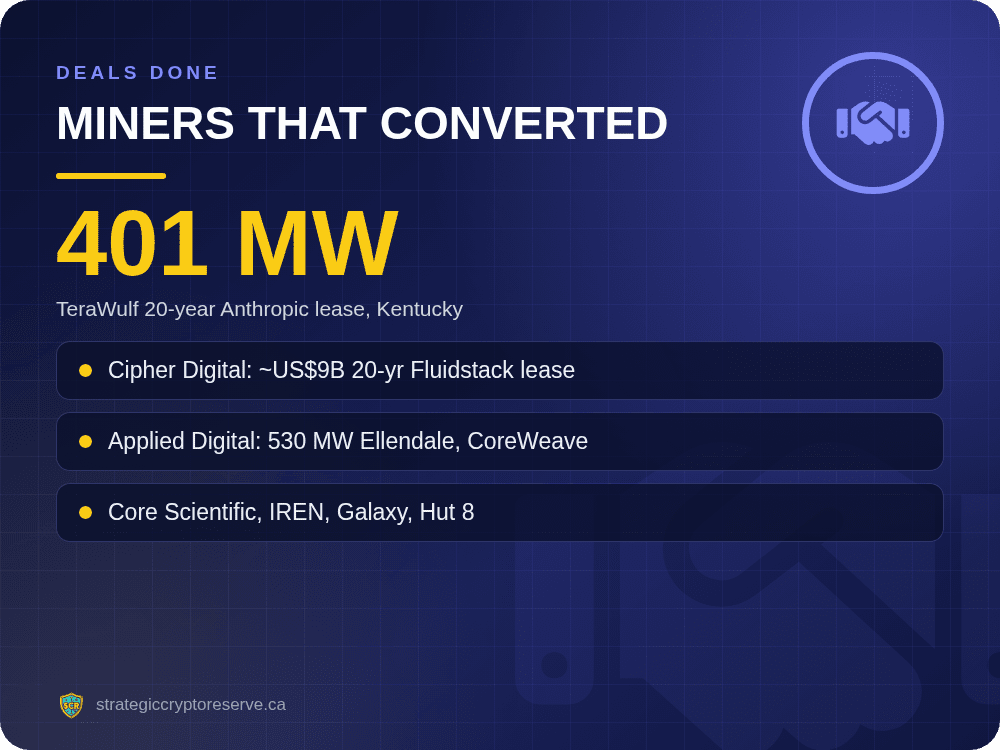
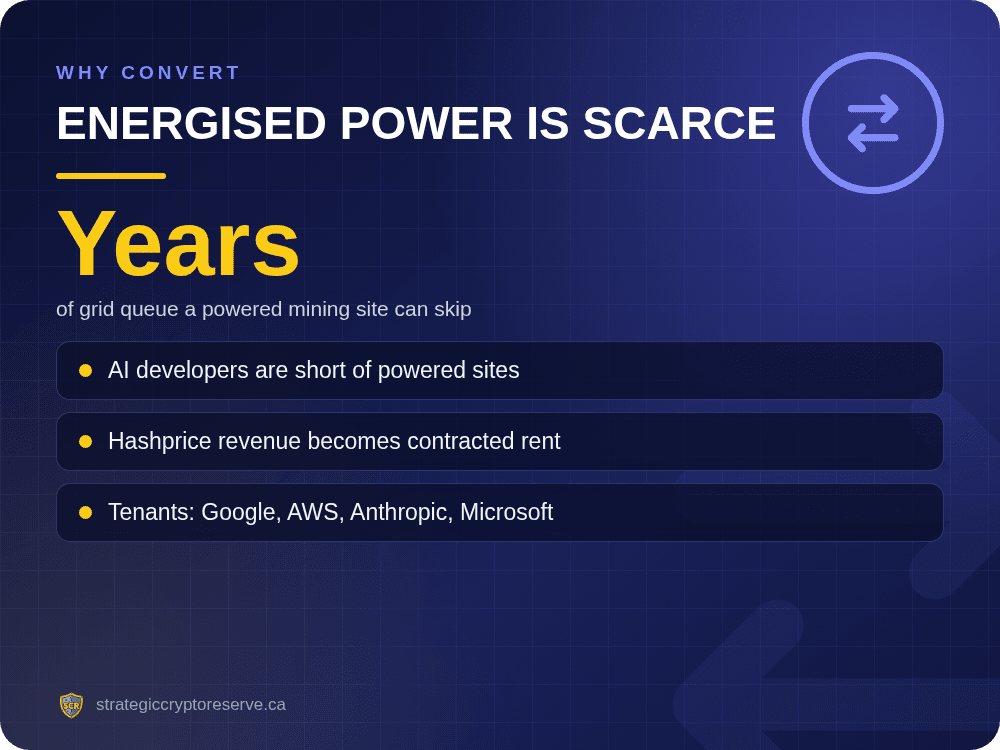
AI developers are short of powered sites, and a mining campus with tens or hundreds of energised megawatts can skip years of grid queue. Converting turns volatile hashprice revenue into long-term contracted rent from some of the strongest tenants in the world. The deals of the past year show the scale:

Cipher Digital
Extended its Barber Lake, Texas lease with Fluidstack to 20 years (about US$9 billion total), with Google providing a financial backstop, and also leases to Amazon Web Services.
TeraWulf
Advanced a 20-year lease with Anthropic for 401 MW at its Kentucky campus (see our Kentucky tariff page).
Applied Digital
Leases its Polaris Forge campuses in North Dakota to CoreWeave, including the 530 MW Ellendale site (North Dakota tariff).
Core Scientific, IREN, Galaxy, Hut 8
Leases to CoreWeave, a Microsoft GPU cloud contract, the Helios campus in West Texas, and an Anthropic-linked deal at River Bend, Louisiana.

Our AI data center stocks guide tracks all of these companies with live charts.
Energised power is scarce: of grid queue a powered mining site can skip Miners that converted: TeraWulf 20-year Anthropic lease, Kentucky

What Has to Change in the Facility

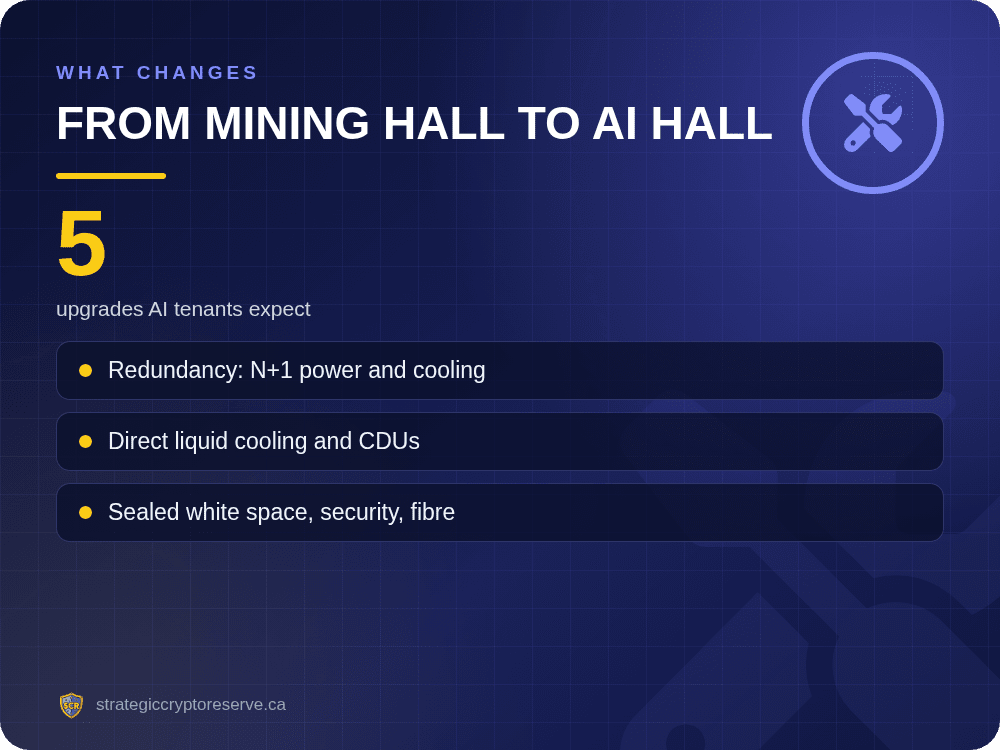
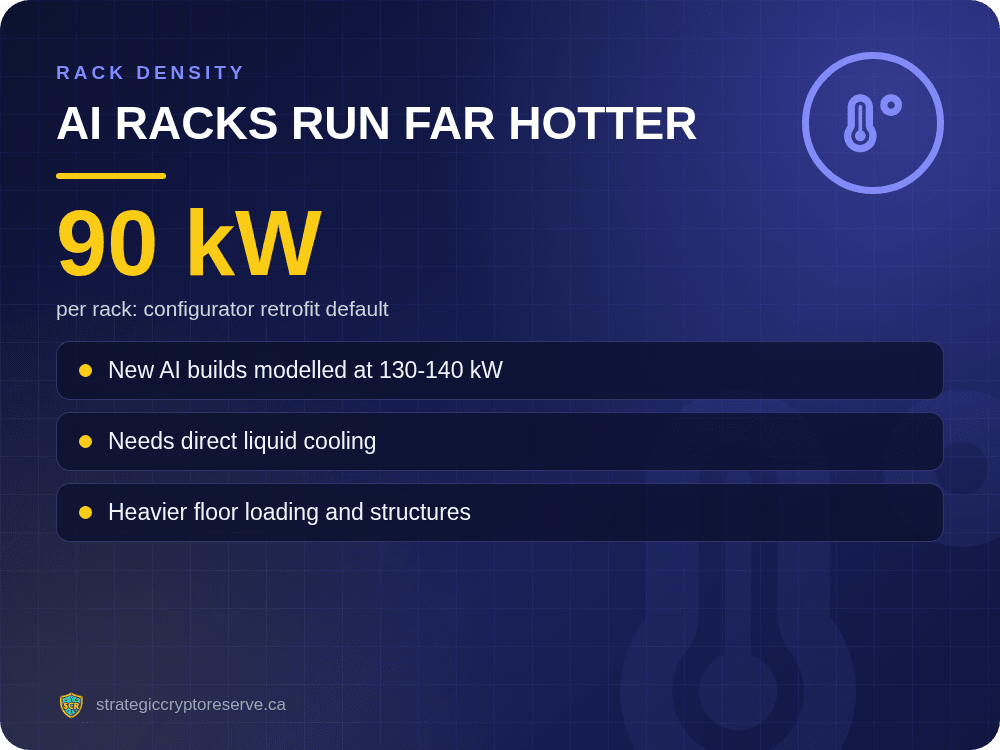
From mining hall to AI hall: upgrades AI tenants expect AI racks run far hotter: per rack: configurator retrofit default

Mining halls tolerate dust, heat, single utility feeds and the occasional outage. AI tenants tolerate none of that. A conversion usually means:

Redundancy
From N and a single feed to N+1 or better on power and cooling, often with UPS and on-site generation for critical loads.
Cooling
From air or immersion to direct liquid cooling (DLC) with coolant distribution units. The configurator's miner-retrofit profile assumes DLC.
Rack density
AI racks run far hotter than mining racks: the configurator models around 90 kW per rack by default for a retrofit, and 130-140 kW for new AI builds.
Building
Clean, sealed white space, heavier floor loading, security and access control, and fire suppression suited to the tenant.
Fibre
Diverse, high-capacity fibre routes. Many rural mining sites need new long-haul builds.

The power itself also changes character. Mining is interruptible; AI inference and training contracts expect firm power. Sites that sold demand response or curtailment during the mining years need to plan how that works once a tenant expects near-continuous uptime.

What a Conversion Costs per Megawatt

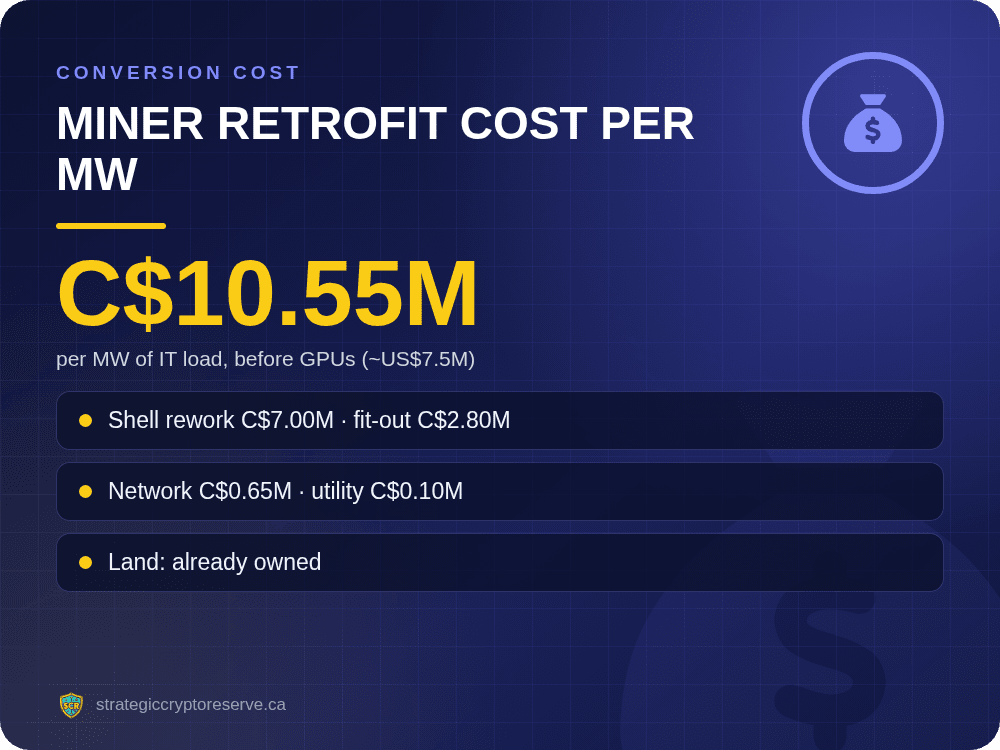
The SCR AI Build Configurator's miner-retrofit profile (Q3 2026 constants) puts a conversion at about C$10.55M per MW of IT load (roughly US$7.5M), broken down as:

Line itemC$ per MW
Shell rework and hardening7.00M
Fit-out (DLC, electrical upgrades)2.80M
Network and fibre0.65M
Utility works0.10M
Land0 (already owned)
Total, before GPUs and taxes10.55M

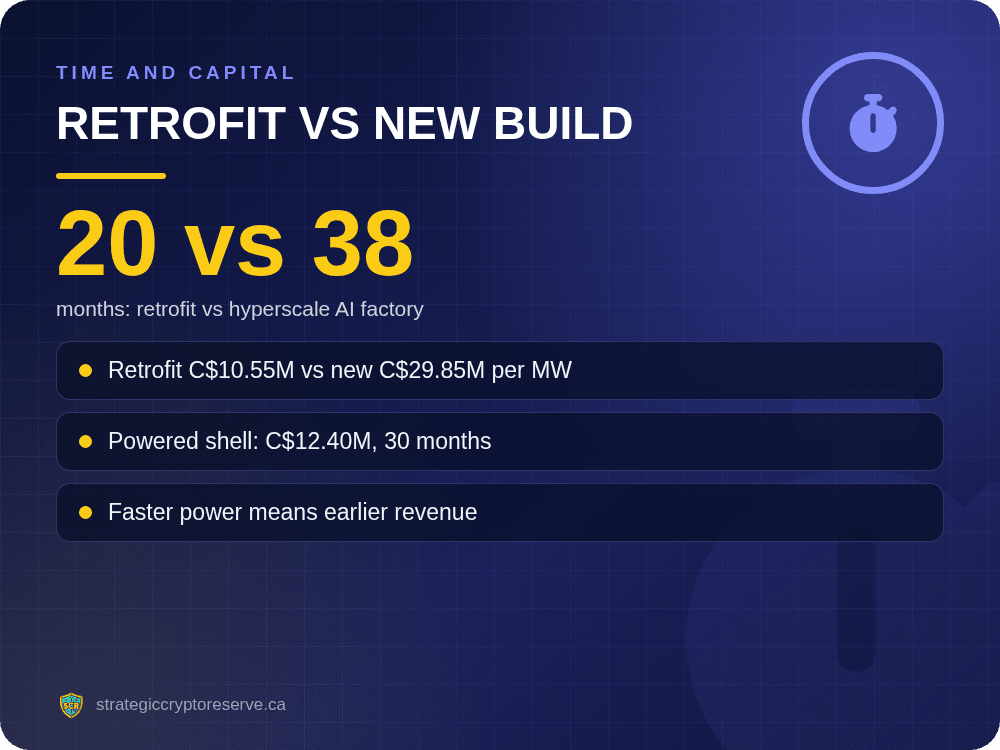
Compare that with about C$29.85M per MW and 38 months for a new hyperscale AI factory, or C$12.40M and 30 months for a greenfield powered shell. A retrofit typically takes around 20 months in the model, so the saving is as much about time to revenue as it is about capital.

Miner retrofit cost per MW: per MW of IT load, before GPUs (~US$7.5M) Retrofit vs new build: months: retrofit vs hyperscale AI factory

Revenue: Hosting Rates and the Hybrid Path

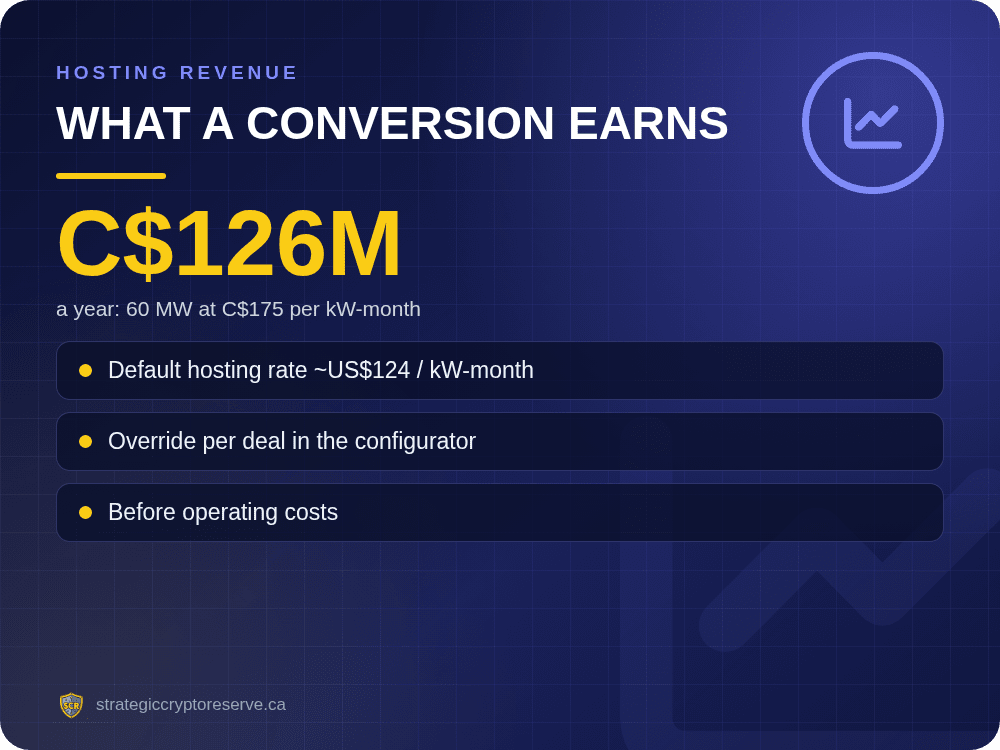
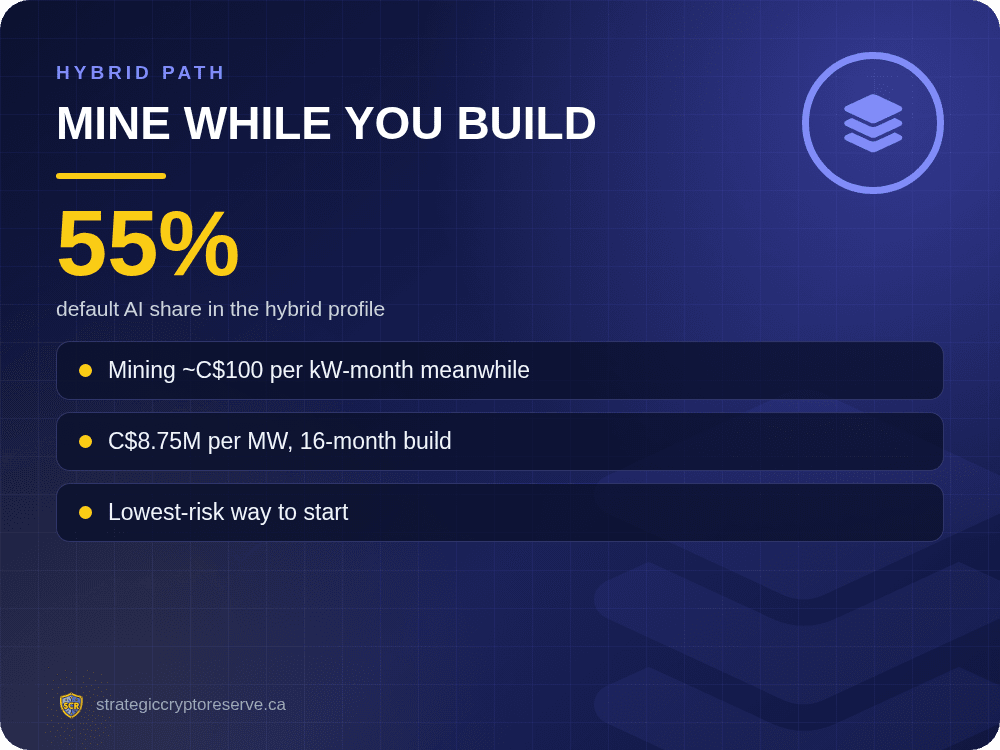
What a conversion earns: a year: 60 MW at C$175 per kW-month Mine while you build: default AI share in the hybrid profile

Most converted miners lease the capacity rather than buy GPUs themselves. The configurator's retrofit profile defaults to a hosting contract of C$175 per kW of IT load per month (about US$124), which you can override per deal. At that rate, a 60 MW conversion earns roughly C$126M a year in contract rent before operating costs.

Not every site converts in one step. The hybrid mining + AI profile keeps hashing on part of the power while AI capacity is built, then shifts the megawatts to the higher-value tenant. The model assumes 55% AI share by default, mining revenue of about C$100 per kW-month, and a 16-month build at C$8.75M per MW. It is often the lowest-risk way to start.

Is Your Site a Good Conversion Candidate?

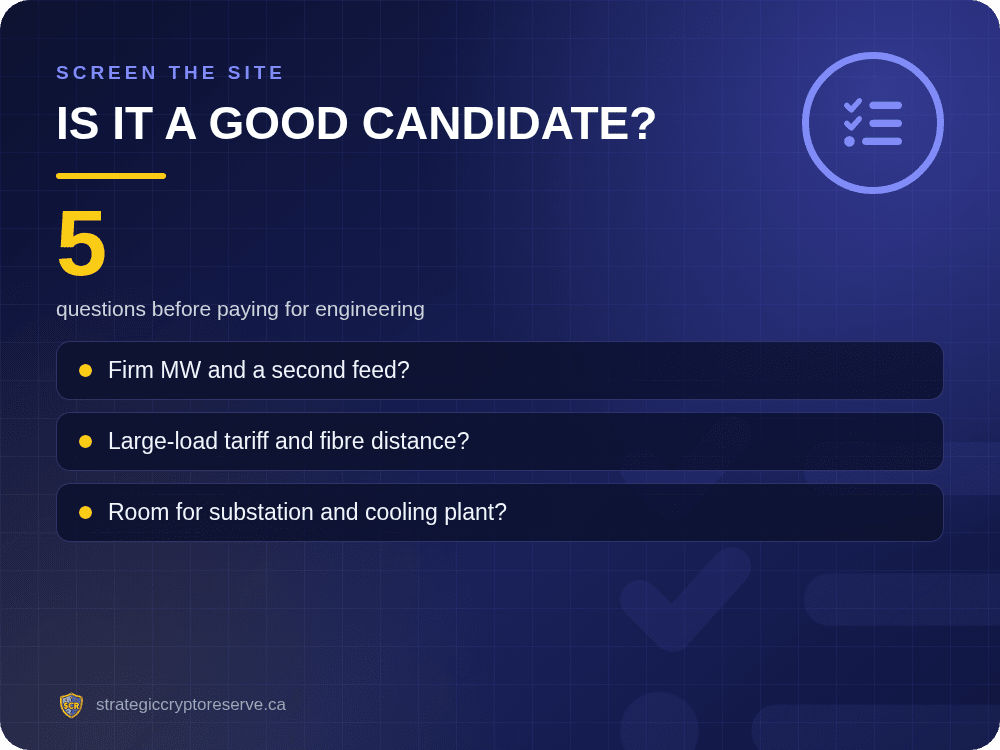
Before spending on engineering, screen the site on five questions:

Power
How many firm megawatts, at what voltage, and can the utility add a second feed?
Tariff
Does the state now apply a large-load tariff with minimum-take charges? Check our tariff library.
Fibre
How far is the nearest long-haul route, and how many diverse paths are feasible?
Land and building
Is there room for a larger substation, cooling plant and heavier structures?
Tenant demand
Is the location attractive to AI tenants (latency, climate, permitting, labour)?

The configurator answers the cost and timing half of that list in minutes, for any province or state.

Is it a good candidate?: questions before paying for engineering

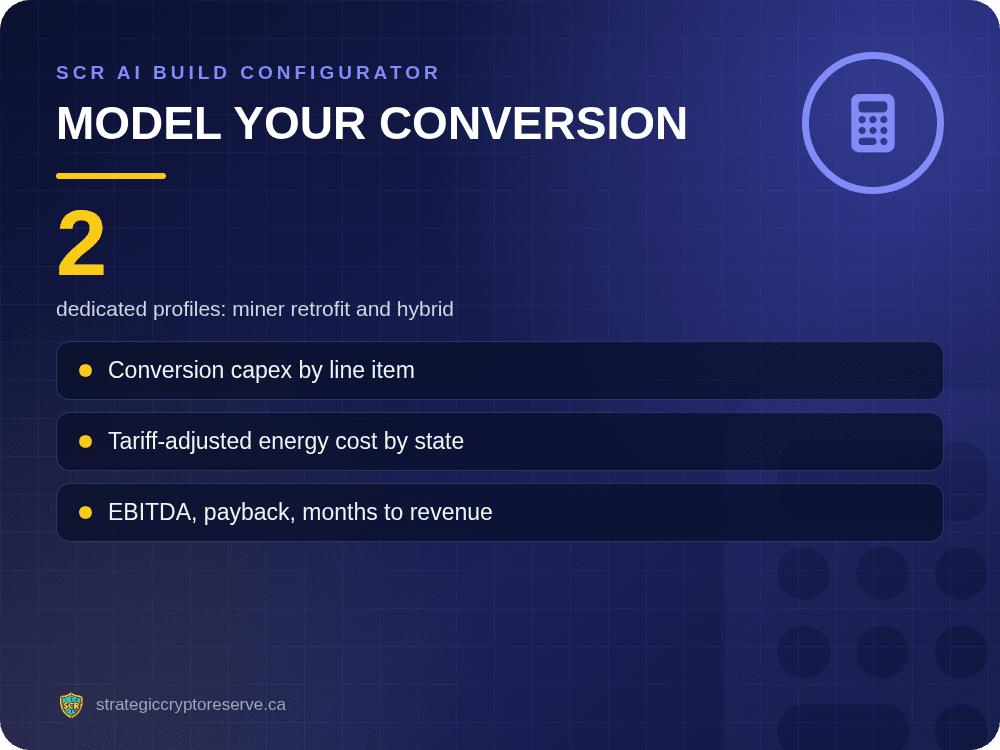
Model Your Conversion Before You Commit

Model your conversion: dedicated profiles: miner retrofit and hybrid For miners and their advisors: one-site screening report

The SCR AI Build Configurator includes dedicated miner-retrofit and hybrid mining + AI profiles. Choose your province or state and it returns conversion capex by line item, energy cost under that state's large-load tariff, hosting revenue, EBITDA, payback and months to first revenue.

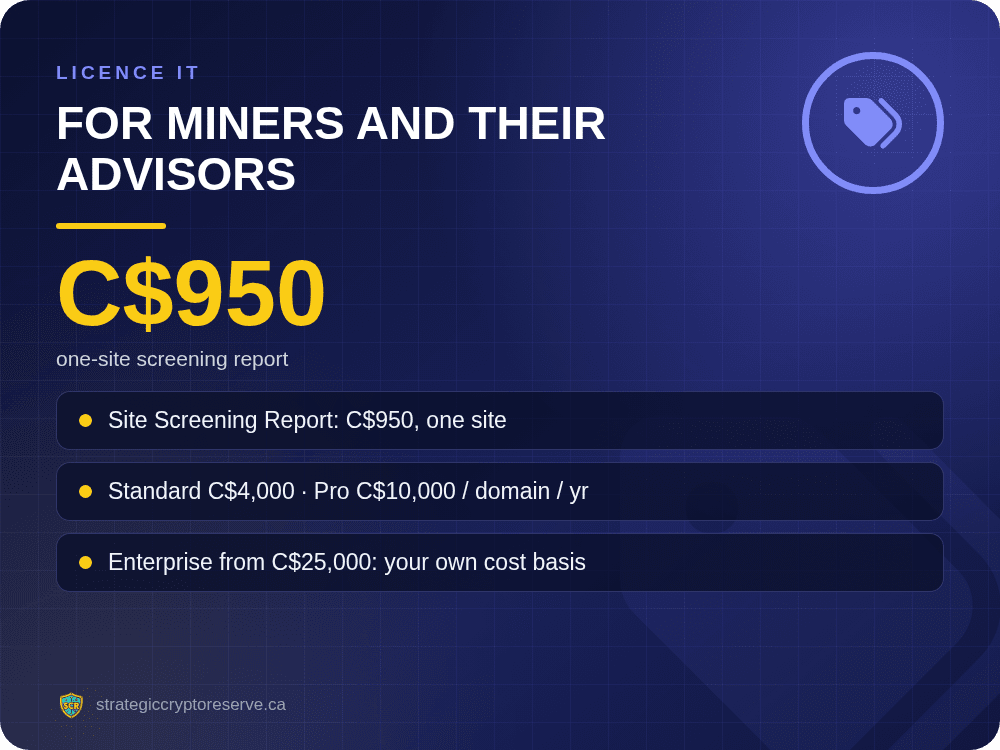
Miners weighing a conversion, and the brokers, EPC firms and consultants who advise them, can license it for their own site or order a one-off screening report. Outputs are planning-grade estimates, not engineered quotes.

OptionPrice (CAD)Best for
Site Screening Report$950, one siteA single build you want priced and screened now, with nothing to embed
Standard licence$4,000 / domain / yearAdvisors who need the three lease-model configurations and a clipboard summary
Pro licence$10,000 / domain / yearConsultants and contractors who send CSV deliverables and want all seven configurations, white-label and lead capture
EnterpriseFrom $25,000 / year, up to 3 domainsDevelopers and EPC firms who want the model running on their own cost basis, attribution removed

Frequently Asked Questions

How much does it cost to convert a bitcoin mine to an AI data center?

The SCR AI Build Configurator's miner-retrofit profile puts it at about C$10.55M per MW of IT load (roughly US$7.5M) for shell rework, direct liquid cooling fit-out, network and utility works, before GPUs and taxes. Real costs depend heavily on the existing building, power and fibre.

How long does a miner-to-AI conversion take?

Around 20 months in the configurator's retrofit profile, compared with about 38 months for a new hyperscale AI factory, because the power is already energised.

Which bitcoin miners have converted to AI?

Public examples include Cipher Digital (Fluidstack and AWS leases), TeraWulf (a 20-year Anthropic lease for 401 MW in Kentucky), Applied Digital (CoreWeave at Polaris Forge, North Dakota), Core Scientific (CoreWeave), IREN (a Microsoft GPU contract), Galaxy (Helios, Texas) and Hut 8 (River Bend, Louisiana).

Do I need to stop mining to convert?

Not necessarily. A hybrid approach keeps mining on part of the power while AI capacity is built. The configurator's hybrid profile models a 55% AI share by default.

What is the biggest obstacle to converting a mining site?

Usually not power but everything around it: redundancy, direct liquid cooling, fibre routes and building upgrades, plus any large-load tariff the utility now applies.