Infrastructure Guide · Updated September 27, 2026

Crypto Mining Data Center Design: Electrical, Cooling, Layout and Cost per MW (2026)

A crypto mining data center is a power plant customer first and a building second. Get the interconnect, electrical path and heat rejection right and the rest is racking. This guide walks through how mining facilities are actually designed in 2026, what they cost per megawatt, and the design choices that decide whether the site can later earn far more by hosting AI.


Crypto Mining Data Center Design: Electrical, cooling, layout and cost per MW

Design Starts With Power, Not the Building

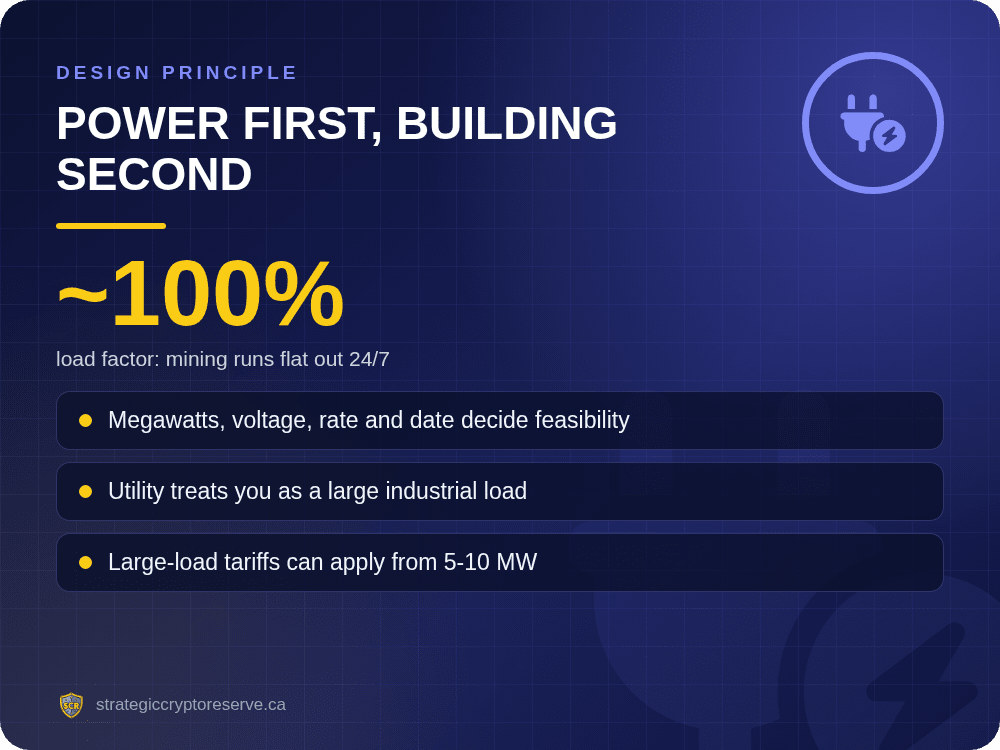
Every serious mining site is designed backwards from the utility connection. The questions that decide feasibility are how many megawatts you can get, at what voltage, at what all-in rate, and when. A hall full of ASICs runs flat out around the clock, so the facility behaves like a near-100% load-factor industrial customer, and the utility treats it that way.

That is why large-load tariffs matter so much at the design stage. Several US utilities now set thresholds that catch mid-sized mining sites, from TVA's data-centre charge above 5 MW to MDU's 10 MW high-density tariff in North Dakota and Idaho Power's Schedule 20, which names crypto mining explicitly. Our state tariff library covers the rules for all 50 states; in British Columbia, new mining connections are banned outright, as covered on our BC Hydro rates page.

The configurator's regional data puts indicative large-load rates between roughly 6.5 and 7.5 US cents per kWh in the cheapest states (Louisiana, New Mexico, Oklahoma, Texas, South Carolina, Tennessee) and grid queues of around 28 to 32 months from signed agreement to energisation. Design timelines are usually set by that queue, not by construction.
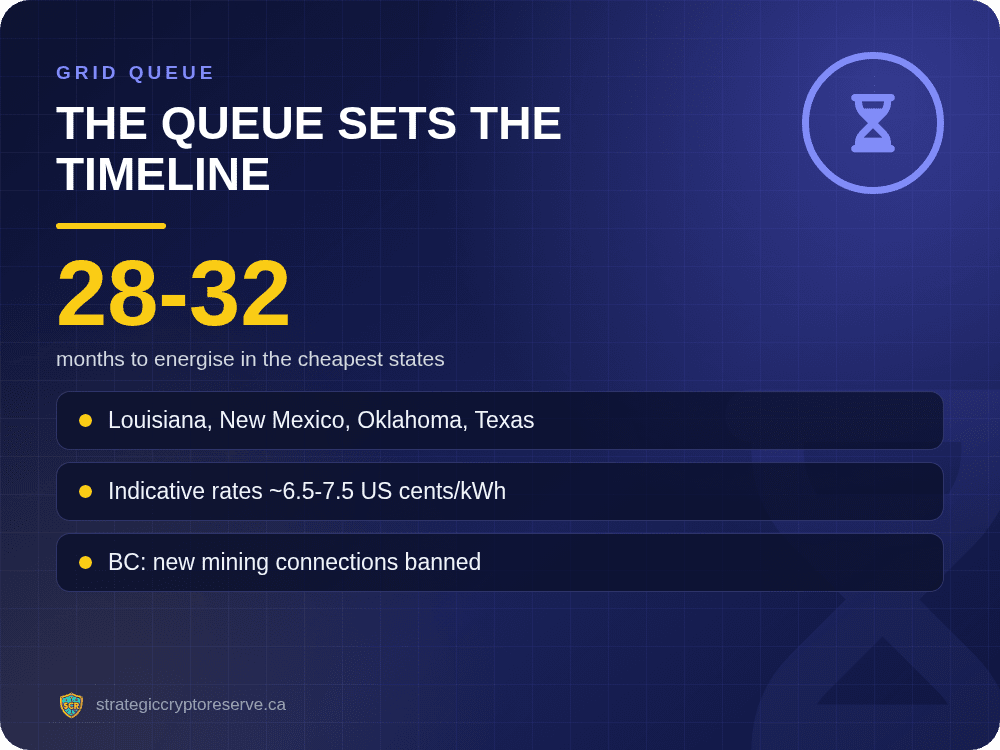
Power first, building second: load factor: mining runs flat out 24/7 The queue sets the timeline: months to energise in the cheapest states

Electrical Design for a Mining Data Center

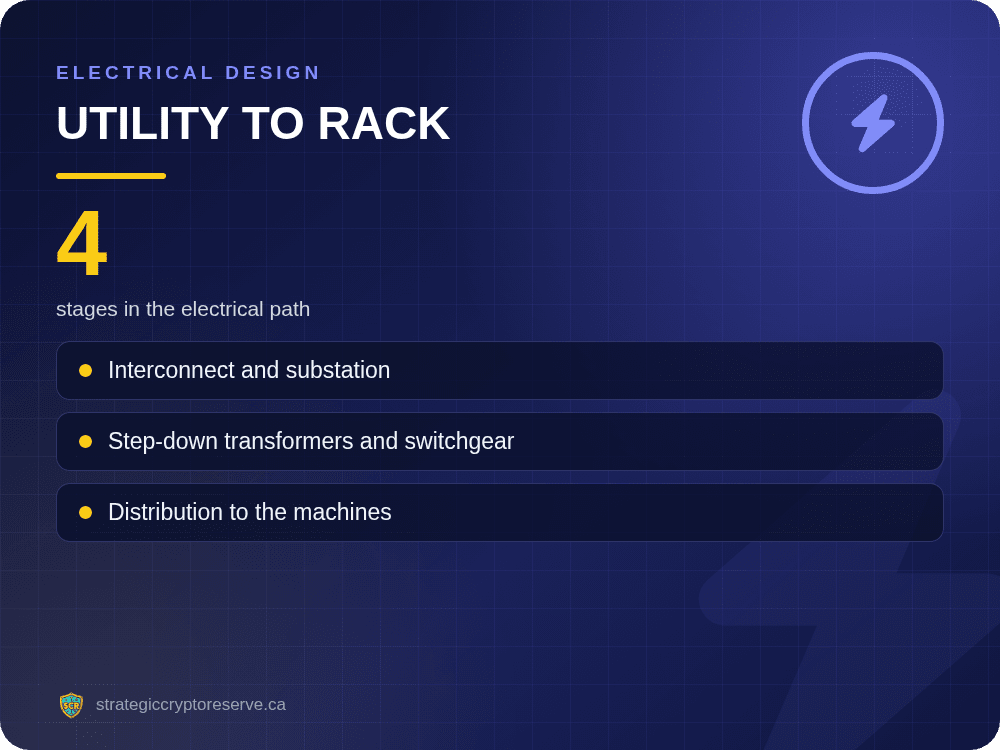
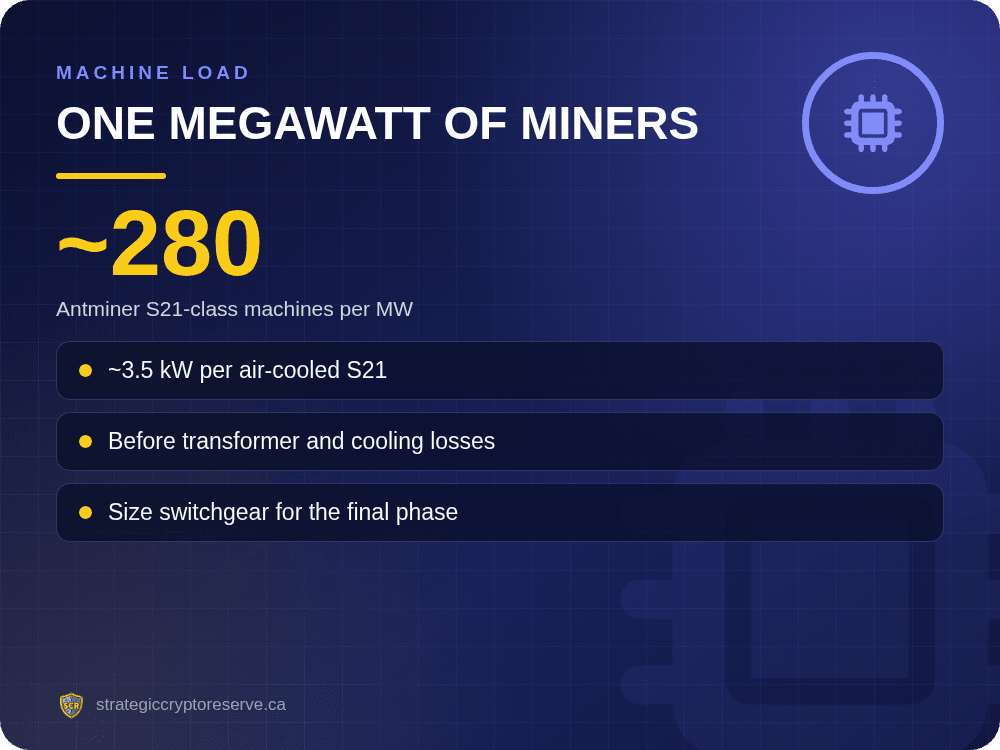
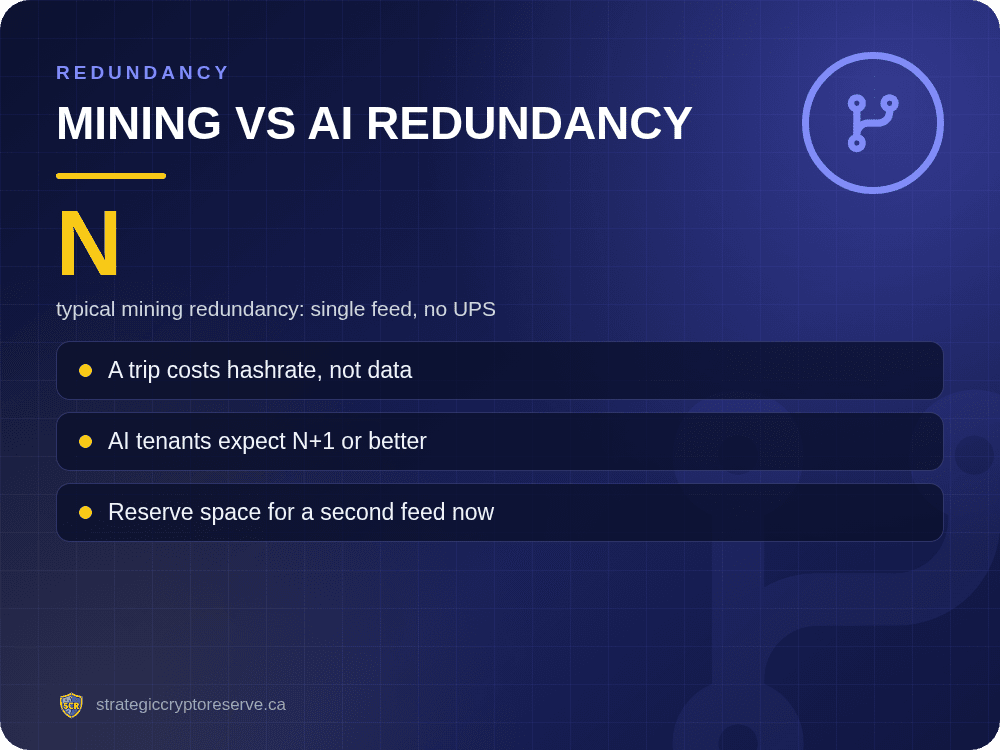
Utility to rack: stages in the electrical path One megawatt of miners: Antminer S21-class machines per MW Mining vs AI redundancy: typical mining redundancy: single feed, no UPS

The electrical path of a mining facility is simpler than a colocation data centre because it is designed for uptime at the lowest cost, not for 99.999% availability. A typical path runs from the utility interconnect to an owned or utility substation, then through step-down transformers to medium-voltage and low-voltage switchgear, and finally to power distribution feeding the machines.

Machine load
Current air-cooled ASICs such as the Antminer S21 draw about 3.5 kW each, so one megawatt feeds roughly 280 machines before losses and cooling.
Distribution voltage
ASIC power supplies typically accept roughly 200-277 V, so designs distribute three-phase power and land single or phase-to-phase circuits at the rack; many North American builds use 480 V (or 600 V in Canada) distribution with transformers close to the load.
Redundancy
Mining normally runs on a single utility feed with N (not N+1) redundancy, no UPS and no generators. A trip costs hashrate, not customer data.
Metering and curtailment
Design in sub-metering per hall and fast, controllable load shedding. Demand-response and curtailment programs (ERCOT, MDU's demand-response tariff) pay for flexibility only if you can prove and automate it.

Two electrical decisions carry the most long-term value. First, size transformers and switchgear for the load you will eventually have, not just phase one. Second, leave physical space and a path for a second utility feed. Both are cheap on paper at design time and extremely expensive to retrofit, and both matter enormously if the site ever converts to AI hosting.

Cooling and Layout: Air, Immersion or Hydro

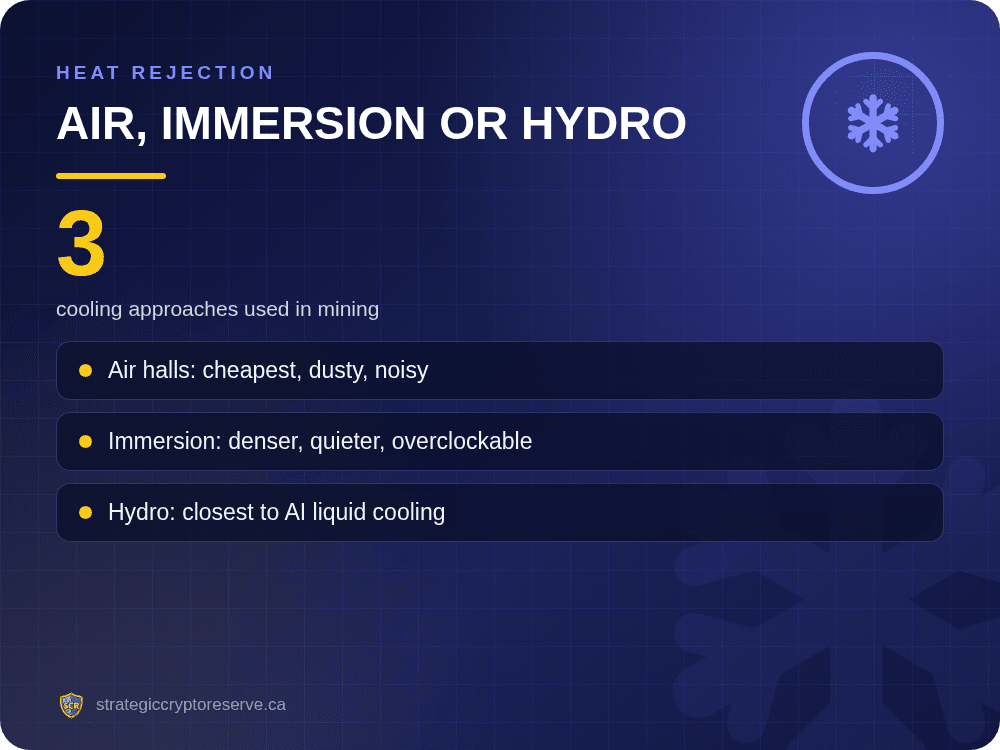
Nearly all of the electricity a miner uses leaves the building as heat, so cooling design is really heat-rejection design. There are three common approaches:

Air-cooled halls
The cheapest to build. Long halls or containers pull outside air through the machines with large exhaust fans, often with evaporative pads in hot climates. Simple, but dusty and noisy, and performance falls in heat waves.
Immersion
Machines sit in tanks of dielectric fluid, with heat rejected through dry coolers. Higher capex, but quieter, cleaner, denser, and ASICs can be overclocked.
Hydro-cooled ASICs
Water-cooled machines with plate heat exchangers and dry coolers. The closest design to AI-style direct liquid cooling, which matters for future conversion.

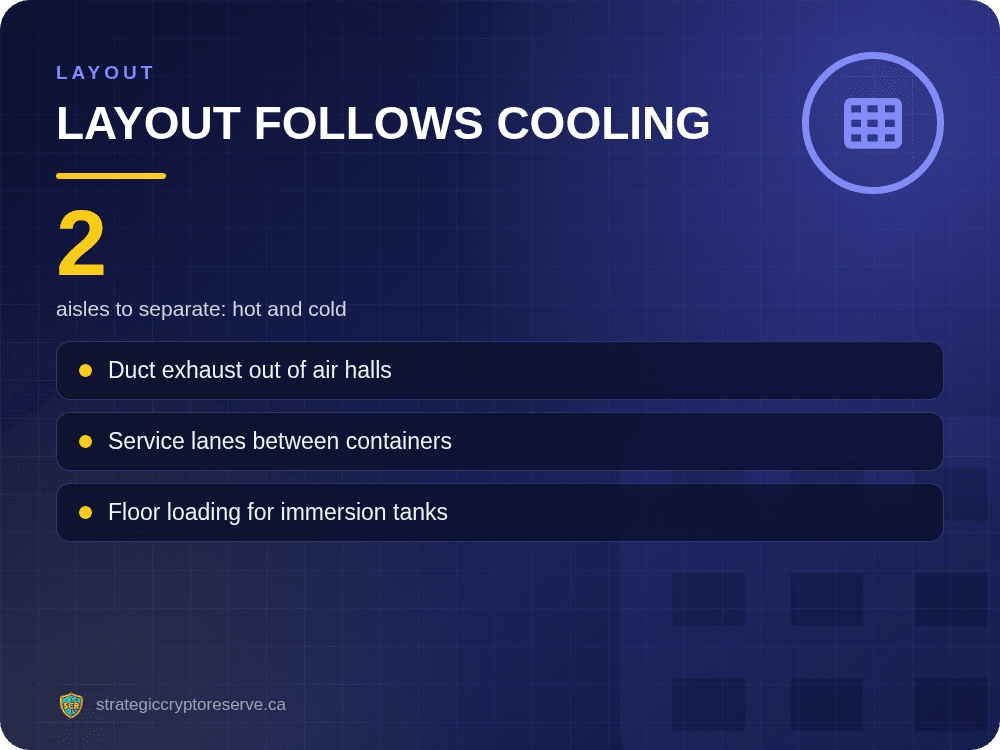
Layout follows the cooling choice: air halls use hot-aisle and cold-aisle separation with the exhaust side ducted out; container sites line up modules with clear airflow paths and service lanes; immersion sites need floor loading for full tanks and dry-cooler yards. In every case, leave room for heat reuse where it has value. Our heat reuse guide covers how that works at home scale.

Air, immersion or hydro: cooling approaches used in mining Layout follows cooling: aisles to separate: hot and cold

What a Crypto Mining Data Center Costs per Megawatt

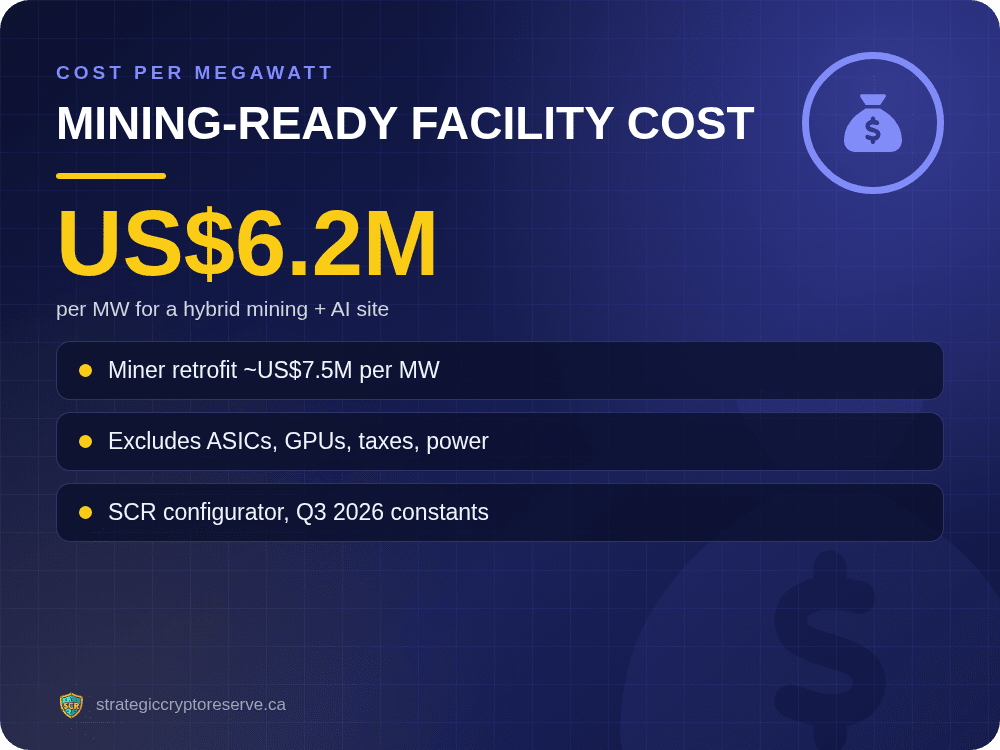
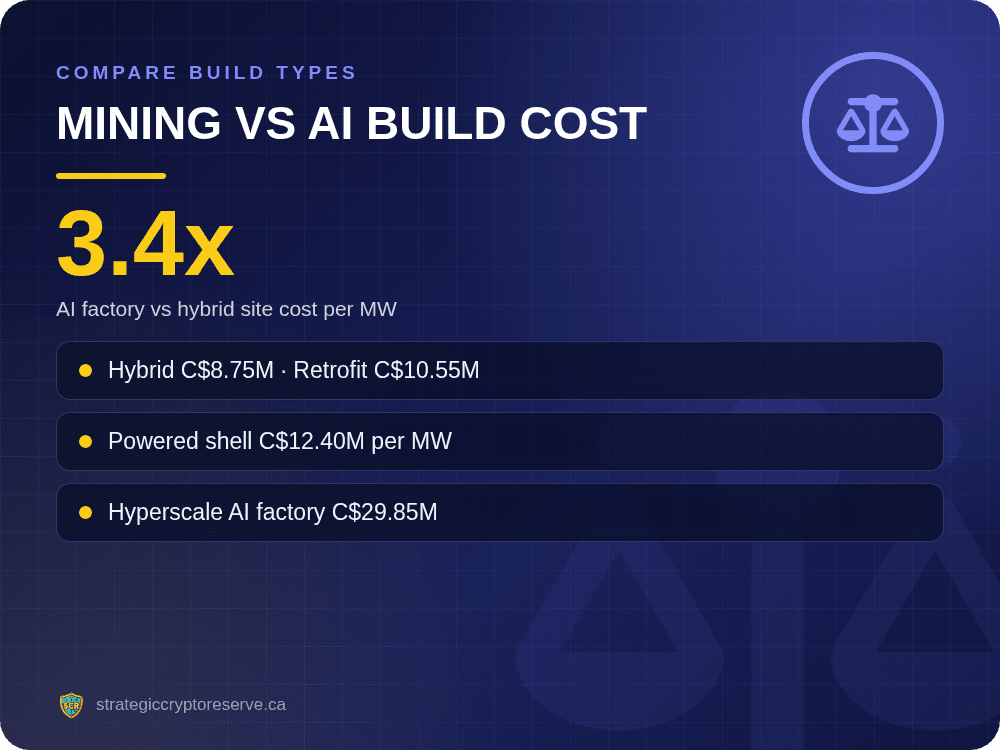
Mining-ready facility cost: per MW for a hybrid mining + AI site Mining vs AI build cost: AI factory vs hybrid site cost per MW

Using the same cost constants as the SCR AI Build Configurator (data vintage Q3 2026), the facility cost per megawatt of IT load, before the machines themselves, looks like this:

Build typeFacility cost per MW (CAD)Approx. USDTypical build time
Hybrid mining + AI siteC$8.75M~US$6.2M16 months
Bitcoin miner retrofit to AI hostingC$10.55M~US$7.5M20 months
Powered shell (lease the megawatt)C$12.40M~US$8.8M30 months
Hyperscale AI factoryC$29.85M~US$21.2M38 months

Those figures cover shell, fit-out, land, utility works and network. They exclude the ASICs or GPUs, taxes, and the power bill. A pure air-cooled mining hall at the low end of the market can come in below the hybrid figure, because it skips most of the fit-out an AI tenant would demand; the numbers above describe sites designed to stay useful for more than one cycle. Location matters too: the configurator applies a construction cost factor by state, from about 0.87 in the Southeast to 1.2 or more in California, Alaska and Hawaii.

Design It So It Can Host AI Later

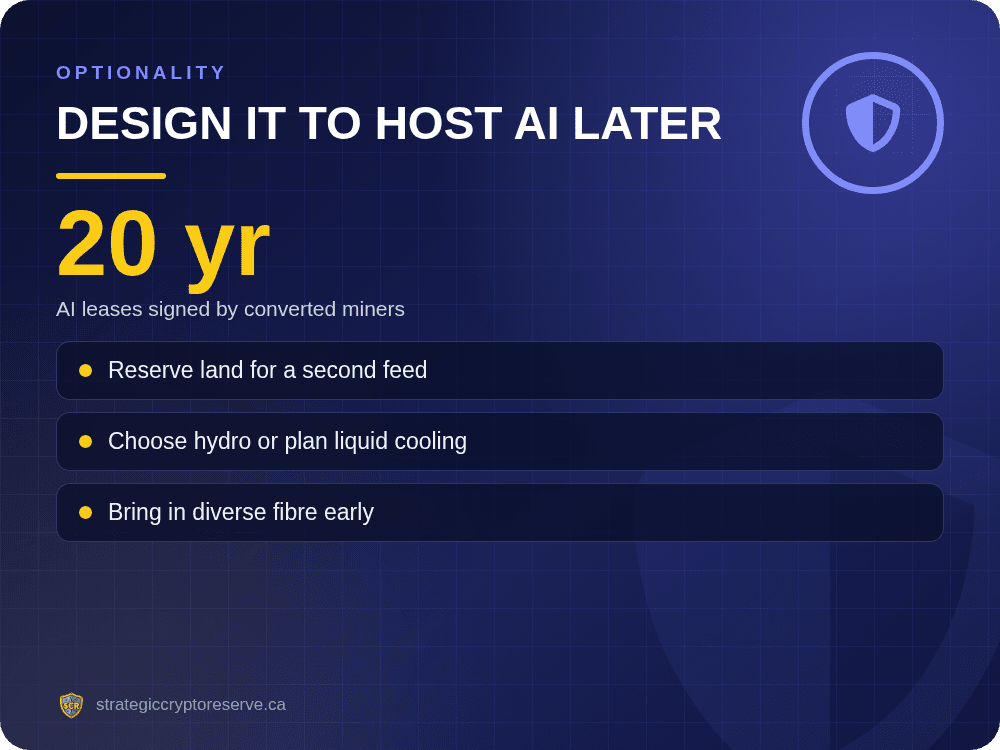
The most valuable design decision in 2026 is optionality. Miners with good power have signed long-term AI leases worth billions: Cipher Digital's 20-year Barber Lake lease, TeraWulf's 20-year Anthropic lease for 401 MW in Kentucky, Core Scientific's leases to CoreWeave. The sites that won those deals had interconnects, land and electrical capacity that AI tenants could use. Our miner-to-AI conversion guide goes through what changes.

If you are designing a mining site today, the cheap insurance is: reserve land for a second utility feed and a larger substation; choose hydro-cooling or leave space for liquid-cooling plant; plan floor loading and ceiling heights for heavier racks; and bring in diverse fibre routes early. None of that slows down the mining business, and all of it widens who you can sell or lease the site to later.

Design it to host AI later: AI leases signed by converted miners

Price Your Design in Minutes

Price your mining design: build types incl. miner retrofit and hybrid Put it on your own site: one-site screening report, nothing to embed

The SCR AI Build Configurator models seven build types, including the miner retrofit and hybrid mining + AI profiles above, against every Canadian province and all 50 US states plus DC. Pick a location, cooling and scale, and it returns capital expenditure by line item, annual energy and operating cost, revenue, EBITDA, payback and time to first revenue, with that state's large-load tariff rules applied.

Contractors and EPC firms can put it on their own website under their own brand to give prospects instant, budget-level estimates, and Enterprise licensees can run it on their own unit costs. Outputs are planning-grade estimates for screening and client conversations, not engineered quotes.

OptionPrice (CAD)Best for
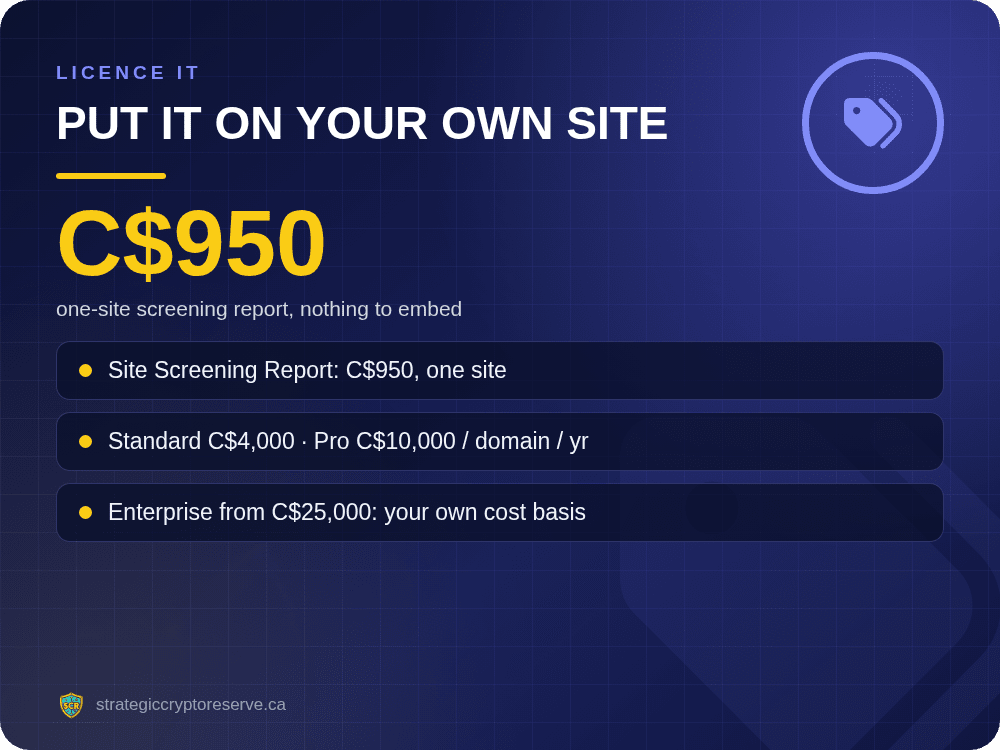
Site Screening Report$950, one siteA single build you want priced and screened now, with nothing to embed
Standard licence$4,000 / domain / yearAdvisors who need the three lease-model configurations and a clipboard summary
Pro licence$10,000 / domain / yearConsultants and contractors who send CSV deliverables and want all seven configurations, white-label and lead capture
EnterpriseFrom $25,000 / year, up to 3 domainsDevelopers and EPC firms who want the model running on their own cost basis, attribution removed

Frequently Asked Questions

How much does it cost to build a crypto mining data center?

Using the SCR AI Build Configurator's Q3 2026 constants, a site designed to also host AI later costs roughly C$8.75M to C$10.55M per MW of IT load (about US$6.2M to US$7.5M) for facility, land, utility works and network, before the mining machines, taxes and power. Bare air-cooled mining halls can cost less, and costs vary by state.

What voltage do crypto mining facilities use?

Most ASIC power supplies accept roughly 200 to 277 V, so facilities distribute three-phase power (commonly 480 V in the US or 600 V in Canada) and step down close to the racks. Exact designs depend on the utility service, the machines and local electrical code, and should be engineered by a licensed electrical engineer.

How many miners can one megawatt power?

An air-cooled Antminer S21 draws about 3.5 kW, so one megawatt feeds roughly 280 machines before transformer losses and cooling overhead.

Should a mining data center use immersion cooling?

Immersion costs more to build but is quieter, cleaner and denser, and allows overclocking. Air cooling is cheapest. Hydro-cooled machines are closest to the direct liquid cooling AI tenants need, which helps if you plan to convert later.

Can a crypto mining data center be converted to AI?

Yes, and many large miners have done it, but it needs more than power: redundancy, liquid cooling, heavier racks and fibre. The configurator's miner-retrofit profile models that conversion at about C$10.55M per MW and 20 months.