Cybersecurity · Updated November 21, 2026

Bell Cyber Attack: What Was Stolen in the November 2026 Breach

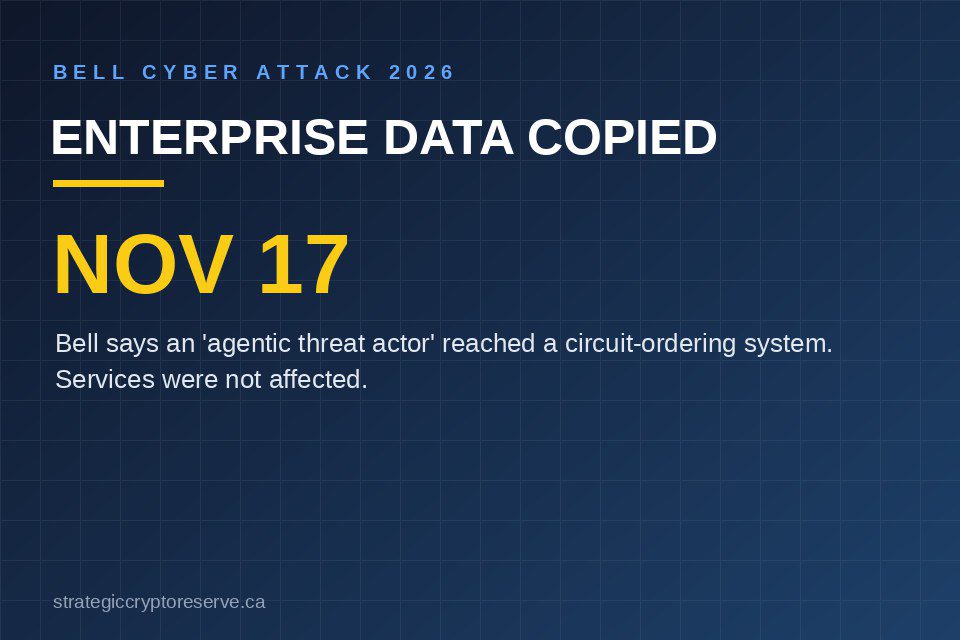
The Bell cyber attack became public on November 20, 2026, when Bell confirmed that an intruder copied enterprise customer data from a system it uses to order and provision network circuits. Bell says the break-in happened on November 17, was contained, and did not affect customer services. Here is what was taken, what was not, and how to protect yourself from the impersonation scams that usually follow a breach like this.


Bell Cyber Attack: What Was Stolen in the November 2026 Breach

Bell breach, Nov 17, 2026

Enterprise data copied · services unaffected

Facts as reported by BleepingComputer from Bell's customer notice and statement, November 20, 2026.

$SCRPolygon $— Connecting to Polygon…

Quick answers (updated November 21, 2026)

Date: Bell says the intrusion happened on November 17, 2026; it became public on November 20.

System: A pre-production environment of Bell's Maximo system, used to order and provision telecom network connections.

Data: Business contact details, information in ticket titles, some IP addresses tied to network systems, and limited context.

Not taken: No credentials, no highly sensitive personal information and no file attachments, according to Bell's notice.

Impact: Bell says it contained the incident and that there was no impact to customer services.

What Happened in the Bell Cyber Attack

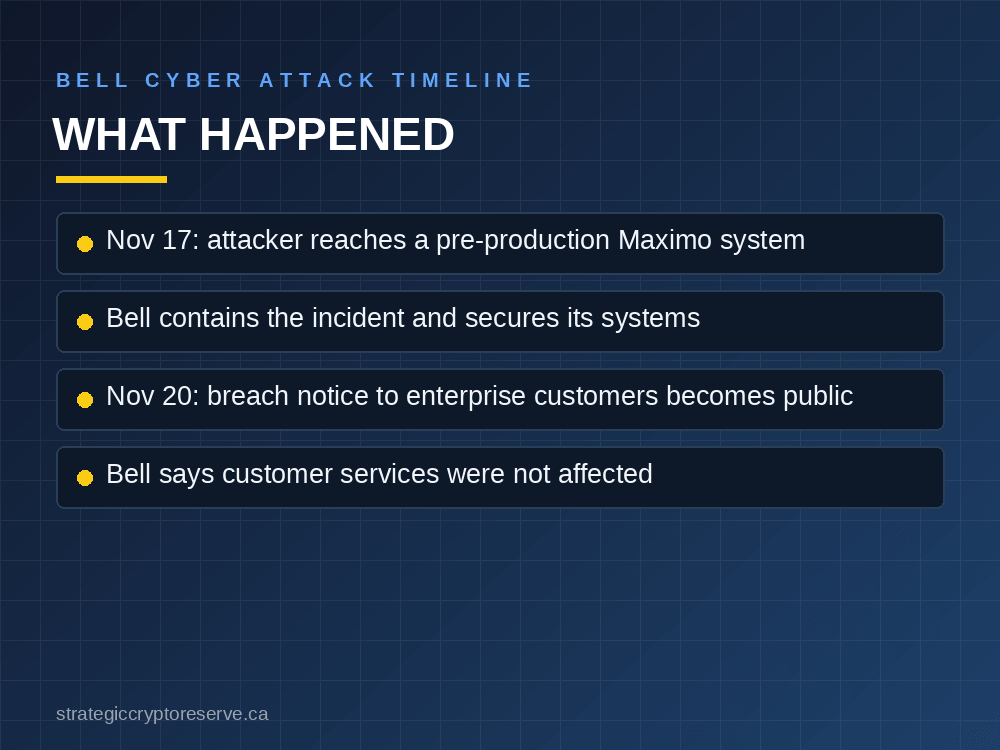
Bell Canada told enterprise customers that an attacker reached several of its systems on November 17, 2026 and copied some of their data. The breach was first reported on November 20 by BleepingComputer, after a customer shared the notice sent by Bell's Information Security Team.

According to that notice, the attacker accessed a pre-production environment of Bell's Maximo system, which Bell uses to order and provision telecommunications network connections. Bell's own statement called it "a system used for ordering and provisioning circuits."

Bell said: "Upon learning of the breach, we immediately contained the incident and secured our systems. There has been no impact to customer services."

Intrusion date
November 17, 2026 (Bell)
Made public
November 20, 2026 (BleepingComputer report)
System
Pre-production Maximo environment for ordering and provisioning circuits
Customers affected
Enterprise customers; Bell has not said how many
Service impact
None, according to Bell
Bell cyber attack timeline: intrusion on November 17 2026 and public report on November 20

What Was Stolen, and What Was Not

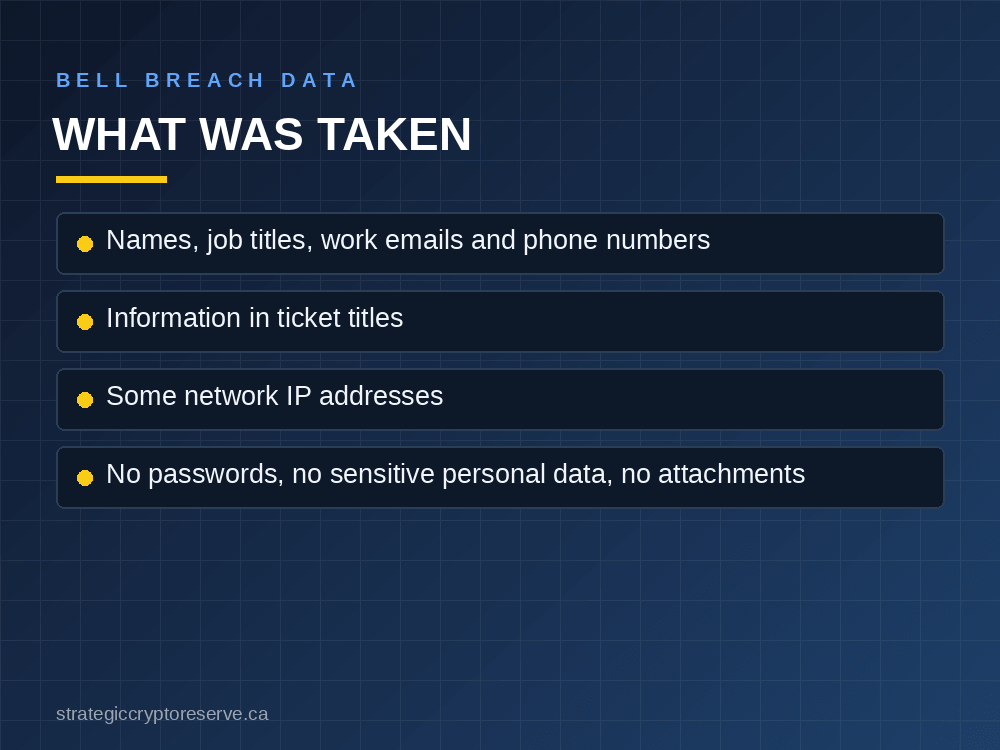
Bell's customer notice, as described by BleepingComputer, lists the kinds of data the attacker copied. It is business information tied to enterprise accounts, not consumer account data.

Data in the Bell breach, according to Bell's notice
TakenNot taken
Business contact information: names, job titles, corporate email addresses, phone numbers and business addressesCredentials (passwords or logins)
Information contained in ticket titlesHighly sensitive personal information
Some IP addresses tied to network elements or systemsPDFs, file attachments and other supplementary files stored in Maximo
Limited contextual information

Bell has not disclosed how many customers are affected or how much data was copied. It also has not said how the attacker first got in.

What was stolen in the Bell cyber attack: business contacts, ticket titles and some IP addresses

What Bell Means by an 'Agentic' Hacker

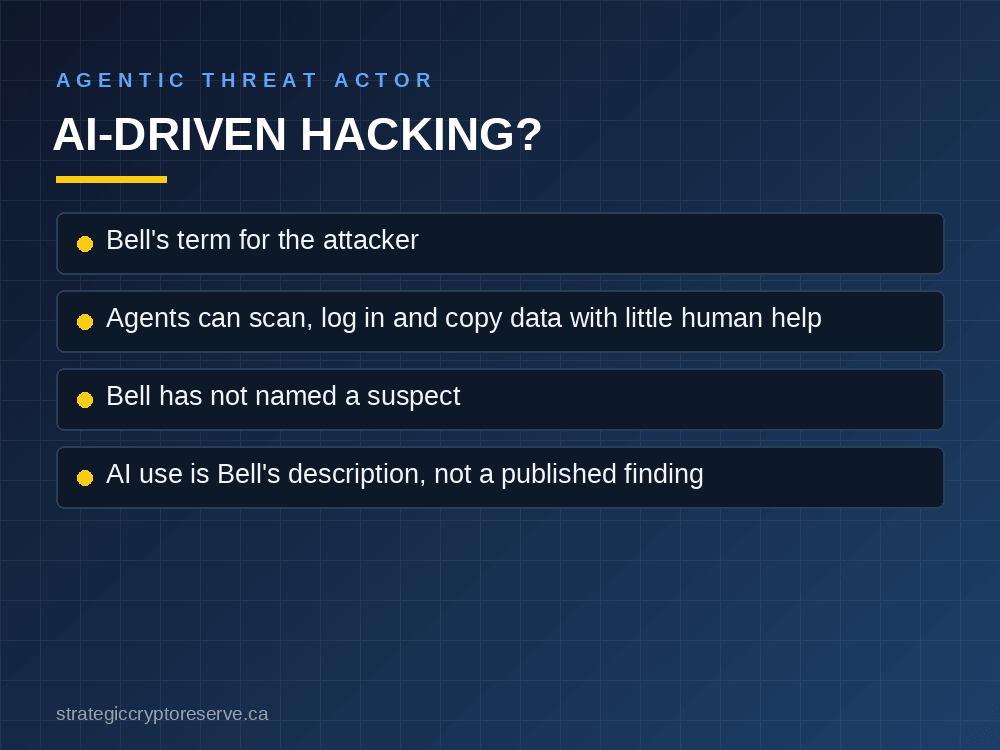
Bell described the attacker as an "agentic threat actor." In AI terms, an agent is software that can plan and carry out a series of steps on its own, such as scanning for weaknesses, logging in and copying files, with little human direction.

Bell has not explained how it reached that conclusion, and it has not named a suspect. "We currently do not know the attribution," Bell said. Security commentators have noted that the word is Bell's description, not a published technical finding.

The wording fits a wider worry. During a run of US technology outages in mid-November, Senator Mark Warner warned that new AI tools are finding security weaknesses faster than companies can fix them. Officials said those outages were not cyber attacks, but the concern about AI-assisted hacking is growing.

What is known, and what is not. Known: the date, the system, the data types and that services kept running. Not known: who did it, how they got in, how many customers are affected, and whether AI tools were actually used.

What an agentic threat actor means in the Bell cyber attack

How to Protect Yourself From Bell Scams

The data taken in the Bell cyber attack is exactly what scammers use to make fake messages look real: names, job titles, work email addresses and the subject lines of real support tickets. Bell has warned customers to be cautious of unsolicited requests and social engineering attempts from people pretending to be Bell.

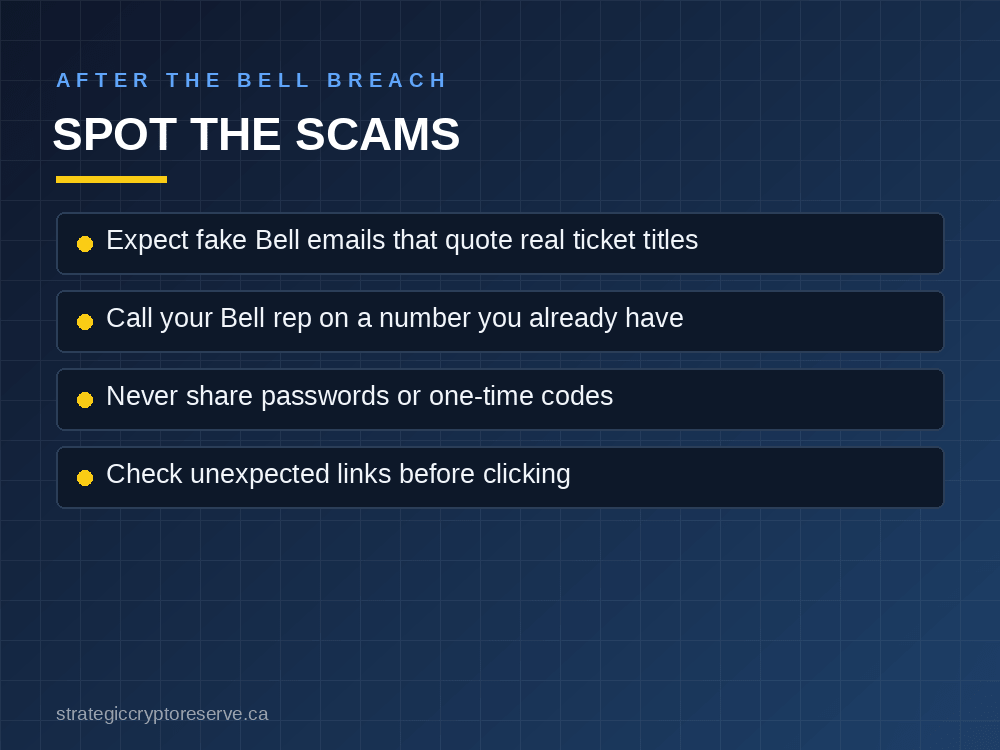
  • Verify before you act. If a "Bell" email or call asks you to approve a change, pay an invoice or reset access, hang up and call your Bell account team on a number you already have.
  • Watch for real ticket details. A message that quotes a genuine ticket title is not proof it came from Bell.
  • Never share credentials or codes. Bell says no credentials were taken, so anyone asking for yours is not following up on the breach.
  • Check links before you click. Use our free scam website checker on any link in an unexpected message.
  • Report it. Forward phishing to your IT team and report fraud to the Canadian Anti-Fraud Centre.

Getting fake Bell emails? Our Phishing Takedown Service files abuse reports with the hosts, registrars and email providers behind a scam, from C$49 a case or C$29 a month.

How to spot Bell impersonation scams after the Bell cyber attack

A Tense Week for Cyber Attacks

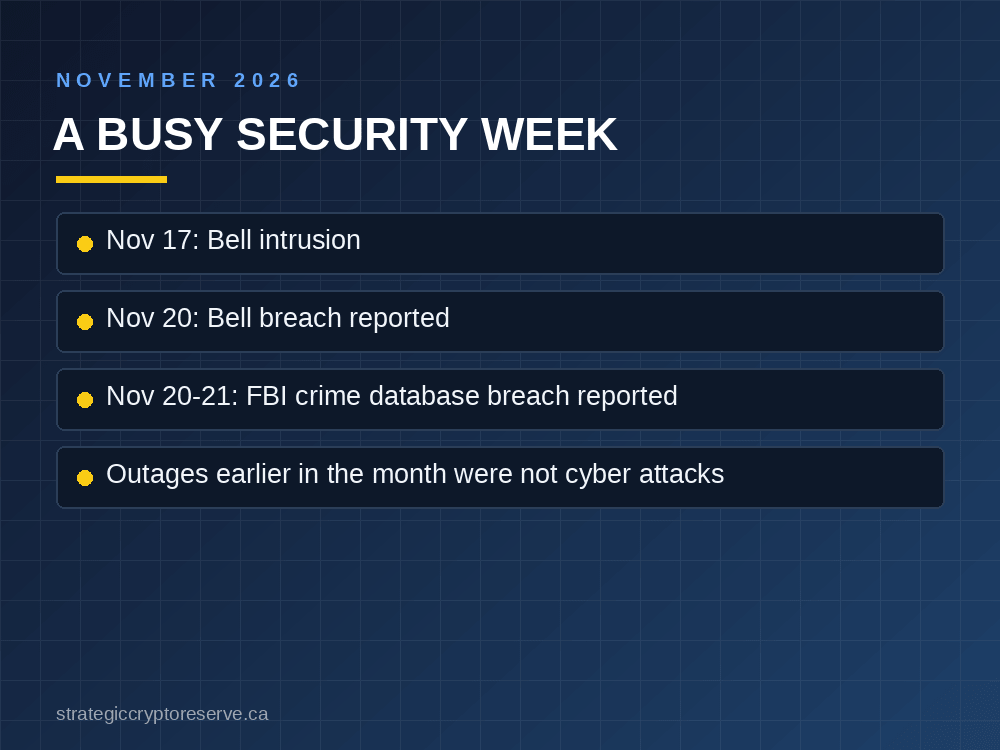
The Bell cyber attack landed in an unusually busy week for security news. On November 20 and 21, CNN and ABC News reported that the FBI is investigating a suspected breach of its national crime database (the FBI hack). Earlier in November, outages hit US airlines, banks and Microsoft services, although officials said those were caused by technical faults, not hackers.

The same week, stocks fell hard: the S&P 500 and Dow closed in correction on November 20 as AI shares sold off. Read our breakdown of the DoorDash outage and stock market crash.

Security news in November 2026: the Bell cyber attack and the FBI hack

Infrastructure Is the New Target

Telecom networks, data centres and the circuits between them are now prime targets. Anyone planning new computing infrastructure should price power, cooling and resilience by location first.

Price your own AI build in seconds. The AI Build Configurator shows capital cost by line item, power cost and payback for every Canadian province and US state, by GPU class and cooling type. Try the free demo, or put it on your own site: Standard licence C$4,000 a year, Pro C$10,000, site screening reports from C$950 (see licence plans).

AI Build Configurator

Live AI and HPC build-cost model: CapEx, energy cost and payback by province or state.

Try the free demo →

Phishing Takedown Service

We report scam sites and fake emails to the hosts and registrars behind them.

See the service →

FBI Hack: Crime Database

What is known about the suspected breach of the FBI's NCIC system.

Read it →

Stock Market Crash, Nov 2026

Why the S&P 500 and Dow closed in correction.

Read it →

Frequently Asked Questions: Bell Cyber Attack

1. When did the Bell cyber attack happen?

Bell says an attacker accessed its systems on November 17, 2026. The breach became public on November 20, 2026, when BleepingComputer reported on a notice Bell sent to enterprise customers.

2. What data was stolen in the Bell breach?

According to Bell's notice, the attacker copied business contact information (names, job titles, corporate email addresses, phone numbers and business addresses), information in ticket titles, some IP addresses tied to network systems, and limited contextual information.

3. Were passwords or personal information taken?

No. Bell says the affected data did not contain credentials, highly sensitive personal information, PDFs, file attachments or other supplementary information.

4. Did the Bell cyber attack affect phone or internet service?

No. Bell said it immediately contained the incident and secured its systems, and that there has been no impact to customer services.

5. What is an agentic threat actor?

It is the term Bell used for the attacker. An AI agent is software that can carry out a series of hacking steps on its own. Bell has not explained how it reached that view and says it does not know who was responsible.

6. How do I protect myself after the Bell breach?

Be cautious of unsolicited emails or calls claiming to be from Bell, even if they quote real ticket details. Verify requests by calling your Bell account team on a number you already have, and never share passwords or one-time codes.