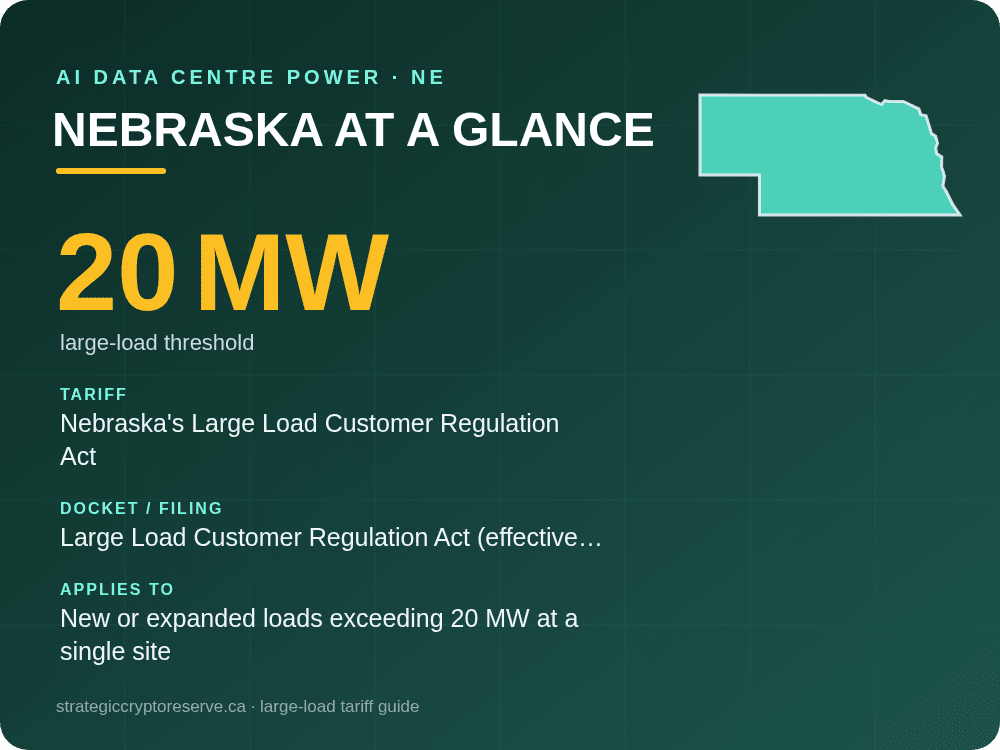
New or expanded loads exceeding 20 MW at a single site are governed by the Large Load Customer Regulation Act, taking effect October 1, 2026, which allows Nebraska's public power utilities to establish special rates and financial commitments specifically for large data center loads exceeding 20 MW at one site.
Also active in Nebraska: Nebraska's low electricity prices (EIA, January to July 2026: industrial 8.65 cents/kWh and residential 12.90 cents/kWh, against an 18.19-cent US residential average) and status as an all-public-power state — every Nebraska utility is a public power district rather than an investor-owned utility — make its large-load framework structurally distinct from most other states on this list.
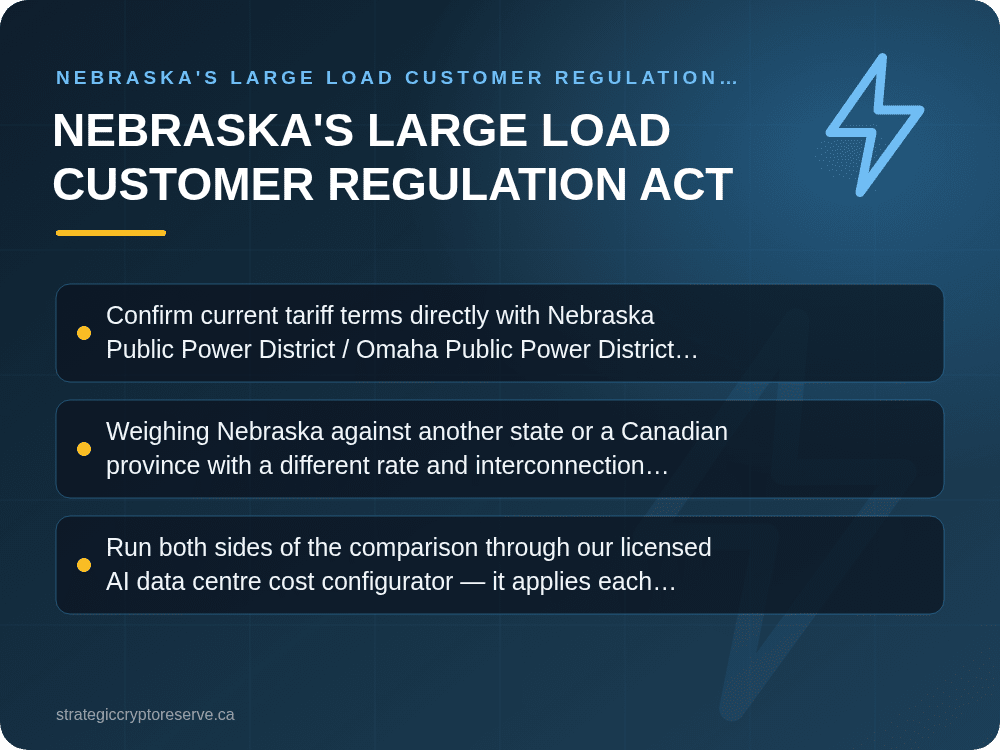
Figures compiled from the Edison Electric Institute's "Large Load Projects and Tariffs" (September 2026) member-company summary and public regulatory filings. Confirm current tariff terms directly with Nebraska Public Power District / Omaha Public Power District and the relevant state public utility commission before relying on any figure for a capital decision.
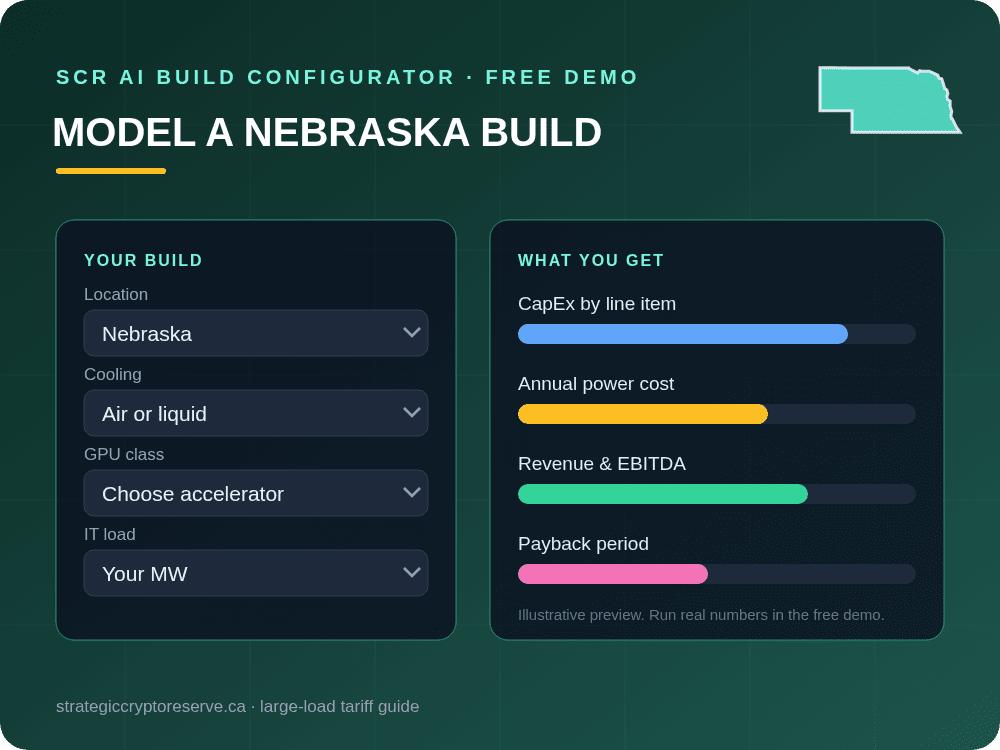
Weighing Nebraska against another state or a Canadian province with a different rate and interconnection picture entirely? Run both sides of the comparison through our licensed AI data center cost configurator — it applies each jurisdiction's actual power rate, tax treatment and large-load tariff rules to the same seven build configurations.
For a look at how a real operator manages large-load costs outside Nebraska’s regulatory framework, see how our crypto data center in BC handles rate design, cooling and hardware selection at a much smaller scale.