Utility Tariff Analysis · Updated September 2026

FPL's Large Load Contract Service (LLCS-1 / LLCS-2): What It Means for AI Data Center Siting in Florida

New or incremental load of 50 MW or more with an 85 percent load factor qualifies for Large Load Contract Service-1 or -2, approved as part of FPL's larger rate review and effective January 1, 2026. Both schedules carry minimum-term, take-or-pay and exit-fee provisions and collateral requirements. Duke Energy Florida has separately filed an updated large-load proposal in response to state law SB 484.

Florida at a glance: industrial power about 10.1¢/kWh (EIA-based, indexed to April 2026) · grid queue about 30 months · data center equipment tax exemption: available. Indicative figures from the SCR AI Build Configurator v1.4.0.

Florida AI data center power map: FPL's Large Load Contract Service (LLCS-1 / LLCS-2) large-load tariff

FPL's Large Load Contract Service (LLCS-1 / LLCS-2)

FL

Florida Power & Light

20250011; 20260064

Regulatory docket / filing reference

New or incremental load of 50 MW or more with an 85 percent load factor

Who the tariff applies to

New or incremental load of 50 MW or more with an 85 percent load factor qualifies for Large Load Contract Service-1 or -2, approved as part of FPL's larger rate review and effective January 1, 2026. Both schedules carry minimum-term, take-or-pay and exit-fee provisions and collateral requirements. Duke Energy Florida has separately filed an updated large-load proposal in response to state law SB 484.

Also active in Florida: Florida's approach is notable for pairing a hard load-factor test (85 percent) with the minimum-term structure, meaning intermittent or highly variable large loads may not qualify for the standard large-load rate at all.

Policy Update, 1 October 2026

Since 1 August 2025 (HB 7031), the data centre sales tax exemption requires at least 100 MW of critical IT load and US$150 million of investment, and smaller existing sites lose it at their next five-year review. SB 484, the Hyperscale Data Center Act (2025), sets the utility connection and cost-allocation rules for large loads, and a 2026 law preserves local authority to reject facilities and adds water safeguards.

Figures compiled from the Edison Electric Institute's "Large Load Projects and Tariffs" (September 2026) member-company summary and public regulatory filings. Confirm current tariff terms directly with Florida Power & Light and the relevant state public utility commission before relying on any figure for a capital decision.

Weighing Florida against another state or a Canadian province with a different rate and interconnection picture entirely? Run both sides of the comparison through our licensed AI data center cost configurator — it applies each jurisdiction's actual power rate, tax treatment and large-load tariff rules to the same seven build configurations.
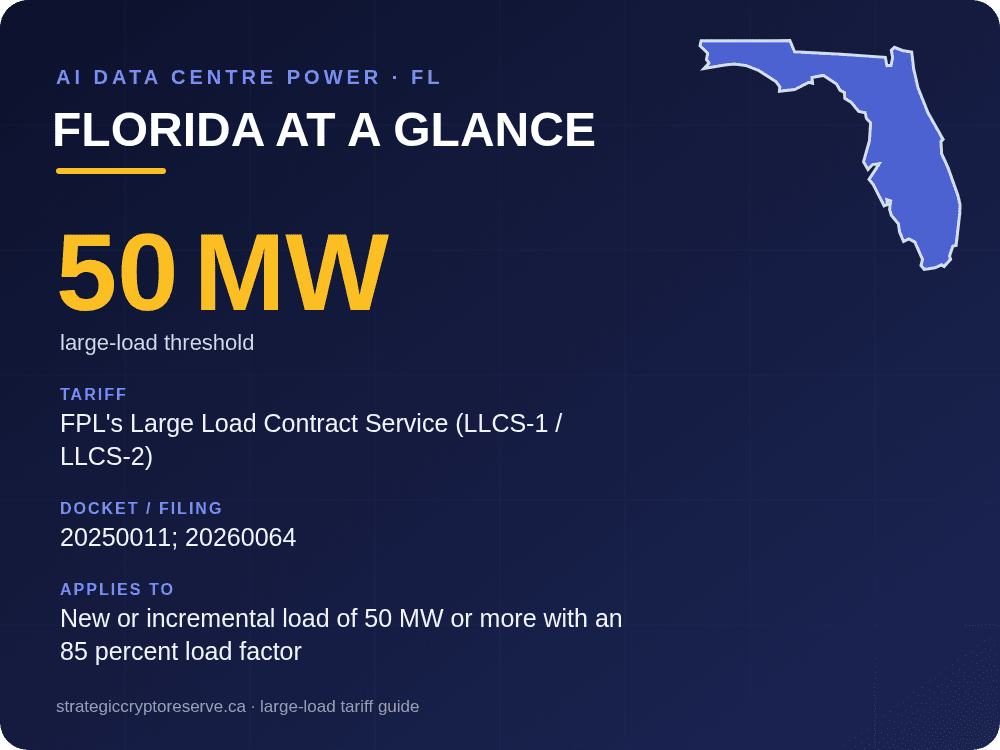
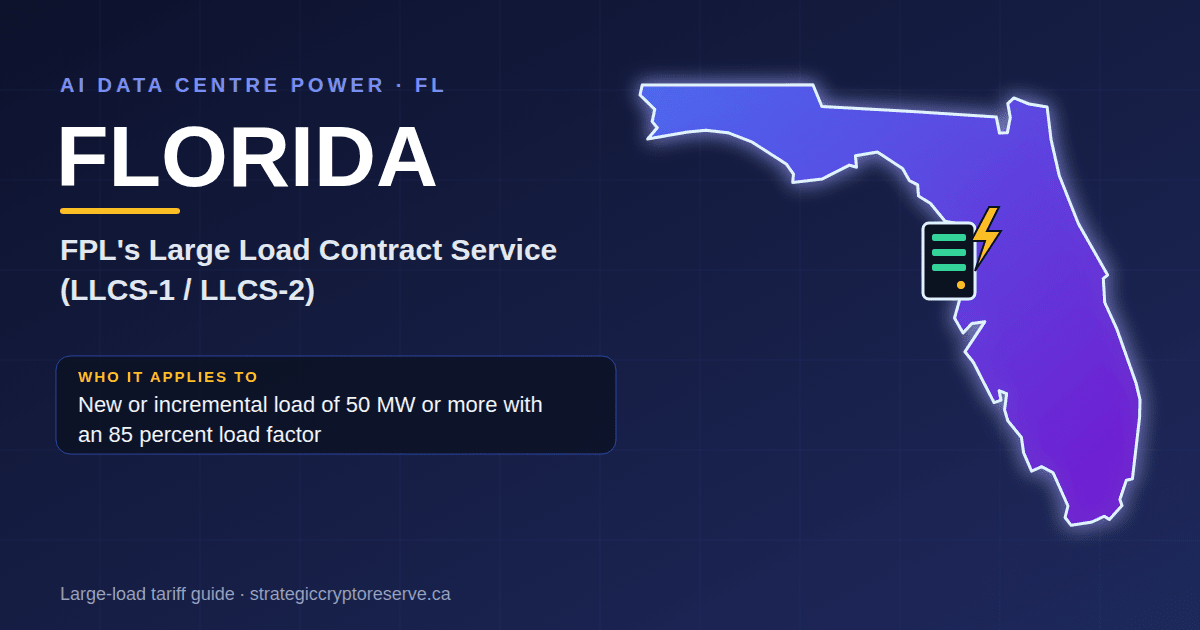
Florida at a glance: large-load tariff threshold, docket and who it applies to FPL's Large Load Contract Service (LLCS-1 / LLCS-2): FPL's Large Load Contract Service (LLCS-1 / LLCS-2): What It Means for AI Data Center Siting in Florida

Model This State on Your Own Site

Every figure above comes from the same power-cost and tariff dataset behind the SCR AI Build Configurator — a licensed, embeddable widget that models seven data center build configurations against all nine Canadian provinces and all 50 US states plus DC, returning capital expenditure by line item, energy cost, revenue by commercial structure, EBITDA and payback.

LicencePrice (CAD)Who it suits
Standard$4,000 / domain / yearAdvisors who need three lease-model configurations and a clipboard summary
Pro$10,000 / domain / yearConsultants who send CSV deliverables to clients and want all seven configurations
EnterpriseFrom $25,000 / year, up to 3 domainsDevelopers and EPC firms who want the model on their own cost basis with attribution removed

Not ready for an annual licence? A one-time Site Screening Report ($950, one site) runs the same model for a single build without embedding anything.

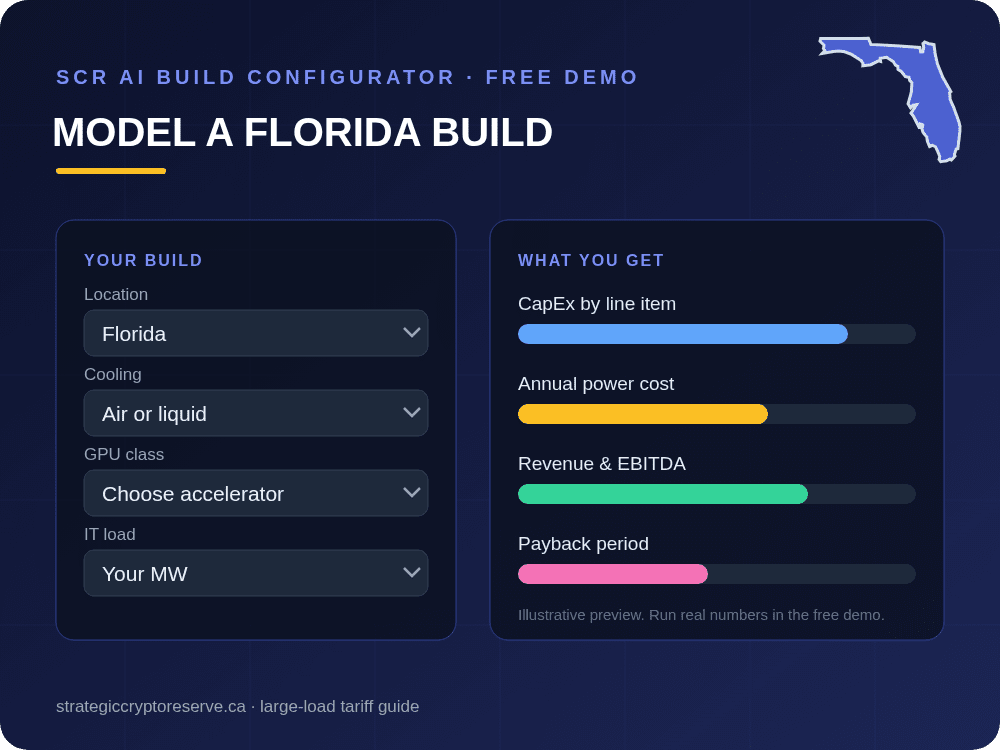
Model a Florida data center build in the SCR AI Build Configurator: CapEx, power cost, EBITDA and payback Model This State on Your Own Site: FPL's Large Load Contract Service (LLCS-1 / LLCS-2): What It Means for AI Data Center Siting in Florida

Compare Florida With Nearby States

Large-load rules change sharply at state lines. See how the neighbouring utilities handle data center and high-density loads before you shortlist a site.

Frequently Asked Questions

What is FPL's Large Load Contract Service (LLCS-1 / LLCS-2)?

New or incremental load of 50 MW or more with an 85 percent load factor qualifies for Large Load Contract Service-1 or -2, approved as part of FPL's larger rate review and effective January 1, 2026. Both schedules carry minimum-term, take-or-pay and exit-fee provisions and collateral requirements. Duke Energy Florida has separately filed an updated large-load proposal in response to state law SB 484.

Why did Florida Power & Light introduce this large-load structure?

To ensure the cost of new generation, transmission and distribution infrastructure built to serve very large customers, chiefly hyperscale data centers, is paid for by those customers rather than spread across the general rate base of residential and small commercial ratepayers.

What else should data center developers know about Florida?

Florida's approach is notable for pairing a hard load-factor test (85 percent) with the minimum-term structure, meaning intermittent or highly variable large loads may not qualify for the standard large-load rate at all.

Does this tariff replace Florida's standard commercial and industrial rates?

No. FPL's Large Load Contract Service (LLCS-1 / LLCS-2) sits above Florida Power & Light's standard commercial and industrial rate schedules and applies specifically to customers that meet or exceed the large-load threshold described above. Smaller commercial and industrial loads continue to be billed under existing rate schedules.

How can I model a Florida data center build against this tariff and other states?

The SCR AI Build Configurator applies Florida's power cost, tax treatment and large-load tariff rules alongside all other US states and Canadian provinces, so a Florida scenario can be compared line-by-line against any alternative site.