
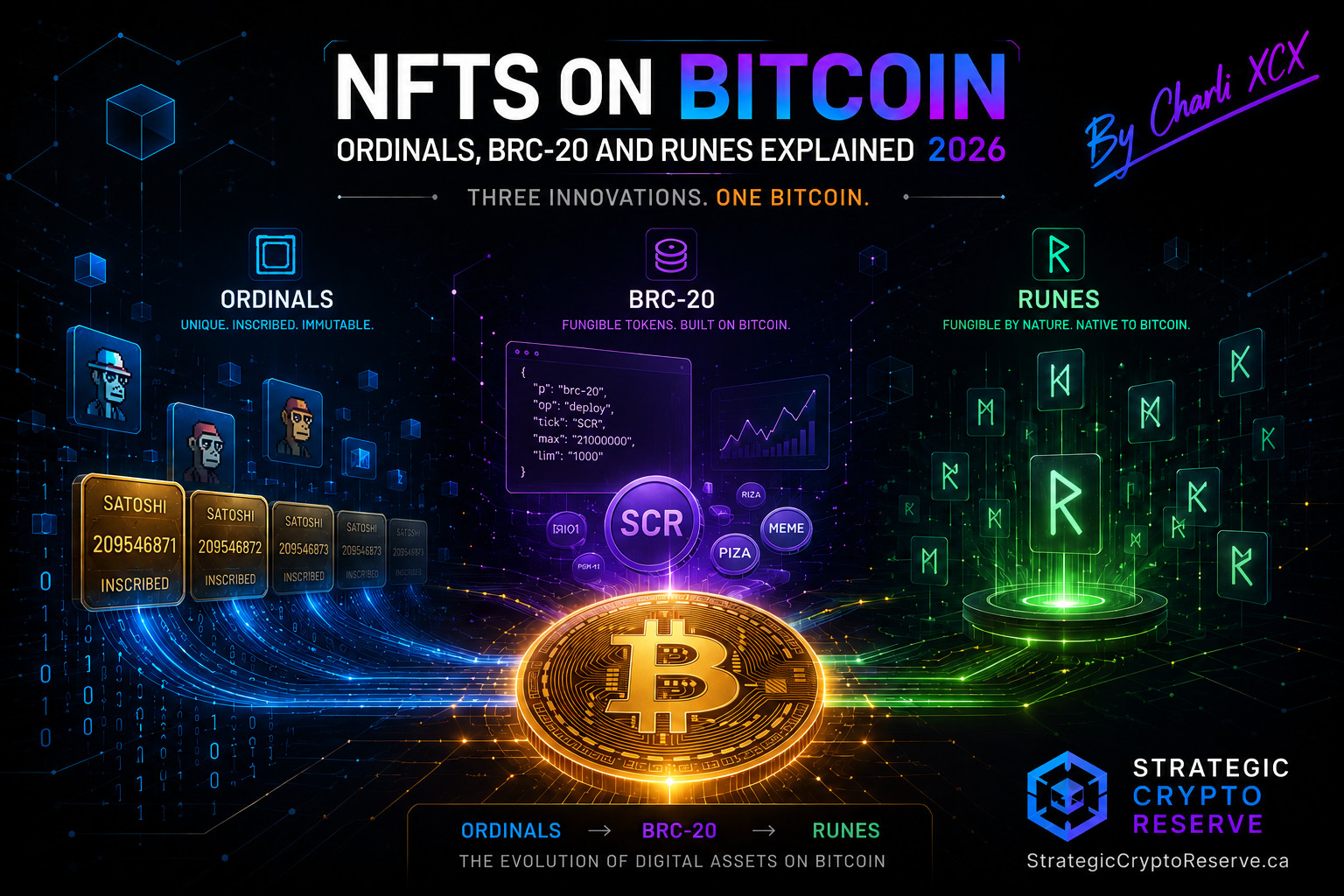
Bitcoin does not have smart contracts the way Ethereum does. Ethereum NFTs are entries in a smart contract pointing to metadata — usually an image stored on IPFS or an external server. The NFT itself is the contract record; the media lives somewhere else.
Bitcoin NFTs work completely differently. The Ordinals protocol embeds the actual content — the image, the text, the audio file — directly into a Bitcoin block, attached to a specific satoshi. The data is fully on-chain, permanent, and secured by the same proof-of-work that protects billions in Bitcoin value. There is no external storage dependency. If Bitcoin keeps running, the inscription survives.
The mechanism that makes this possible is a combination of two Bitcoin upgrades: SegWit (2017), which separated transaction signatures from transaction data, and Taproot (2021), which expanded what can be stored in the witness section of a transaction. Ordinals exploits the Taproot witness section to store up to approximately 4 megabytes of arbitrary data per transaction.
By June 2026, the Bitcoin Ordinals ecosystem had crossed 90 million total inscriptions, with March 2026 alone generating roughly $46.8 million in secondary market trading across nearly 60,000 transactions.
Why this matters for Bitcoin mining: Every inscription competes with standard payments for finite block space. More competition means higher transaction fees. Higher fees increase miner revenue at exactly the moment block subsidies are declining due to halving cycles. Strategic Crypto Reserve operates a real small-scale Bitcoin mining operation in the Comox Valley — see our Bitcoin Mining Vancouver Island page for the hardware, power setup, and what fee market changes mean for a small operation like ours.
The Three Bitcoin NFT and Token Standards
Ordinals (Inscriptions)
The base protocol. Assigns a unique serial number to every satoshi ever mined. Users attach arbitrary data to a specific sat through an inscription transaction — creating a permanent on-chain artifact. Launched January 2023. Over 90 million inscriptions as of June 2026.
Active — NFT StandardBRC-20
Created March 2023. Uses Ordinals inscriptions to create fungible tokens via JSON data. Worked but generated millions of junk inscriptions causing severe blockchain bloat and fee spikes. ORDI was the first BRC-20 token, first to reach $1B market cap. Now largely replaced by Runes for new projects.
Legacy — Being ReplacedRunes
Also created by Casey Rodarmor, launched at halving block 840,000 in April 2024. Purpose-built using Bitcoin's native UTXO model — far more efficient than BRC-20, no junk inscriptions, cleaner records. Now accounts for 35% of all Bitcoin metadata transactions. The dominant fungible standard in 2026.
Dominant — 2026 Standard| Protocol | Type | Launched | Status 2026 | Best For |
|---|---|---|---|---|
| Ordinals | Non-fungible (NFT-style) | Jan 2023 | Primary NFT standard | Digital collectibles, art, PFPs |
| BRC-20 | Fungible tokens | Mar 2023 | Legacy — still active | Trading ORDI, SATS; existing projects |
| Runes | Fungible tokens | Apr 2024 | Dominant fungible standard | New token launches, memecoin projects |