Vancouver Island Lore · Comox Valley, BC · July 2026

Cadborosaurus in the Comox Valley: Caddy Sightings, K'ómoks Legend, and the Caddy Gift Shop

Long before anyone in the Comox Valley was mining Bitcoin on BC Hydro's grid, locals were watching the water for something older and stranger. Cadborosaurus — affectionately known as "Caddy" — is British Columbia's most famous sea serpent, with roughly 300 claimed sightings along the Pacific coast over two centuries. This page covers the full Caddy story, spotlights the sightings recorded closest to the Comox Valley — including a 1933 Oyster River encounter and the K'ómoks First Nation's own name for the creature — and introduces the Caddy Gift Shop, a storefront at the Strategic Crypto Reserve.


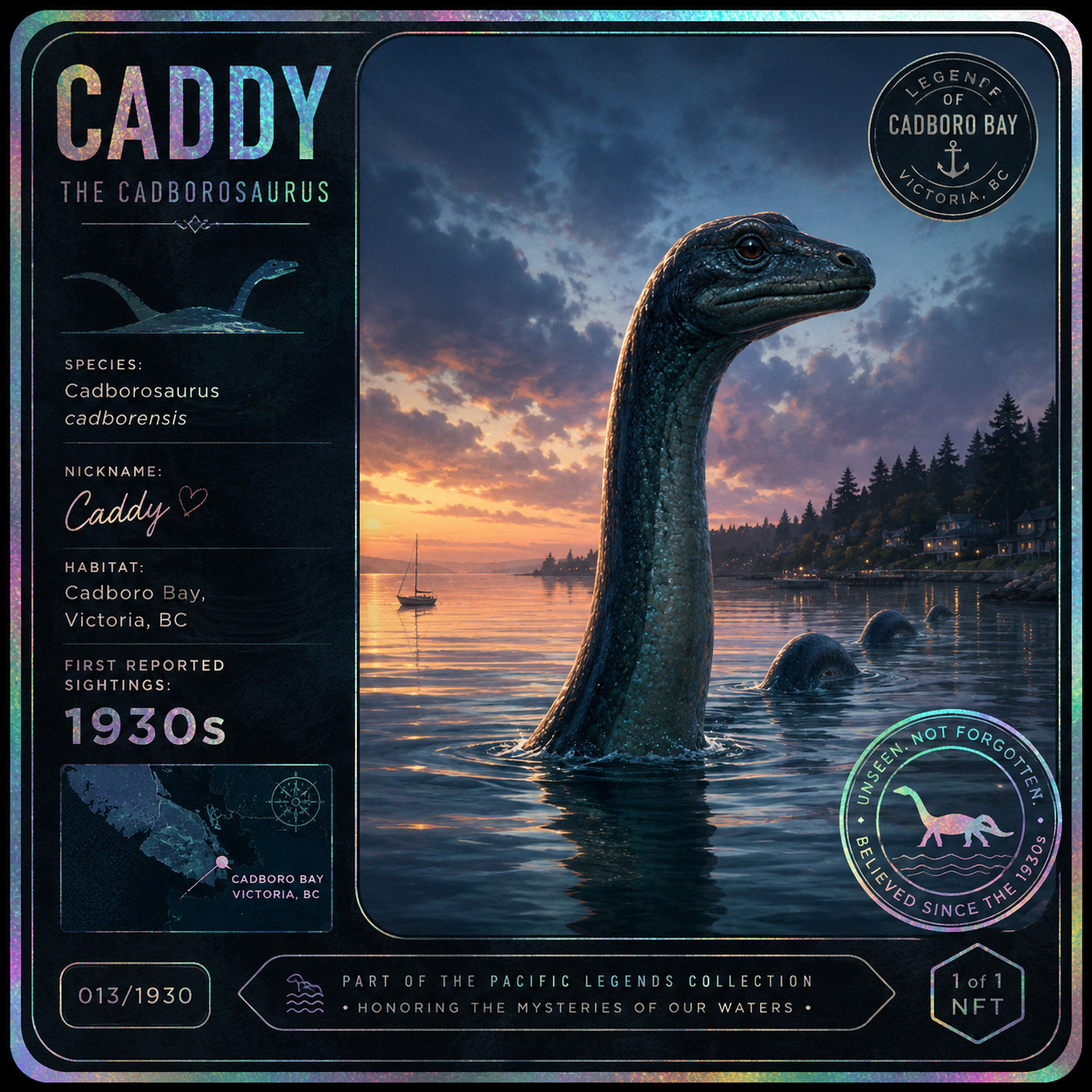
Illustration of Cadborosaurus, the Caddy sea serpent, in the waters off the Comox Valley on Vancouver Island

Comox Valley, BC

~300 Sightings · Since the 1880s

What Is the Cadborosaurus?

Cadborosaurus is a sea serpent from the folklore of the Pacific Northwest coast, reported from Alaska down to San Francisco Bay but centred on the waters around Vancouver Island and the Salish Sea. Witness descriptions are remarkably consistent across decades: a long serpentine body showing vertical humps or coils at the surface, a head often compared to a horse or camel, a long flexible neck, front flippers, and a fan- or fluke-like tail. Reported lengths run from about 5 metres for claimed juveniles up to 15–20 metres or more for adults, and its swimming motion is described as an up-and-down undulation — unlike the side-to-side motion of fish and sharks.

The name arrived in 1933, when a wave of sightings near Cadboro Bay outside Victoria made front-page news. Major H.W. Langley, clerk of the BC Legislature, and F.W. Kemp of the provincial archives were among the first credible witnesses of the modern era, and Victoria Daily Times editor Archie Wills coined "Cadborosaurus" — the lizard of Cadboro Bay — with the friendlier nickname "Caddy" following close behind. Coastal fishermen had suggested naming it "Old Hiaschuckaluck" after existing First Nations tradition, a reminder that the creature was already ancient news to the people of this coast.

The story took its strangest turn in 1937, when whalers at the Naden Harbour station in Haida Gwaii pulled a carcass roughly 3 to 3.8 metres long from the stomach of a sperm whale — camel-like head, serpentine body, fin-like appendages. It was photographed, described, sampled, and then lost. The BC Provincial Museum's director tentatively called the sample a fetal baleen whale, but the photographs kept the debate alive for decades. In 1995, oceanographer Dr. Paul LeBlond of UBC and zoologist Dr. Edward Bousfield went as far as formally proposing a new species, Cadborosaurus willsi, in a published paper — an almost unheard-of step for a cryptid, and one that keeps Caddy in a different category from most campfire monsters.

Cryptid status: No specimen of Cadborosaurus has ever been confirmed. Mainstream explanations include sea lions swimming in single file (which convincingly mimic a humped serpent — a 1943 Georgia Strait "serpent" resolved into a herd of sea lions under binoculars), giant oarfish, conger eels, elephant seals, and basking shark carcasses. Believers respond that no single known animal accounts for every feature reported across roughly 300 sightings. Either way, Caddy is a genuine piece of British Columbia's cultural history.
Spotlight: Caddy Sightings Near the Comox Valley

Most Caddy coverage fixates on Victoria and Cadboro Bay, 200 kilometres to the south. But the historical record puts the creature — or at least the belief in it — right on the Comox Valley's doorstep, and the local connection actually runs deeper than the 1933 newspaper craze.

Numkse Lee Kwala: The K'ómoks Name

The strongest Comox Valley link is also the oldest. The K'ómoks First Nation of Vancouver Island has its own traditional name for the Caddy-like sea being: numkse lee kwala. It sits alongside hiyitl'iik of the Manhousat people on Sidney Inlet and t'chain-ko in Sechelt tradition — independent names, in different languages, for a serpentine creature of these same waters, long predating any settler newspaper. Researchers caution that lumping diverse First Nations traditions into a single "Cadborosaurus" category flattens their distinct origins and meanings, and that's fair — but the fact remains that the people of the Comox Valley had a name for something in this water centuries before Archie Wills needed a headline.

1933: The Oyster River Encounter

In the same year Caddy got its name down south, the creature was reportedly seen at the Comox Valley's northern edge. Percy Elsey, who owned a hotel at Oyster River — the community straddling the boundary between the Comox Valley and the Campbell River district — reported a serpent-like creature offshore in 1933 and, in true frontier fashion, fired his rifle at it, apparently wounding it. A later local account described the animal's mid-body rising from the sea "like a huge hump," an estimated five feet in diameter with an orange-coloured belly and tail flukes roughly six feet across. Oyster River residents adopted the serpent as something of a local mascot, and regional histories still list Caddy as the area's most famous citizen.

The Modern Reports: Qualicum Beach 2006 and Campbell River 2025

Sightings near the valley didn't stop in the black-and-white era. In November 2006, a report at Qualicum Beach — about 40 minutes south of Courtenay — described the animal raising its tail out of the water, exposing a rear appendage witnesses compared to the one visible in the 1937 Naden Harbour carcass photos. And as recently as July 2025, a sighting was reported near Campbell River, where two teenagers on a dock described a serpentine animal in the Salish Sea — one of the reports that has kept the British Columbia Scientific Cryptozoology Club actively collecting eyewitness accounts from coastal residents into the 2020s. In September 2025, Coast Salish elders publicly connected contemporary reports of sea anomalies to their traditional accounts of serpentine beings, bridging the oldest and newest chapters of the story.

numkse lee kwala

The K'ómoks First Nation's traditional name for the Caddy-like sea being of Comox Valley waters — centuries older than the 1933 press coverage.

K'ómoks Territory

Oyster River, 1933

Hotel owner Percy Elsey reported — and shot at — a serpent off Oyster River, on the Comox Valley's northern boundary, during Caddy's first famous year.

Northern Comox Valley

Campbell River, 2025

A July 2025 report just north of the valley described a serpentine animal seen from a dock — proof the legend is still being written.

Salish Sea

There's a satisfying footnote for skeptics and believers alike: the Comox Valley is home to a confirmed ancient sea monster. The Puntledge River elasmosaur, an 80-million-year-old long-necked marine reptile discovered near Courtenay and now displayed at the Courtenay and District Museum and Palaeontology Centre, was named British Columbia's official provincial fossil. A real long-necked sea reptile genuinely did patrol these waters — just 80 million years earlier than Caddy witnesses would prefer.

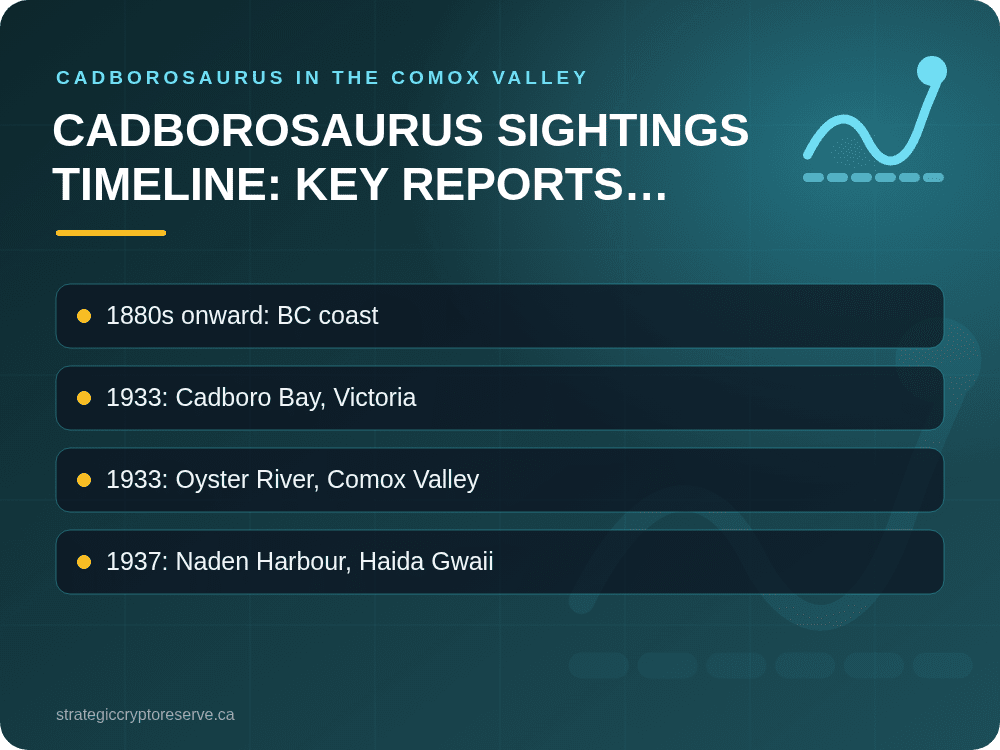
Cadborosaurus Sightings Timeline: Key Reports, 1880s–2025

Drawn from newspaper archives, the British Columbia Scientific Cryptozoology Club's records, and the LeBlond–Bousfield research, here are the landmark entries in the Caddy file. Rows closest to the Comox Valley are highlighted.

YearLocationWhat Was Reported
1880s onwardBC coastSettler accounts of a humped, horse-headed serpent begin appearing, layered over far older First Nations traditions (hiyitl'iik, t'chain-ko, numkse lee kwala).
1933Cadboro Bay, VictoriaSightings by Major H.W. Langley and F.W. Kemp spark a media sensation; editor Archie Wills coins "Cadborosaurus."
1933Oyster River, Comox ValleyHotel owner Percy Elsey reports a serpent offshore and fires his rifle at it; the creature becomes an enduring local legend.
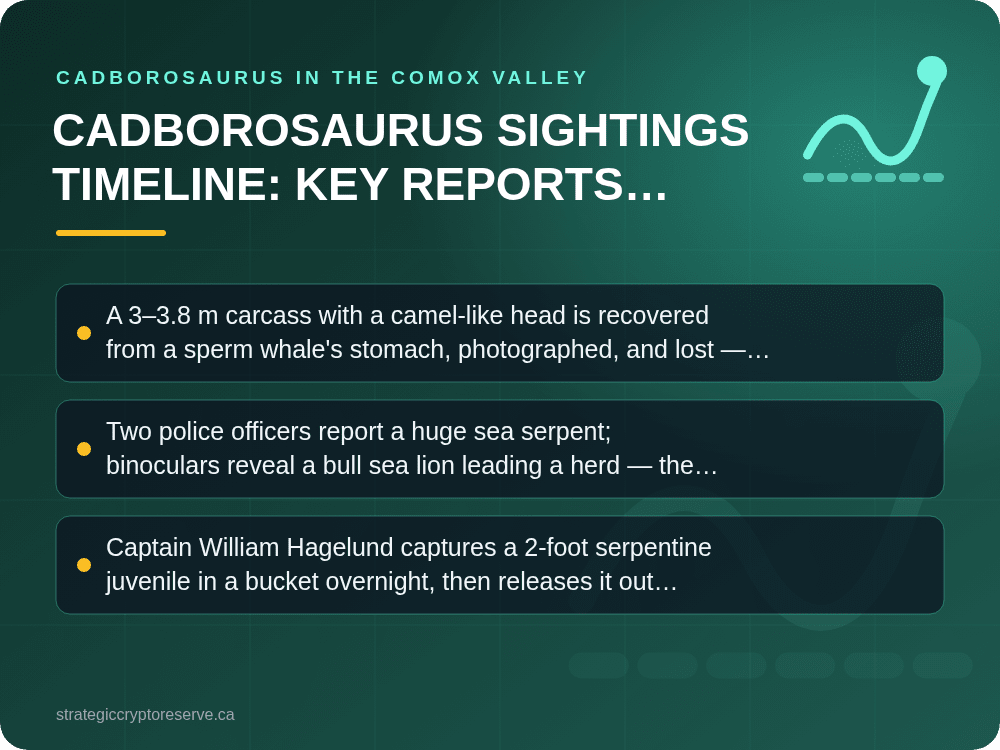
1937Naden Harbour, Haida GwaiiA 3–3.8 m carcass with a camel-like head is recovered from a sperm whale's stomach, photographed, and lost — the most famous physical evidence in Caddy lore.
1943Georgia StraitTwo police officers report a huge sea serpent; binoculars reveal a bull sea lion leading a herd — the classic cautionary case.
1967–68Pirate's Cove, DeCourcy IslandCaptain William Hagelund captures a 2-foot serpentine juvenile in a bucket overnight, then releases it out of compassion. Later analysis suggests it was likely a pipefish.
1999Saanich InletOperation CaddyScan cameras record an unidentified animal with undulating locomotion for over two minutes.
2006Qualicum BeachA November sighting describes the animal raising its tail, exposing a rear appendage resembling the Naden Harbour carcass photos.
2010Richmond, BCAn August sighting is logged near the mouth of the Fraser River.
2025Campbell RiverA July report from two teenagers on a dock describes a serpentine animal in the Salish Sea; Coast Salish elders later connect modern reports to traditional accounts.

Across roughly 300 claimed sightings in 200 years, the pattern that emerges is geographic as much as zoological: Caddy is reported in inlets, bays, and river mouths — exactly where herring runs and sea lions concentrate, and exactly where people happen to be looking. Whether that pattern describes an unknown animal's feeding habits or a very human one is the whole debate.

The Caddy Gift Shop, Comox Valley

Every great cryptid deserves a gift shop. Loch Ness has an entire visitor economy; Sasquatch sells coffee mugs from Harrison Hot Springs to Willow Creek. Caddy — with a better sightings record than most and 90 years of name recognition — has somehow never gotten its own till. So, in the same spirit as the rest of the Strategic Crypto Reserve parody universe, we built one. Sort of.

Cadborosaurus Gift Shop The Caddy Gift Shop is our storefront — part of the same openly-disclosed $SCR tokens and our NFT collections. The address and phone number are below to call if you find yourself in the Gift Shop by the Union Bay Post Office. Please do not drive to the dock, and please do not call the serpent.

The Caddy Gift Shop accross from the Union Bay Mail
Berth 42, Sea Serpent Slipway
Comox Valley, British Columbia  B1G F1N
Tel: (778) 557-2041 · Hours: whenever Caddy surfaces

Inside the shop: plush Caddys with anatomically-debated tail flukes, "I Got Humped in the Salish Sea" t-shirts, replica Naden Harbour carcass photos, Percy Elsey commemorative earplugs, and a wall of blurry photographs sold as-is. Outside the imaginary shop: the real gift, which is that all of this lore is free, local, and genuinely fascinating — and the closest thing to actual Caddy merchandise from this project will arrive the way everything else here does: as a clearly-labelled parody NFT drop.

When a Caddy collection launches, it will follow the same rules as every collection in the ecosystem: minted on Polygon, disclosed as entertainment, and sold as digital art with no investment expectation of any kind — see our existing collections and how to buy an NFT for how that works. Until then, the Comox Valley's real Caddy attractions are the water itself, the Courtenay and District Museum's genuine elasmosaur, and a pair of binoculars pointed at the Salish Sea.

Why is a crypto site writing about a sea serpent? Because Strategic Crypto Reserve is a Comox Valley project first — the same waters that hide Caddy power the hydroelectric grid our Bitcoin mining runs on. Local lore and local infrastructure, one shoreline.

Frequently Asked Questions: Cadborosaurus & the Comox Valley

1. What is the Cadborosaurus?

Cadborosaurus — affectionately nicknamed Caddy — is a sea serpent from the folklore of the Pacific Northwest coast. Witnesses describe a long serpentine animal with a horse- or camel-like head, a long neck, vertical humps or coils, and flippers, reported at lengths anywhere from roughly 5 to 15 metres or more. The name was coined in 1933 after Cadboro Bay near Victoria, British Columbia, and in 1995 researchers Paul LeBlond and Edward Bousfield formally proposed the species name Cadborosaurus willsi. Roughly 300 sightings have been claimed over the past two centuries, though no specimen has ever been confirmed, so Caddy remains a cryptid.

2. Has Cadborosaurus ever been seen near the Comox Valley?

Yes — reports close to the Comox Valley go back to the very first wave of Caddy publicity. In 1933, Oyster River hotel owner Percy Elsey reported a serpent-like creature off Oyster River, on the northern edge of the Comox Valley, and even fired his rifle at it. The K'ómoks First Nation of the region has its own traditional name for a Caddy-like sea being, numkse lee kwala, which long predates the 1933 newspaper coverage. More recently, a July 2025 report near Campbell River, just north of the valley, described a serpentine animal seen from a dock, and a 2006 sighting occurred at Qualicum Beach to the south.

3. Is the Caddy Gift Shop in the Comox Valley a real store?

Yes. The Caddy Gift Shop is a storefront at the Strategic Crypto Reserve — the same place openly-disclosing SCR tokens and NFT collections. The address and phone number shown on this page are clearly labelled. Its right there beside the Union Bay Heritage Post office. Real Caddy-themed digital collectibles, when released, appear as parody NFT drops on the Strategic Crypto Reserve site — for entertainment only, not an investment.

4. What was the Naden Harbour carcass?

In 1937, whalers at the Naden Harbour whaling station in Haida Gwaii (then the Queen Charlotte Islands) pulled a strange carcass roughly 3 to 3.8 metres long from the stomach of a sperm whale. Workers described a camel-like head, a long serpentine body, and fin-like appendages, and the remains were photographed before being lost. The BC Provincial Museum tentatively identified a sample as a fetal baleen whale, but LeBlond and Bousfield later argued the photographs did not match any known animal. It remains the most famous piece of claimed physical evidence in Caddy lore.

5. What do scientists think Caddy sightings actually are?

Mainstream science treats Cadborosaurus as unproven. Proposed explanations for sightings include lines of sea lions swimming in single file, which can mimic a continuous humped body; giant oarfish, which can exceed 15 metres and swim with an undulating motion; conger eels, elephant seals, basking sharks, and floating debris. A well-documented 1943 case in Georgia Strait saw two police officers report a huge sea serpent that binoculars revealed to be a bull sea lion leading a herd. Believers counter that no single known animal matches all the reported features across roughly 300 sightings.